


看
着 — Be Affected, Catch Fire, or Reach Result
着 (zháo) can mean to be affected by something, catch fire or fall asleep, or mark a successful result after a verb in Mandarin Chinese.
着
TOP-50
Frequency
The ranking is based on data from open sources.
HSK 3.0 · Level 4
Translation
- (v./n.) wear (clothes); come into contact with; apply, use; assign, dispatch; order; whereabouts
- (n./v.) trick, move; move in chess; (dialect) to put in, to add
- (par.) (after a verb to indicate an action is in a progress or in a certain state that continues)
- (v.) attach, come in contact with; be affected (by...); catch fire; fall asleep
- (aux.) used after a verb as a complement to indicate the result of the action
Simplified
着
Traditional
著
Strokes count
11

Words with 着 19
Similar pronunciation 30
Synonyms 20
Writing and worksheets
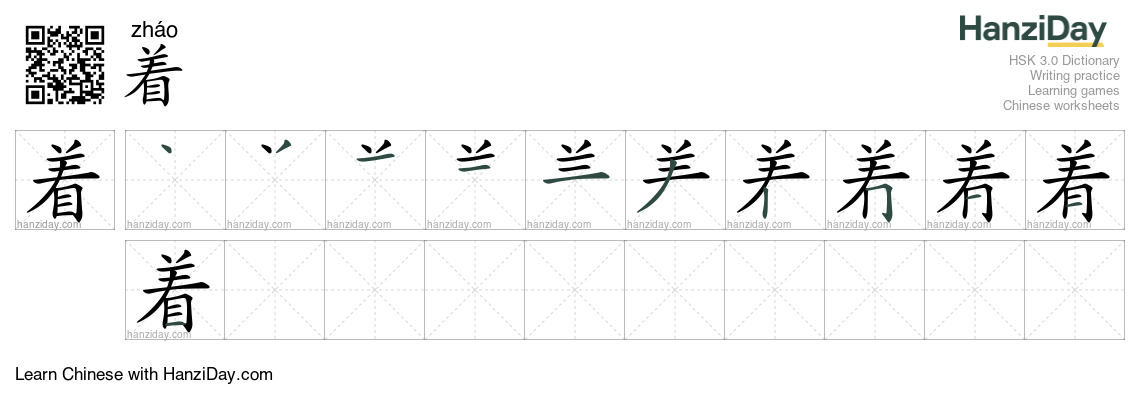
Stroke order
Games & Exercises 9
Find Hanzi
Find Hanzi is a playful exercise for learning Chinese. Spot characters, boost attention, download PDF, and enjoy studying Chinese through games!
Find Radical
Practice Chinese radicals online: choose the Hanzi containing the target component, use optional pinyin hints, and create printable PDF exercises.
Tone Trainer
Learn Mandarin tones online with the Chinese Tone Trainer. Practice tone recognition, pronunciation, and exercises for beginners and advanced learners.
Hanzi Connect
Match Hanzi with pinyin or identify words by sound. Use your own vocabulary or HSK 3.0/YCT levels. Play online after sign-in; printable PDFs with answers are for PRO.
Lost Stroke
Play online: find the missing stroke or radical, restore Chinese characters in order, and create printable PDF worksheets with pinyin and answers.
Calligraphy
Create calligraphy and custom Chinese character coloring pages with pinyin, stroke order, outline styles, and writing grids. Download a print-ready PDF for class or home.
Memo
Flip cards to match Chinese characters or pair Hanzi with Pinyin. Build a custom HSK 3.0 or YCT deck, play online, and create printable PDF cards.
Sudoku
Play Hanzi Sudoku online with 4×4, 6×6, or 9×9 grids, four difficulty levels, custom characters, and HSK 3.0/YCT sets. Create printable PDFs with answers.
Writing trainer
Practice Chinese character writing online with correct stroke order, outlines, a 3–2–1 preview, mistake-based hints, pinyin, and focused Hanzi review.









Examples of use 11
着
手
(v.) set about, start to do something
着
眼
(v.) have one's eye on (e.g. a goal), to have something in mind
爸
爸
到
家
的
时
候
,
我
们
早
就
睡
着
了
。
By the time Dad got home, we were already asleep.
我
脑
子
里
总
想
着
这
件
事
,
怎
么
也
睡
不
着
。
I always think about it in my mind, and I can't sleep.
你
不
是
说
晚
上
睡
不
着
觉
吗
?
You're not saying you can't sleep at night, are you?
你
不
是
说
晚
上
睡
不
着
觉
吗
?
You're not saying you don't sleep at night, are you?
一
路
上
,
翟
峰
一
家
经
历
了
船
身
着
火
、
漏
水
等
大
大
小
小
十
多
次
险
情
。
Along the way, Zhai Feng's family experienced more than ten dangerous situations, such as fire and water leakage.
着
地
to land | to touch the ground | also pr. [zhuo2 di4]
着
装
to dress | dress | clothes | outfit
着
陆
landing | touchdown | to land | to touch down
衣
着
clothes
With the reading zháo, 着 often marks an achieved result or a change of state, as in 睡着了 (shuì zháo le), “fell asleep.” The aspect particle 着 is pronounced zhe.