


七
Learn 也 — HSK 3.0 Level 1
也
Translation
- (adv.) also, too, either, as well; even, even if; used for emphasis (often in negative sentences); used to soften the tone
- (par.) (lit.) used at the end of a sentence indicating affirmation; used in the middle of a sentence marking off the topic of the statement
Radical
Simplified
也
Traditional
也
Strokes count
3

Words with 也 2
Same pronunciation 4
Similar pronunciation 39
Synonyms 6
Writing and worksheets
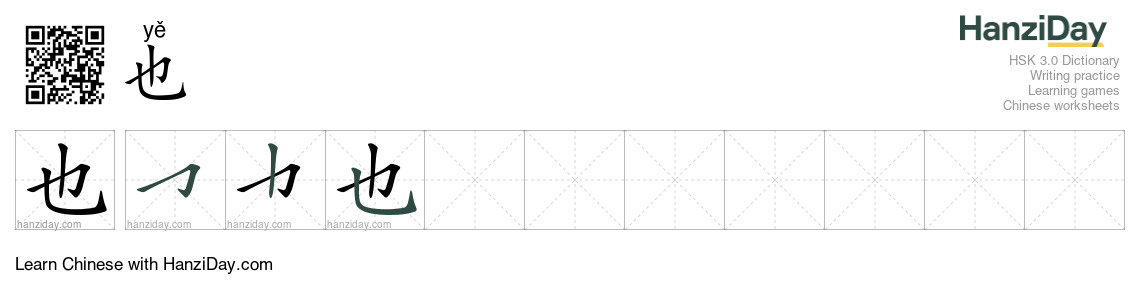
Stroke order
Games & Exercises 9
Find Hanzi
Find Hanzi is a playful exercise for learning Chinese. Spot characters, boost attention, download PDF, and enjoy studying Chinese through games!
Find Radical
Practice Chinese radicals online: choose the Hanzi containing the target component, use optional pinyin hints, and create printable PDF exercises.
Tone Trainer
Learn Mandarin tones online with the Chinese Tone Trainer. Practice tone recognition, pronunciation, and exercises for beginners and advanced learners.
Hanzi Connect
Match Hanzi with pinyin or identify words by sound. Use your own vocabulary or HSK 3.0/YCT levels. Play online after sign-in; printable PDFs with answers are for PRO.
Lost Stroke
Play online: find the missing stroke or radical, restore Chinese characters in order, and create printable PDF worksheets with pinyin and answers.
Calligraphy
Create calligraphy and custom Chinese character coloring pages with pinyin, stroke order, outline styles, and writing grids. Download a print-ready PDF for class or home.
Memo
Flip cards to match Chinese characters or pair Hanzi with Pinyin. Build a custom HSK 3.0 or YCT deck, play online, and create printable PDF cards.
Sudoku
Play Hanzi Sudoku online with 4×4, 6×6, or 9×9 grids, four difficulty levels, custom characters, and HSK 3.0/YCT sets. Create printable PDFs with answers.
Writing trainer
Practice Chinese character writing online with correct stroke order, outlines, a 3–2–1 preview, mistake-based hints, pinyin, and focused Hanzi review.









Examples of use 60
他
也
八
岁
。
He is also eight years old.
也
许
有
人
认
为
,
在
这
种
情
况
下
根
本
不
可
能
分
辨
出
来
。
Some people may think that it is impossible to distinguish in this case.
现
在
这
样
的
局
面
,
我
也
不
知
道
怎
么
办
了
。
In this situation, I don't know what to do.
西
安
真
是
个
好
地
方
,
不
仅
风
景
很
美
,
而
且
人
也
非
常
热
情
。
Xi'an truly is a good place; not only is the scenery beautiful, the people are also extremely enthusiastic.
我
脑
子
里
总
想
着
这
件
事
,
怎
么
也
睡
不
着
。
I always think about it in my mind, and I can't sleep.
一
年
前
,
我
第
一
次
来
到
中
国
,
当
时
我
一
句
汉
语
也
不
会
说
。
A year ago, when I first came to China, I couldn't even speak a word of Mandarin.
你
看
,
现
在
已
经
不
刮
风
了
,
也
许
明
天
不
会
下
雨
。
You see, it's not windy now, perhaps it won't rain tomorrow.
每
个
人
都
想
当
一
个
富
人
,
但
其
实
富
人
也
并
不
那
么
快
乐
。
Everyone wants to be a rich person, but in reality, rich people are not even that happy.
其
实
在
海
底
什
么
也
看
不
见
,
那
儿
太
黑
了
。
In fact, you can't see anything at the bottom of the sea. It's too dark there.
和
女
朋
友
分
手
以
后
,
他
一
点
儿
也
不
难
受
。
After breaking up with his girlfriend, he didn't feel bad at all.
我
们
学
校
的
作
业
不
多
也
不
少
。
There is neither much nor much homework in our school.
刚
搜
索
了
一
下
,
离
不
开
手
机
也
是
一
种
精
神
病
。
I just searched, and it is also a kind of mental illness to be inseparable from mobile phones.
看
今
晚
的
天
色
,
明
天
也
许
不
会
下
雨
。
Look at the weather tonight, it may not rain tomorrow.
哪
怕
你
不
说
,
大
家
也
会
知
道
。
Even if you don't say it, everyone will know.
回
家
的
快
乐
和
被
亲
情
包
围
的
幸
福
感
染
了
我
,
我
也
恨
不
得
马
上
飞
到
父
母
跟
前
,
与
他
们
团
圆
。
The happiness of going home and being surrounded by family infected me, and I couldn't wait to fly to my parents immediately to reunite with them.
在
很
多
人
看
来
,
只
有
年
轻
人
才
会
网
上
购
物
,
其
实
不
少
老
年
人
也
会
。
In the eyes of many people, only young people can shop online, in fact so can many old people.
我
们
虽
然
这
次
考
得
不
错
,
但
也
不
能
太
得
意
。
Although we did well in the exam this time, we can't be too proud.
我
喜
欢
吃
炒
面
,
也
喜
欢
吃
蛋
炒
饭
。
I like fried noodles and fried rice with eggs.
一
般
情
况
下
,
你
花
的
钱
越
多
,
买
的
东
西
也
就
越
好
。
Under normal circumstances, the more money you spend, the better things you buy.
他
的
中
文
学
好
了
,
他
的
自
信
心
也
有
了
。
His Chinese is better, and his self-confidence is better.
老
鼠
是
山
神
的
宠
物
,
它
厌
倦
了
宠
物
的
生
活
,
也
很
厌
恶
宠
物
这
个
角
色
。
Mouse is the pet of mountain god. It is tired of pet life and hates the role of pet.
女
儿
却
是
一
脸
的
疑
惑
,
反
问
道
:
“
你
们
不
是
也
有
时
候
说
,
哪
个
朋
友
好
相
处
,
哪
个
朋
友
很
自
私
吗
?
The daughter was puzzled and asked, "don't you sometimes say which friend is easy to get along with and which friend is selfish?
沙
浴
也
是
一
些
鸟
儿
喜
欢
的
保
养
方
式
。
Sand bath is also a favorite maintenance method for some birds.
谁
也
无
法
保
证
这
么
做
一
定
是
安
全
的
。
No one can guarantee that it will be safe to do so.
给
花
换
盆
剪
枝
施
肥
的
活
儿
他
越
做
越
熟
练
,
花
生
病
长
虫
他
也
知
道
如
何
应
付
了
。
He became more and more skilled in changing pots, pruning and fertilizing flowers, and he knew how to deal with sick and worms.
对
不
起
,
这
件
事
我
也
无
能
为
力
,
你
找
别
人
帮
你
吧
。
Sorry, there's nothing I can do about it. Please find someone else to help you.
认
识
你
我
也
很
高
兴
。
I'm very pleased to meet you too.
三
个
小
时
快
乐
减
一
个
小
时
无
聊
等
于
两
个
小
时
快
乐
,
也
就
是
说
,
我
愉
快
地
度
过
了
两
个
小
时
。
Three hours of happiness minus one hour of boredom equals two hours of happiness, that is to say, I spent two hours happily.
年
度
考
核
,
我
和
小
林
的
敬
业
精
神
、
兢
兢
业
业
的
工
作
态
度
受
到
了
表
扬
,
经
济
上
也
得
到
了
丰
厚
的
回
报
。
In the annual assessment, Kobayashi and I were praised for our professionalism and conscientious working attitude, and we also got rich returns economically.
我
没
有
猫
,
也
没
有
狗
。
I don't have a cat or a dog.
还
算
侥
幸
,
三
祖
爷
的
腿
也
好
了
。
Luckily, Sanzu's legs are all right.
她
好
,
他
也
好
。
She is good, so is he.
你
也
很
好
。
You're very well, too.
他
和
我
一
样
,
也
是
十
五
岁
。
He, like me, is fifteen.
我
们
偶
尔
也
要
学
会
勇
敢
地
拒
绝
别
人
。
We should learn to bravely reject others sometimes.
“
精
诚
所
至
,
金
石
为
开
”
这
一
成
语
也
便
由
此
流
传
下
来
。
The idiom "Where you go sincerely, the stone opens" has been handed down from this.
我
相
信
老
师
,
也
相
信
自
己
!
I believe in teachers and myself!
最
近
,
老
师
在
使
用
网
络
上
课
,
学
生
也
在
使
用
网
络
学
习
。
Recently, teachers use the internet for classes, and students also use the internet for learning.
你
十
四
岁
,
我
也
十
四
岁
。
You are fourteen and I am fourteen too.
人
类
自
身
也
饱
受
污
染
的
危
害
。
Human beings themselves suffer from pollution.
她
人
美
,
心
也
美
。
She is beautiful in person and heart.
小
月
是
中
国
人
,
小
天
也
是
中
国
人
。
Xiao Yue is Chinese; Xiao Tian is Chinese, too.
有
时
候
上
班
前
打
扮
一
下
,
也
是
一
种
礼
貌
。
Sometimes to dress up before a little before you go to work is a kind of courtesy
我
也
四
十
岁
I'm forty too
明
天
也
许
会
下
雨
。
It may rain tomorrow.
这
太
难
了
,
我
也
没
有
什
么
方
法
。
It is too difficult, and I also have no idea.
中
国
菜
闻
起
来
很
香
,
营
养
也
很
丰
富
。
Chinese food smells good and is also rich in nutrition.
连
.
.
.
也
.
.
.
even
你
汉
语
说
得
真
好
。
哪
里
哪
里
,
也
就
一
般
。
Your Chinese is very good.--Not at all, just so so.
这
样
既
有
好
处
,
也
有
坏
处
。
This way there are advantages and also disadvantages.
我
也
是
这
么
想
的
。
I also think that way.
我
们
也
都
是
学
生
。
We are all students, too.
不
冷
也
不
热
neither cold nor hot
这
个
班
的
学
生
一
点
也
不
差
。
The students in this class are not bad at all.
明
知
不
敌
也
要
亮
剑
。
Fully aware that oneself will be defeated, he/she still draws the sword.
想
想
也
是
(often used independently between sentences with a softened tone) if you think about it, then it's...
什
么
也
阻
挡
不
了
他
。
Nothing could stop him.
到
下
课
也
没
做
出
来
didn't manage to figure out (the answer of a question) when the class was over
倒
也
是
(with a softened tone) it's indeed (this case), it's quite (like this); (contrary to one's expectation or common sense) (though...,) it is...
我
也
想
去
。
I also want to go.
Learn 也 (yě) in context
也 appears here with its available localized meaning and tone-marked pinyin yě. Listen to the pronunciation and review any examples, illustrations, or lexical links shown for this entry.
Use the sections available on this page to compare characters, components, radicals, related words, matching pronunciation, synonyms, or antonyms. HanziDay shows only the information supported by this entry.
也 in HSK 3.0 Level 1
HanziDay organizes HSK 3.0 vocabulary around the new three-stage, nine-level framework. This entry belongs to Level 1; open the level list to study it alongside other vocabulary from the same stage.
Practice the stroke order for 也
Use the stroke animation to follow the writing order, then practice the sequence with the interactive writing tool. After signing in, you can also create a printable worksheet from this entry within your current allowance.