


这
Learn 还 — HSK 3.0 Level 1
还
Translation
- (v.) give back, return; go back; do sth. in return
- (adv.) also, in addition; yet, still
- (adv.) even more
- (adv.) passably, fairly
Radical
Simplified
还
Traditional
還
Strokes count
7

Words with 还 7
Same pronunciation 2
Similar pronunciation 13
Synonyms 9
Writing and worksheets
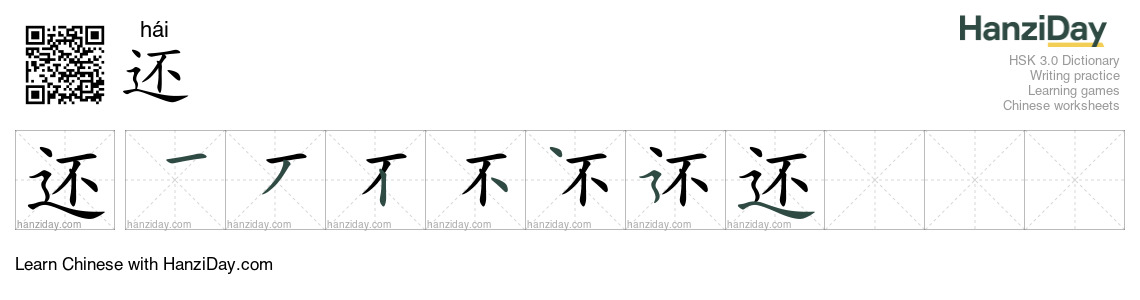
Stroke order
Games & Exercises 9
Find Hanzi
Find Hanzi is a playful exercise for learning Chinese. Spot characters, boost attention, download PDF, and enjoy studying Chinese through games!
Find Radical
Practice Chinese radicals online: choose the Hanzi containing the target component, use optional pinyin hints, and create printable PDF exercises.
Tone Trainer
Learn Mandarin tones online with the Chinese Tone Trainer. Practice tone recognition, pronunciation, and exercises for beginners and advanced learners.
Hanzi Connect
Match Hanzi with pinyin or identify words by sound. Use your own vocabulary or HSK 3.0/YCT levels. Play online after sign-in; printable PDFs with answers are for PRO.
Lost Stroke
Play online: find the missing stroke or radical, restore Chinese characters in order, and create printable PDF worksheets with pinyin and answers.
Calligraphy
Create calligraphy and custom Chinese character coloring pages with pinyin, stroke order, outline styles, and writing grids. Download a print-ready PDF for class or home.
Memo
Flip cards to match Chinese characters or pair Hanzi with Pinyin. Build a custom HSK 3.0 or YCT deck, play online, and create printable PDF cards.
Sudoku
Play Hanzi Sudoku online with 4×4, 6×6, or 9×9 grids, four difficulty levels, custom characters, and HSK 3.0/YCT sets. Create printable PDFs with answers.
Writing trainer
Practice Chinese character writing online with correct stroke order, outlines, a 3–2–1 preview, mistake-based hints, pinyin, and focused Hanzi review.








Examples of use 47
讨
价
还
价
(v.) bargain, haggle
杯
子
里
还
有
茶
吗
?
Is there any tea in the cup?
你
住
在
上
海
还
是
北
京
?
Do you live in Shanghai or Beijing?
上
个
月
我
去
了
北
京
,
明
年
我
还
想
去
。
I went to Beijing last month. I want to go there again next year.
我
还
没
想
好
要
不
要
去
那
个
公
司
工
作
。
I still have not finished thinking about whether or not I want to go and work at that company.
今
天
学
的
跳
舞
动
作
有
点
儿
难
,
我
恐
怕
做
得
不
太
标
准
,
在
比
赛
前
我
还
想
多
练
习
练
习
。
The dance moves I learned today are a bit difficult. I'm afraid I didn't do them very well. I want to practice more before the competition.
如
果
不
是
女
儿
反
驳
,
我
还
意
识
不
到
,
我
们
自
己
的
做
法
和
对
孩
子
的
要
求
实
行
的
是
两
套
标
准
,
那
便
是
对
自
己
宽
容
,
对
孩
子
严
厉
。
If it weren't for my daughter's rebuttal, I still didn't realize that our own practices and requirements for children are two sets of standards, that is, we are tolerant of ourselves and strict with children.
这
么
晚
了
,
谁
还
在
不
停
地
唱
歌
?
Who is still singing at this late hour?
他
们
不
仅
要
观
色
、
闻
香
、
尝
味
、
赏
形
,
而
且
还
要
求
食
物
具
有
养
生
方
面
的
特
色
。
They not only want to watch the color, smell the fragrance, taste the taste and appreciate the shape, but also require the food to have the characteristics of keeping in good health.
最
近
我
的
朋
友
不
但
失
去
了
工
作
,
还
和
妻
子
离
了
婚
,
日
子
真
是
太
苦
了
。
Recently, my friend not only lost his job, but also divorced his wife. Life is really hard.
我
作
业
还
没
做
好
,
妈
妈
不
让
我
下
楼
。
I haven't finished my homework yet, so my mother won't let me go downstairs.
不
管
你
说
错
多
少
次
汉
语
,
你
还
是
要
坚
持
多
说
,
因
为
这
是
学
习
口
语
的
正
确
方
法
。
No matter how many times you make mistakes in Chinese, you should persist on speaking, because this is the correct way to learn spoken Chinese.
这
家
饭
馆
菜
的
味
道
马
马
虎
虎
,
但
服
务
还
可
以
。
The food in this restaurant tastes so-so, but the service is OK.
冰
箱
里
有
很
多
吃
的
和
喝
的
,
有
水
果
,
有
牛
奶
,
还
有
菜
。
There are many things to eat and drink in the refrigerator, including fruits, milk and vegetables.
我
还
没
吃
药
。
I haven't taken my medicine yet.
还
有
一
个
钟
头
吃
晚
饭
。
There is still an hour to have dinner.
你
是
先
刷
牙
还
是
先
吃
早
饭
?
Do you brush your teeth or have breakfast first?
会
议
已
经
进
行
了
两
个
多
小
时
,
大
家
还
在
认
真
地
讨
论
这
个
问
题
。
The meeting has been going on for more than two hours, and everyone is still discussing this issue seriously.
你
这
棵
树
已
经
五
十
岁
了
,
年
龄
比
我
还
大
。
This tree of yours is already fifty years old - that's older than me.
你
想
要
咸
的
饼
干
还
是
甜
的
?
Do you want salty biscuits or sweet ones?
你
看
,
这
是
五
年
前
他
给
我
写
的
信
,
我
还
留
着
信
封
呢
。
You see, this is a letter he wrote to me five years ago. I still have the envelope.
他
真
可
怜
,
已
经
努
力
了
很
多
年
,
但
还
是
没
实
现
他
的
理
想
。
It's really sad for him. He has worked hard for many years, but he still hasn't realised his dreams.
你
还
有
什
么
要
讲
的
吗
?
Do you have anything else to say?
讲
完
电
话
,
张
师
傅
还
没
忘
了
向
我
炫
耀
他
的
女
儿
。
After talking on the phone, Master Zhang didn't forget to show off his daughter to me.
我
的
数
学
考
得
还
可
以
。
I did OK in the math exam.
您
还
需
要
别
的
东
西
吗
?
Do you need anything else?
十
点
钟
了
,
哥
哥
还
在
睡
觉
。
It's ten o'clock, and my brother is still sleeping.
十
点
了
,
哥
哥
还
在
睡
懒
觉
。
It's ten o'clock, and my brother is still sleeping late.
最
近
这
部
电
影
非
常
火
,
你
还
没
看
过
吗
?
This movie is very popular recently. Haven't you seen it yet?
一
个
被
通
缉
了
1
5
年
的
罪
犯
,
今
天
还
应
该
为
当
初
触
犯
法
律
的
行
为
受
到
惩
罚
吗
?
Should a criminal who has been wanted for 15 years still be punished for breaking the law today?
还
算
侥
幸
,
三
祖
爷
的
腿
也
好
了
。
Luckily, Sanzu's legs are all right.
我
还
要
喝
牛
奶
。
I also want to drink milk.
因
为
哥
哥
还
没
回
家
,
所
以
妈
妈
很
生
气
。
Mother is very angry because my brother hasn't come home yet.
我
下
次
还
会
选
择
这
家
饭
馆
。
I will still choose this restaurant next time.
你
家
住
楼
房
还
是
平
房
?
Do you live in a building or a bungalow?
这
块
鸡
肉
做
成
鸡
丁
还
是
鸡
肉
片
?
Is this chicken diced or sliced?
班
上
有
一
位
同
学
对
花
粉
过
敏
,
一
位
对
面
粉
过
敏
,
另
一
位
对
花
生
过
敏
,
还
有
一
位
对
尘
土
过
敏
。
其
他
人
都
没
有
什
么
过
敏
。
One student in the class is allergic to pollen, one is allergic to flour, another is allergic to peanuts, and another is allergic to dust. No one else has any allergies.
你
喜
欢
住
在
城
市
还
是
乡
村
?
Do you prefer to live in the city or in the country?
你
更
喜
欢
住
在
城
市
还
是
乡
下
?
Do you prefer to live in the city or in the country?
我
还
没
去
过
。
I haven't been there yet.
不
但
要
少
玩
电
脑
,
还
要
认
真
学
习
。
Not only need to play less of computer, but also need to study seriously.↵
她
的
变
化
还
是
挺
让
咱
们
欣
慰
的
。
Her changes are quite gratifying to us.
我
喜
欢
踢
足
球
,
还
喜
欢
游
泳
。
I like playing football and swimming.
我
这
个
周
末
过
得
还
不
错
!
I had a good weekend!
还
手
to hit back | to retaliate
还
书
return books
还
乡
(literary) to return to one's native place
Learn 还 (hái) in context
还 appears here with its available localized meaning and tone-marked pinyin hái. Listen to the pronunciation and review any examples, illustrations, or lexical links shown for this entry.
Use the sections available on this page to compare characters, components, radicals, related words, matching pronunciation, synonyms, or antonyms. HanziDay shows only the information supported by this entry.
还 in HSK 3.0 Level 1
HanziDay organizes HSK 3.0 vocabulary around the new three-stage, nine-level framework. This entry belongs to Level 1; open the level list to study it alongside other vocabulary from the same stage.
Practice the stroke order for 还
Use the stroke animation to follow the writing order, then practice the sequence with the interactive writing tool. After signing in, you can also create a printable worksheet from this entry within your current allowance.