


左
Learn 在 — HSK 3.0 Level 1
在
Translation
- (adv.) in the process of, in the course of (indicating an action in progress)
- (prep./v.) in, at; exist, be alive; be on the job; lie in, consist in
Simplified
在
Traditional
在
Strokes count
6

Words with 在 19
Same pronunciation 5
Similar pronunciation 8
Synonyms 32
Antonyms 3
Writing and worksheets
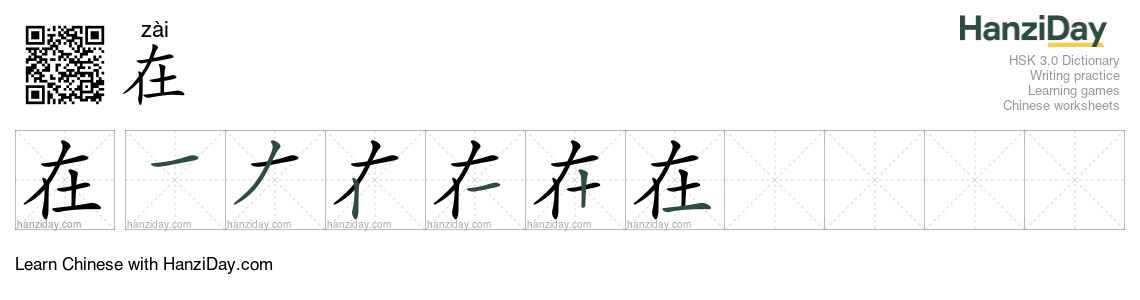
Stroke order
Games & Exercises 9
Find Hanzi
Find Hanzi is a playful exercise for learning Chinese. Spot characters, boost attention, download PDF, and enjoy studying Chinese through games!
Find Radical
Practice Chinese radicals online: choose the Hanzi containing the target component, use optional pinyin hints, and create printable PDF exercises.
Tone Trainer
Learn Mandarin tones online with the Chinese Tone Trainer. Practice tone recognition, pronunciation, and exercises for beginners and advanced learners.
Hanzi Connect
Match Hanzi with pinyin or identify words by sound. Use your own vocabulary or HSK 3.0/YCT levels. Play online after sign-in; printable PDFs with answers are for PRO.
Lost Stroke
Play online: find the missing stroke or radical, restore Chinese characters in order, and create printable PDF worksheets with pinyin and answers.
Calligraphy
Create calligraphy and custom Chinese character coloring pages with pinyin, stroke order, outline styles, and writing grids. Download a print-ready PDF for class or home.
Memo
Flip cards to match Chinese characters or pair Hanzi with Pinyin. Build a custom HSK 3.0 or YCT deck, play online, and create printable PDF cards.
Sudoku
Play Hanzi Sudoku online with 4×4, 6×6, or 9×9 grids, four difficulty levels, custom characters, and HSK 3.0/YCT sets. Create printable PDFs with answers.
Writing trainer
Practice Chinese character writing online with correct stroke order, outlines, a 3–2–1 preview, mistake-based hints, pinyin, and focused Hanzi review.









Examples of use 238
我
八
点
前
在
家
。
I will be at home before eight o'clock.
他
们
八
月
十
七
日
在
吗
?
Are they here on August 17th?
现
在
八
点
二
十
分
。
It's twenty minutes past eight.
现
在
八
点
钟
。
It's eight o'clock.
我
爸
爸
今
天
不
在
家
。
My father is not at home today.
妈
妈
不
在
家
,
她
和
爸
爸
出
门
了
。
Mum is not home. She and Dad have gone out.
爸
爸
不
在
家
,
他
出
去
了
。
Dad is not at home. He is out.
我
爸
爸
目
前
在
上
海
工
作
。
My father is currently working in Shanghai.
爸
爸
在
这
个
工
地
上
工
作
。
Dad works on this construction site.
杯
子
在
桌
子
里
。
(phr.) The cup is inside the table (or desk).
我
的
杯
子
在
哪
儿
呢
?
Where is my cup?
你
住
在
上
海
还
是
北
京
?
Do you live in Shanghai or Beijing?
我
家
住
在
北
京
的
东
边
。
My family lives in the east of Beijing.
哥
哥
和
妈
妈
一
起
住
在
北
京
。
My brother and mother live together in Beijing.
日
本
在
中
国
的
东
边
。
Japan is to the east of China.
你
的
手
机
本
来
放
在
哪
儿
?
Where did you put your mobile phone?
你
的
钱
包
本
来
放
在
哪
儿
?
Where did (you) put your wallet originally?
也
许
有
人
认
为
,
在
这
种
情
况
下
根
本
不
可
能
分
辨
出
来
。
Some people may think that it is impossible to distinguish in this case.
如
果
您
在
本
商
店
购
买
超
过
三
百
元
的
商
品
,
就
可
以
得
到
一
个
精
美
的
购
物
袋
,
多
买
多
得
。
If you buy more than 300 yuan's worth of goods in this shop, you can get a beautiful shopping bag, and you can get more if you buy more.
买
东
西
不
用
在
川
流
不
息
的
人
群
中
奔
走
,
仅
需
登
录
网
站
,
动
几
下
手
指
,
下
几
道
指
令
就
可
以
把
东
西
买
回
家
。
You don't have to run in the endless stream of people to buy things, just log on to the website, move your fingers and give instructions to buy things home.
虽
然
这
件
事
发
生
在
上
个
世
纪
,
但
是
人
们
永
远
都
不
能
忘
记
那
段
历
史
。
Although this happened in the last century, people can never forget that history.
现
在
这
样
的
局
面
,
我
也
不
知
道
怎
么
办
了
。
In this situation, I don't know what to do.
实
在
对
不
起
。
(phr.) (I am) so sorry.
如
果
突
然
被
闹
钟
叫
醒
,
将
在
心
理
上
使
人
产
生
心
慌
、
情
绪
低
落
、
感
觉
没
睡
醒
等
不
适
。
If you are suddenly woken up by the alarm clock, it will make people feel flustered, depressed and uncomfortable.
你
看
,
现
在
已
经
不
刮
风
了
,
也
许
明
天
不
会
下
雨
。
You see, it's not windy now, perhaps it won't rain tomorrow.
在
其
他
粮
食
不
足
的
情
况
下
,
用
橡
子
喂
猴
子
倒
是
个
办
法
。
In other cases of food shortage, feeding monkeys with acorns is a way.
今
天
学
的
跳
舞
动
作
有
点
儿
难
,
我
恐
怕
做
得
不
太
标
准
,
在
比
赛
前
我
还
想
多
练
习
练
习
。
The dance moves I learned today are a bit difficult. I'm afraid I didn't do them very well. I want to practice more before the competition.
其
实
在
海
底
什
么
也
看
不
见
,
那
儿
太
黑
了
。
In fact, you can't see anything at the bottom of the sea. It's too dark there.
在
面
试
的
时
候
千
万
不
能
害
羞
,
应
该
努
力
表
现
出
自
己
的
优
点
。
Don't be shy during the interview, you should try your best to show your strengths.
这
种
手
机
不
可
能
卖
五
千
块
钱
。
你
是
不
是
在
骗
我
?
This kind of mobile phone can't sell for 5,000 yuan. Are you lying to me?
不
要
在
路
口
玩
,
小
心
汽
车
!
Don't play at the intersection, watch out for cars!
奶
奶
喜
欢
在
家
里
,
不
喜
欢
外
出
。
Grandma prefers being at home to going out.
张
老
师
出
去
了
,
不
在
办
公
室
。
Miss Zhang is out, not in the office.
你
们
不
该
在
饭
厅
打
球
。
You shouldn't play ball in the dining room.
马
老
师
不
在
家
。
Miss Ma is not at home.
这
么
晚
了
,
谁
还
在
不
停
地
唱
歌
?
Who is still singing at this late hour?
部
分
留
学
生
寒
假
不
回
国
,
他
们
打
算
在
中
国
过
春
节
。
Some overseas students don't return home during winter vacation. They plan to spend the Spring Festival in China.
在
很
多
人
看
来
,
只
有
年
轻
人
才
会
网
上
购
物
,
其
实
不
少
老
年
人
也
会
。
In the eyes of many people, only young people can shop online, in fact so can many old people.
对
不
起
,
我
们
不
能
在
一
起
,
你
无
法
给
我
我
想
要
的
生
活
。
Sorry, we can't be together, you are unable to give me the life I want.
如
果
你
能
节
约
钱
,
不
随
便
在
淘
宝
上
买
东
西
,
你
的
生
活
费
一
定
是
够
用
的
。
If you can save money and not buy things casually on Taobao, your living expenses will be enough.
这
个
健
身
计
划
不
适
合
他
,
所
以
事
倍
功
半
,
尽
管
他
努
力
地
锻
炼
身
体
,
但
是
现
在
没
有
什
么
效
果
。
This fitness program is not suitable for him, so it gets twice the effort with half the result. Although he works hard to exercise, it has no effect now.
请
不
要
在
教
室
里
吃
东
西
。
Please don't eat in the classroom.
妈
妈
在
院
子
里
种
了
很
多
蔬
菜
。
Mother grows a lot of vegetables in the yard.
很
多
老
年
人
喜
欢
在
这
里
喝
茶
。
Many old people like to drink tea here.
在
吃
药
之
前
,
应
该
好
好
读
一
下
盒
子
里
的
说
明
。
You should read the instructions in the box carefully before taking the medicine.
中
午
在
外
面
吃
什
么
了
?
What did you eat out at noon?
山
西
人
喜
欢
吃
酸
,
这
在
全
中
国
都
是
有
名
的
。
People from Shanxi like sour food. This is well known all over China.
我
在
学
校
吃
午
饭
。
I have lunch at school.
你
在
吃
什
么
?
What are you eating?
我
们
在
饭
厅
吃
饭
。
We eat in the dining room.
他
在
给
朋
友
打
电
话
呢
。
He is on the phone with a friend.
我
现
在
会
用
汉
语
打
电
话
了
。
I can make phone calls in Chinese now.
我
明
天
要
和
我
在
英
国
的
爷
爷
奶
奶
打
电
话
。
I'm going to call my grandparents in England tomorrow.
你
现
在
能
打
电
话
吗
?
Can you make a phone call now?
从
前
,
大
概
在
距
今
两
千
五
百
多
年
前
的
春
秋
时
期
,
有
一
个
人
叫
子
路
,
他
是
孔
子
最
年
长
的
学
生
。
Once upon a time, in the Spring and Autumn Period about 2,500 years ago, there was a man named Zilu, who was the oldest student of Confucius.
大
家
开
始
在
附
近
挖
掘
。
Everyone started digging nearby.
会
议
已
经
进
行
了
两
个
多
小
时
,
大
家
还
在
认
真
地
讨
论
这
个
问
题
。
The meeting has been going on for more than two hours, and everyone is still discussing this issue seriously.
今
天
全
校
师
生
都
在
体
育
馆
里
开
大
会
。
Today, all the teachers and students have a meeting in the gymnasium.
他
在
大
学
学
教
育
学
。
He studied pedagogy at the university.
我
们
的
车
在
大
山
里
沿
着
公
路
盘
旋
而
行
。
Our car circled along the highway in the mountains.
我
哥
哥
在
武
汉
上
大
学
。
My brother goes to college in Wuhan.
大
山
现
在
在
国
外
。
Dashan is abroad now.
请
你
讲
讲
你
在
大
学
里
的
日
子
,
好
吗
?
Would you please tell me something about your days in college?
警
察
正
在
扩
大
搜
索
范
围
。
The police are expanding their search.
在
中
国
的
时
候
,
你
要
是
需
要
帮
助
,
就
可
以
去
你
们
国
家
的
大
使
馆
。
When you are in China, if you need help, you can go to your country's embassy.
大
象
现
在
毫
无
抵
抗
能
力
,
只
要
我
在
它
身
体
的
重
要
部
位
咬
几
个
洞
,
它
就
没
命
了
。
The elephant has no resistance now. As long as I bite a few holes in important parts of its body, it will die.
大
家
现
在
可
以
回
家
了
。
Everyone can go home now.
他
大
概
是
在
附
近
那
家
医
院
工
作
。
He probably works in the nearby hospital.
建
伟
在
大
学
的
一
座
公
寓
楼
里
开
了
一
家
书
店
,
顺
便
卖
点
儿
文
具
、
电
池
、
小
日
用
品
等
。
Jianwei opened a bookstore in an apartment building of the university, selling stationery, batteries and small daily necessities by the way.
由
于
这
个
大
学
越
来
越
有
名
,
中
国
学
生
和
外
国
留
学
生
的
数
量
都
在
增
加
。
As the university becomes more and more famous, the number of Chinese students and foreign students is increasing.
他
家
住
在
这
栋
大
楼
里
。
His family lives in this building.
他
想
要
在
上
海
上
大
学
。
He wants to go to university in Shanghai.
他
想
在
上
海
上
大
学
。
He wants to go to college in Shanghai.
可
以
回
收
的
东
西
请
放
在
那
里
。
Please put things that can be recycled there.
你
现
在
适
应
中
国
的
生
活
了
吗
?
Have you adapted to life in China now?
我
的
小
猫
总
是
在
睡
觉
。
My kitten is always sleeping.
一
年
级
在
二
年
级
的
左
边
。
The first grade is on the left of the second grade.
今
天
在
餐
厅
过
生
日
的
小
朋
友
可
以
获
得
一
个
生
日
蛋
糕
。
Children who are celebrating their birthday in the restaurant today can get a birthday cake.
中
国
的
学
生
一
年
有
两
个
长
的
假
期
,
一
个
在
夏
天
,
一
个
在
冬
天
。
Chinese students have two long holidays a year, one in summer and one in winter.
你
跟
我
打
招
呼
的
时
候
,
我
没
注
意
到
你
,
当
时
正
在
接
电
话
。
When you greeted me, I didn't notice you. I was answering the phone.
妈
妈
把
全
部
的
时
间
都
花
在
照
顾
三
个
孩
子
上
了
。
Mother spent all her time taking care of three children.
我
的
全
家
都
住
在
中
国
。
My whole family lives in China.
我
的
一
家
人
都
住
在
上
海
。
My family all live in Shanghai.
床
在
房
间
的
北
边
。
The bed is on the north side of the room.
没
想
到
这
两
个
颜
色
放
在
一
起
怪
好
看
的
。
I didn't expect these two colours to look so unusually good together.
你
的
家
人
在
美
国
的
什
么
地
方
?
Where is your family in America?
你
在
中
国
的
生
活
怎
么
样
?
How is your life in China?
这
是
中
国
的
西
安
,
我
有
一
个
朋
友
在
那
儿
。
This is Xi'an, China. I have a friend there.
他
的
父
母
因
为
生
病
都
没
了
工
作
,
他
家
现
在
的
生
活
很
困
难
。
His parents have lost their jobs because of illness, and his family's life is very difficult now.
很
多
游
客
在
马
来
西
亚
度
假
以
后
,
都
对
马
来
西
亚
有
很
好
的
印
象
。
Many tourists have a good impression of Malaysia after their holidays in Malaysia.
这
是
我
们
网
站
的
网
址
,
在
上
面
你
可
以
看
到
更
多
的
东
西
。
This is the URL of our website. You can see more things on it.
姐
姐
在
用
平
板
电
脑
看
电
子
书
,
弟
弟
在
白
板
上
画
画
,
我
们
的
狗
在
地
板
上
睡
觉
。
My sister is reading e-books on her tablet, my brother is drawing on the whiteboard, and our dog is sleeping on the floor.
我
在
中
国
过
了
一
个
难
忘
的
春
节
。
I had an unforgettable Spring Festival in China.
你
要
在
信
里
讲
讲
自
己
的
近
况
。
You need to talk about your own recent situation in the letter.
奶
奶
说
,
现
在
的
生
活
比
以
前
的
生
活
好
多
了
。
Grandma said that life is much better now than before.
男
的
在
一
个
宠
物
店
工
作
。
The man works in a pet shop.
家
长
会
在
学
校
的
体
育
馆
开
。
The parents' meeting is held in the school gymnasium.
在
我
的
脑
海
里
,
父
亲
很
少
与
我
们
亲
近
。
In my mind, my father is rarely close to us.
我
很
喜
欢
新
来
的
美
术
老
师
,
现
在
美
术
课
是
我
最
喜
欢
的
课
了
。
I like the new art teacher very much. Now art class is my favorite class.
在
中
国
的
北
方
,
冬
天
的
时
候
每
家
都
有
暖
气
。
In the north of China, every family has heating in winter.
我
的
房
间
在
你
的
左
边
。
My room is on your left.
图
书
馆
在
餐
厅
的
前
边
。
The library is in front of the dining room.
我
们
的
画
被
妈
妈
放
在
了
客
厅
里
。
Our picture was put in the living room by my mother.
导
游
让
游
客
休
息
的
时
候
,
一
部
分
人
会
在
车
上
睡
觉
,
另
一
部
分
人
会
下
车
活
动
一
下
儿
。
When the tour guide gives tourists a rest, some people will sleep in the car, while others will get off the bus for a while.
江
苏
省
在
上
海
的
西
北
边
。
Jiangsu Province is to the northwest of Shanghai.
我
是
在
这
家
医
院
出
生
的
。
I was born in this hospital.
你
的
鞋
在
哪
儿
?
Where are your shoes?
在
你
的
朋
友
之
中
,
你
最
喜
欢
谁
?
Who do you like best among your friends?
保
护
森
林
就
是
在
保
护
地
球
,
保
护
我
们
自
己
的
家
。
To protect the forest is to protect the earth and our own home.
有
的
花
喜
干
,
就
别
多
浇
水
;
有
的
花
喜
欢
潮
湿
的
环
境
,
就
别
放
在
太
阳
地
里
。
Some flowers like to dry, don't water more; Some flowers like humid environment, so don't put them in the sun.
我
的
很
多
亲
人
都
在
上
海
。
Many of my relatives are in Shanghai.
我
买
了
一
面
镜
子
,
放
在
我
的
房
间
里
。
I bought a mirror and put it in my room.
他
现
在
已
经
是
一
个
非
常
著
名
的
歌
手
了
。
He is a very famous singer now.
在
中
国
,
公
立
学
校
是
什
么
样
的
?
What are public schools like in China?
例
如
,
做
节
目
时
,
与
开
幕
式
相
比
,
我
们
宁
可
把
更
多
的
精
力
集
中
在
闭
幕
式
上
,
这
样
可
以
加
强
观
众
对
节
目
的
印
象
。
For example, when doing a program, we would rather focus more on the closing ceremony than the opening ceremony, which can enhance the audience's impression of the program.
她
喜
欢
在
下
雨
的
日
子
在
书
店
里
看
书
。
She likes reading in the bookstore on rainy days.
他
的
电
脑
在
他
的
书
包
里
。
His computer is in his schoolbag.
她
的
女
儿
在
中
国
学
书
法
。
Her daughter is studying calligraphy in China.
我
们
明
天
上
午
九
点
在
野
生
动
物
园
门
口
上
车
。
We'll take the bus at the gate of the safari park at nine tomorrow morning.
我
昨
天
下
午
四
点
在
家
看
电
视
呢
。
I was watching TV at home at four o'clock yesterday.
这
次
国
际
会
议
安
排
在
下
午
三
点
。
This international conference is arranged for three o'clock in the afternoon.
十
点
钟
了
,
哥
哥
还
在
睡
觉
。
It's ten o'clock, and my brother is still sleeping.
你
能
给
我
倒
点
儿
水
吗
?
我
现
在
有
点
儿
渴
。
Can you pour me some water? I'm a little thirsty now.
我
们
下
午
三
点
在
书
店
见
,
好
吗
?
Let's meet at the bookstore at three o'clock in the afternoon, shall we?
现
在
五
点
。
It is 5 O'clock now.
汽
车
会
在
上
午
十
点
离
开
旅
馆
。
The bus will leave the hotel at ten in the morning.
已
经
十
点
了
,
你
怎
么
还
在
睡
觉
?
It's already ten o'clock. Why are you still sleeping?
弟
弟
一
直
在
烦
妈
妈
,
妈
妈
觉
得
有
点
烦
了
。
My brother has been bothering my mother, and my mother feels a little bored.
现
在
是
六
点
差
十
分
。
It's ten to six.
十
点
了
,
哥
哥
还
在
睡
懒
觉
。
It's ten o'clock, and my brother is still sleeping late.
你
在
中
国
,
至
少
要
会
说
一
点
儿
中
文
。
When you are in China, you should speak at least a little Chinese.
电
脑
现
在
能
上
网
了
吗
?
Can the computer surf the Internet now?
那
个
明
星
这
两
年
很
火
,
我
经
常
在
电
视
上
看
到
他
。
That celebrity has been very popular in the past two years. I often see him on TV.
我
更
愿
意
在
家
看
电
视
I prefer to watch TV at home
昨
天
在
家
无
聊
,
我
就
看
起
电
影
来
了
。
Yesterday I was bored at home, so I started watching movies.
别
假
装
正
经
,
我
知
道
你
们
都
在
玩
儿
手
机
。
Don't pretend to be serious, I know you are all playing with mobile phones.
我
在
读
书
呢
。
I am reading.
对
不
起
,
我
赶
着
开
会
,
现
在
没
时
间
跟
你
聊
天
。
Sorry, I'm in a hurry for a meeting. I don't have time to chat with you now.
很
多
人
拿
着
鲜
花
站
在
门
口
。
Lots of people are standing at the door holding flowers.
球
场
上
有
很
多
学
生
在
玩
球
。
There are many students playing ball on the court.
我
在
中
国
有
很
多
朋
友
。
I have many friends in China.
你
要
是
在
这
里
该
有
多
好
啊
!
It would be good if you were here!
你
要
在
这
儿
多
好
!
It would be so good if you were here.↵
有
很
多
外
国
人
住
在
上
海
。
There are many foreigners living in Shanghai.
我
在
香
港
有
很
多
朋
友
。
I have many friends in Hong Kong.
他
儿
子
在
学
校
上
小
班
。
His son is in a small class at school.
他
受
伤
时
,
一
个
人
在
山
上
,
好
在
后
来
救
护
车
来
了
,
他
得
救
了
。
When he was injured, he was alone in the mountains. Fortunately, the ambulance came and he was saved.
在
第
一
个
红
绿
灯
往
右
走
。
Go right at the first traffic light.
我
一
个
人
在
家
,
经
常
感
到
孤
单
。
I am at home alone and often feel lonely.
她
在
看
音
乐
节
目
,
这
个
节
目
很
有
意
思
。
She is watching a music program, which is very interesting.
一
个
孩
子
在
哭
。
A child is crying.
我
发
现
在
难
得
的
寂
静
中
工
作
是
那
么
美
好
。
I find it wonderful to work in rare silence.
小
狗
在
椅
子
下
。
The puppy is under the chair.
我
在
学
习
汉
语
和
日
语
。
I'm learning Chinese and Japanese.
姐
姐
打
排
球
打
得
很
好
,
她
在
学
校
放
学
后
常
常
上
排
球
课
。
My sister plays volleyball very well. She often has volleyball lessons after school.
我
们
在
上
海
火
车
站
见
,
好
吗
?
Shall we meet at Shanghai Railway Station?
你
们
在
喝
什
么
?
What are you drinking?
徐
健
和
他
的
队
伍
天
天
在
路
上
忙
碌
着
。
Jian Xu and his team are busy on the road every day.
由
于
人
们
在
一
周
内
的
营
养
摄
入
和
饮
食
模
式
会
影
响
到
他
们
的
体
重
变
化
,
因
此
节
食
者
的
体
重
会
在
一
周
内
上
下
波
动
。
Because people's nutrient intake and diet patterns will affect their weight changes during the week, dieters' weight will fluctuate up and down during the week.
在
和
别
人
对
话
时
,
你
应
该
看
着
别
人
,
这
是
一
种
礼
貌
。
When talking with others, you should look at the other person. This is a way to show courtesy.
我
在
学
校
学
中
文
和
法
语
。
I study Chinese and French at school.
河
马
会
在
河
床
上
行
走
。
Hippos will walk on the riverbed.
在
生
活
中
我
们
需
要
自
信
,
别
总
是
担
心
自
己
会
失
败
。
We need self-confidence in life, and don't always worry about losing.
我
这
几
天
住
在
爷
爷
家
。
I'm staying at Grandpa's these days.
我
家
住
在
黄
河
边
上
。
My family lives near the Yellow River.
我
家
就
在
这
个
小
区
。
My home is in this neighborhood.
马
老
师
在
家
。
Miss Ma is at home.
马
老
师
在
家
吗
?
Is Miss Ma at home?
他
说
女
儿
念
了
硕
士
,
有
学
位
,
在
一
家
一
流
的
公
司
上
班
。
He said that his daughter has a master's degree and works in a first-class company.
你
在
爷
爷
家
玩
得
开
心
吗
?
Did you have a good time at Grandpa's house?
我
们
国
家
人
口
一
直
在
增
长
。
The population of our country has been increasing.
我
们
今
天
坐
游
船
在
西
湖
一
日
游
。
We took a one-day cruise in the West Lake today.
九
月
中
旬
的
一
天
早
晨
,
詹
森
照
常
提
前
出
门
赶
在
早
高
峰
之
前
去
交
通
部
。
One morning in mid-September, Zhan Sen went out early as usual to go to the Ministry of Transportation before the morning rush hour.
你
在
开
玩
笑
吗
?
Are you joking?
他
们
在
学
校
看
书
。
They are reading at school.
昨
天
妈
妈
没
有
在
小
学
门
口
看
见
你
。
Mother didn't see you at the primary school gate yesterday.
他
在
马
路
边
捡
了
几
块
钱
。
He picked up a few dollars by the side of the road.
我
马
上
出
来
了
,
你
在
哪
里
?
I'll be right out. Where are you?
最
近
,
老
师
在
使
用
网
络
上
课
,
学
生
也
在
使
用
网
络
学
习
。
Recently, teachers use the internet for classes, and students also use the internet for learning.
请
问
,
我
可
以
在
这
里
照
相
吗
?
Excuse me, can I take pictures here?
你
住
在
哪
里
?
Where do you live?
科
学
馆
在
哪
里
?
Where is the Science Museum?
他
们
星
期
六
在
吗
?
Are they here on Saturday?
王
力
这
个
星
期
五
下
午
在
吗
?
Will Wang Li be here this Friday afternoon?
他
们
这
个
星
期
五
下
午
在
吗
?
Will they be here this Friday afternoon?
在
中
国
生
活
有
什
么
困
难
吗
?
Have you had any difficulties with life in China?
你
喜
欢
住
在
市
区
吗
?
Do you like living downtown?
小
猫
在
桌
子
下
。
The kitten is under the table.
我
们
明
天
在
什
么
地
方
见
?
Where shall we meet tomorrow?
她
女
儿
在
哪
儿
?
Where is her daughter?
你
一
年
以
前
在
哪
儿
?
Where were you a year ago?
你
住
在
哪
儿
?
Where do you live?
请
问
,
你
住
在
哪
儿
?
Excuse me, where do you live?
汽
车
站
在
哪
儿
?
Where is the bus stop?
你
在
哪
个
学
院
学
习
?
Which college do you study in?
他
们
在
玩
儿
呢
。
They're playing.
奶
奶
在
跳
舞
呢
。
Grandma is dancing.
他
在
看
你
。
He's looking at you.
你
现
在
在
上
什
么
课
?
What class are you taking now?
你
喜
欢
住
在
城
市
还
是
乡
村
?
Do you prefer to live in the city or in the country?
你
更
喜
欢
住
在
城
市
还
是
乡
下
?
Do you prefer to live in the city or in the country?
请
在
前
边
停
车
,
我
要
下
车
。
Please stop ahead. I want to get off.
我
现
在
去
学
校
。
I'm going to school now.
他
在
网
上
教
别
人
怎
么
理
发
,
是
一
位
网
红
理
发
师
。
He teaches others how to have a haircut online. He is a hairdresser in online celebrity.
我
们
在
体
育
课
上
学
习
武
术
。
We learn martial arts in physical education class.
是
谁
在
黑
板
上
故
意
乱
画
?
Who deliberately scribbled on the blackboard?
学
生
们
每
天
早
上
在
操
场
上
做
运
动
。
The students do sports on the playground every morning.
姐
姐
喜
欢
小
孩
子
,
她
在
幼
儿
园
上
班
。
My sister likes children. She works in kindergarten.
书
包
在
桌
子
上
边
。
The schoolbag is on the table.
一
只
小
鸟
在
天
上
飞
。
A bird is flying in the sky.
放
学
后
,
我
们
在
什
么
地
方
见
?
Where shall we meet after school?
我
们
下
午
在
什
么
地
方
见
?
Where shall we meet this afternoon?
这
是
我
第
一
次
在
中
国
过
春
节
。
This is my first Spring Festival in China.
他
们
在
一
起
学
课
文
。
They study the text together.
他
在
学
中
文
,
因
为
他
喜
欢
学
汉
字
。
He is learning Chinese because he likes learning Chinese characters.
他
在
数
学
学
院
学
习
。
He studies at the School of Mathematics.
他
一
直
在
流
泪
。
He has been crying.
他
们
正
在
球
场
上
玩
球
。
They are playing ball on the court.
我
在
听
中
文
课
文
录
音
。
I'm listening to the recording of the Chinese text.
我
在
这
儿
。
I am here.
我
在
中
国
留
学
。
I am studying abroad in China.
希
望
您
在
我
们
酒
店
住
得
愉
快
。
Hope you enjoy your stay in our hotel.
我
现
在
在
逛
街
。
I'm shopping now.
我
一
直
在
笑
。
I keep laughing.
我
在
做
运
动
。
I'm doing sports.
外
面
在
下
雨
。
It's raining outside.
现
在
小
明
在
学
汉
字
。
Xiao Ming is learning Chinese characters now.
学
生
们
在
看
手
机
。
The students are looking at their mobile phones.
鼻
子
在
这
儿
。
The nose is here.
弟
弟
在
踢
足
球
。
My younger brother is playing football.
妹
妹
没
在
练
习
口
语
。
My sister is not practicing her spoken English.
弟
弟
在
睡
午
觉
。
My brother is taking a nap.
弟
弟
正
在
看
动
画
片
。
My brother is watching cartoons.
在
中
国
,
结
婚
时
常
用
红
色
,
因
为
它
代
表
喜
庆
。
In China, red is often used when getting married, because it represents happiness.
他
在
睡
觉
。
He is sleeping.
他
在
打
电
话
呢
。
He is making a phone call.
你
在
说
什
么
?
What are you talking about?
我
在
吃
饭
呢
。
I'm having a meal.
Learn 在 (zài) in context
在 appears here with its available localized meaning and tone-marked pinyin zài. Listen to the pronunciation and review any examples, illustrations, or lexical links shown for this entry.
Use the sections available on this page to compare characters, components, radicals, related words, matching pronunciation, synonyms, or antonyms. HanziDay shows only the information supported by this entry.
在 in HSK 3.0 Level 1
HanziDay organizes HSK 3.0 vocabulary around the new three-stage, nine-level framework. This entry belongs to Level 1; open the level list to study it alongside other vocabulary from the same stage.
Practice the stroke order for 在
Use the stroke animation to follow the writing order, then practice the sequence with the interactive writing tool. After signing in, you can also create a printable worksheet from this entry within your current allowance.