


块
地 — Land, Ground, or Location
地 (dì) can mean land or ground, a place or location, or the earth as a surface in Mandarin Chinese.
地
TOP-50
Frequency
The ranking is based on data from open sources.
HSK 3.0 · Level 3
Translation
- (n.) land, soil; the earth; ground; location; position; prefecture; space; background; distance; mental state
- (par.) used to create adverbs or adverbial phrases (placed before the predicate)
Radical
Simplified
地
Traditional
地
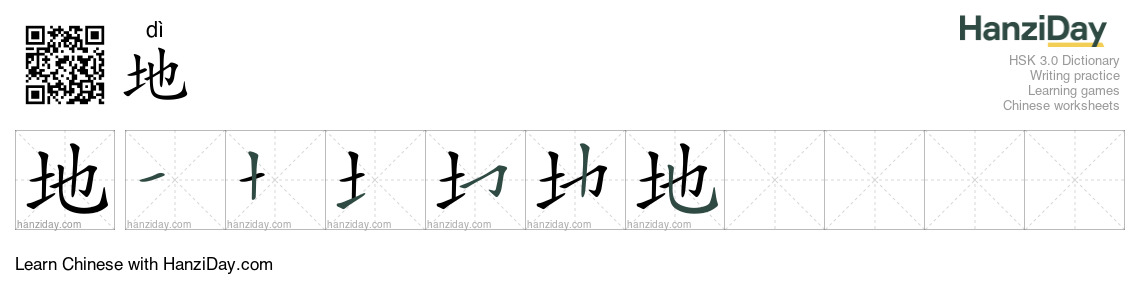
Strokes count
6

Words with 地 69
Same pronunciation 29
Similar pronunciation 49
Synonyms 28
Writing and worksheets
Stroke order
Games & Exercises 9
Find Hanzi
Find Hanzi is a playful exercise for learning Chinese. Spot characters, boost attention, download PDF, and enjoy studying Chinese through games!
Find Radical
Practice Chinese radicals online: choose the Hanzi containing the target component, use optional pinyin hints, and create printable PDF exercises.
Tone Trainer
Learn Mandarin tones online with the Chinese Tone Trainer. Practice tone recognition, pronunciation, and exercises for beginners and advanced learners.
Hanzi Connect
Match Hanzi with pinyin or identify words by sound. Use your own vocabulary or HSK 3.0/YCT levels. Play online after sign-in; printable PDFs with answers are for PRO.
Lost Stroke
Play online: find the missing stroke or radical, restore Chinese characters in order, and create printable PDF worksheets with pinyin and answers.
Calligraphy
Create calligraphy and custom Chinese character coloring pages with pinyin, stroke order, outline styles, and writing grids. Download a print-ready PDF for class or home.
Memo
Flip cards to match Chinese characters or pair Hanzi with Pinyin. Build a custom HSK 3.0 or YCT deck, play online, and create printable PDF cards.
Sudoku
Play Hanzi Sudoku online with 4×4, 6×6, or 9×9 grids, four difficulty levels, custom characters, and HSK 3.0/YCT sets. Create printable PDFs with answers.
Writing trainer
Practice Chinese character writing online with correct stroke order, outlines, a 3–2–1 preview, mistake-based hints, pinyin, and focused Hanzi review.







Examples of use 48
地
区
(n.) area, zone
殖
民
地
(n.) colony
她
骄
傲
地
说
:
尽
管
我
的
家
很
小
,
但
这
里
是
全
世
界
最
温
暖
的
地
方
,
因
为
有
家
人
的
爱
。
She proudly said: Although my home is small, it is the warmest place in the world because of the love of my family.
爸
爸
在
这
个
工
地
上
工
作
。
Dad works on this construction site.
我
们
的
目
的
地
是
北
京
。
Our destination is Beijing.
我
去
过
中
国
的
很
多
地
方
:
西
安
、
桂
林
、
北
京
,
等
等
。
I have been to many places in China: Xi'an, Guilin, Beijing, and so on.
可
是
,
经
过
测
验
计
算
发
现
,
以
大
树
输
送
管
道
的
尺
寸
产
生
的
毛
细
作
用
,
根
本
无
法
把
水
分
送
到
几
十
米
高
的
地
方
。
However, after testing and calculation, it was found that the capillary effect produced by the size of the big tree transportation pipeline could not send water to places tens of meters high at all.
西
安
真
是
个
好
地
方
,
不
仅
风
景
很
美
,
而
且
人
也
非
常
热
情
。
Xi'an truly is a good place; not only is the scenery beautiful, the people are also extremely enthusiastic.
不
要
从
高
的
地
方
往
下
跳
。
Don't jump from high places.
我
心
里
隐
约
有
些
不
安
,
抱
着
包
裹
就
往
工
地
跑
。
I was vaguely uneasy in my heart, so I ran to the construction site with the parcel in my arms.
这
么
多
天
不
下
雨
,
土
地
都
干
了
。
After so many days without rain, the land has dried up.
如
果
有
不
懂
的
地
方
,
一
定
要
问
老
师
。
If there is something you don't understand, you must ask the teacher.
我
喜
欢
去
不
同
的
地
方
旅
游
,
了
解
当
地
人
的
生
活
。
I like to travel to different places and learn about the life of local people.
如
果
饿
了
,
我
们
就
找
个
地
方
吃
饭
。
If we are hungry, we will find a place to eat.
当
大
导
演
进
一
步
询
问
原
因
时
,
当
地
人
的
回
答
令
他
受
益
终
生
。
When the director asked further why, the local people's answers benefited him all his life.
你
知
道
地
球
上
一
共
有
几
个
大
洲
吗
?
Do you know how many continents there are on the earth?
这
个
地
方
最
美
的
季
节
是
春
季
。
The most beautiful season in this place is spring.
这
是
我
的
电
子
邮
件
地
址
。
This is my email address.
这
个
城
市
的
地
铁
已
经
有
上
百
年
的
历
史
了
。
The subway in this city already has a history of more than a hundred years.
你
的
家
人
在
美
国
的
什
么
地
方
?
Where is your family in America?
姐
姐
在
用
平
板
电
脑
看
电
子
书
,
弟
弟
在
白
板
上
画
画
,
我
们
的
狗
在
地
板
上
睡
觉
。
My sister is reading e-books on her tablet, my brother is drawing on the whiteboard, and our dog is sleeping on the floor.
请
问
,
这
里
有
没
有
打
印
的
地
方
?
Excuse me, is there any place to print here?
当
地
的
居
民
都
很
友
好
。
The local residents are very friendly.
当
地
的
人
民
都
很
友
好
。
The local people are very friendly.
中
国
各
地
的
人
都
喜
欢
来
这
里
旅
游
。
People from all over China like to travel here.
商
场
的
地
下
是
停
车
场
。
Underground the mall is a parking lot.
请
问
,
这
里
附
近
有
停
车
的
地
方
吗
?
Excuse me, is there a parking place near here?
保
护
森
林
就
是
在
保
护
地
球
,
保
护
我
们
自
己
的
家
。
To protect the forest is to protect the earth and our own home.
有
的
花
喜
干
,
就
别
多
浇
水
;
有
的
花
喜
欢
潮
湿
的
环
境
,
就
别
放
在
太
阳
地
里
。
Some flowers like to dry, don't water more; Some flowers like humid environment, so don't put them in the sun.
这
个
地
方
的
雪
山
很
有
名
。
This place is famous for its snow-capped mountains.
当
地
的
人
都
很
乐
于
助
人
。
The local people are very helpful.
那
个
地
方
四
季
如
春
,
所
以
很
多
人
喜
欢
去
那
里
度
假
。
That place is like spring all the year round, so many people like to go there for vacation.
这
个
地
方
夏
天
多
雨
。
This place is rainy in summer.
他
雇
了
2
0
来
个
当
地
人
为
他
带
路
和
搬
运
行
李
。
He hired about 20 locals to lead the way and carry his luggage.
我
很
喜
欢
上
海
这
个
地
方
。
I like Shanghai very much.
我
很
喜
欢
这
个
地
方
。
I like this place very much.
我
们
明
天
在
什
么
地
方
见
?
Where shall we meet tomorrow?
他
搓
着
手
,
迟
疑
地
说
:
“
有
件
事
想
拜
托
你
。
”
He rubbed his hands and said hesitantly, "I have something to ask you."
放
学
后
,
我
们
在
什
么
地
方
见
?
Where shall we meet after school?
我
们
下
午
在
什
么
地
方
见
?
Where shall we meet this afternoon?
地
名
place name | toponym
心
地
character
扫
地
to sweep the floor | (fig.) (of one's reputation etc) to reach rock bottom | to be at an all-time low
空
地
air-to-surface (missile)
菜
地
vegetable field
他
脱
下
的
衣
服
掉
在
了
地
上
。
The clothing he took off fell on the floor.
一
片
草
地
a lawn; meadow
外
地
的
房
子
比
北
京
便
宜
。
Houses are cheaper out of Beijing.
Learn 地 (dì) in context
地 appears here with its available localized meaning and tone-marked pinyin dì. Listen to the pronunciation and review any examples, illustrations, or lexical links shown for this entry.
Use the sections available on this page to compare characters, components, radicals, related words, matching pronunciation, synonyms, or antonyms. HanziDay shows only the information supported by this entry.
地 in HSK 3.0 Level 3
HanziDay organizes HSK 3.0 vocabulary around the new three-stage, nine-level framework. This entry belongs to Level 3; open the level list to study it alongside other vocabulary from the same stage.
Practice the stroke order for 地
Use the stroke animation to follow the writing order, then practice the sequence with the interactive writing tool. After signing in, you can also create a printable worksheet from this entry within your current allowance.