交
界
(v./n.) have a common border; common boundary, common border
界
定
(v./n.) to delimit, to define; definition
界
线
(n.) boundary line, borderline
眼
界
(n.) ken, scope, outlook, field of vision
自
然
界
(n.) nature, natural world
Same pronunciation
16
借
(v.) borrow; lend | (v.) to make use of; to make a pretext of
届
(m.) session, period (measure word for events, meetings, elections, sporting fixtures etc.) | (v.) to fall due, to expire
戒
(v./n.) to give up, to refrain or abstain from (enjoying or doing something); ring (short for 戒指)
介
(char.) (introduce; never used alone)
价
(literary) messenger; servant
唶
sigh | groan | loud laughter
犗
castrated bull | bullock
玠
jade tablet indicating rank
疥
scabies
芥
mustard
藉
(literary) cushion; mat | (literary) to put some padding underneath
蚧
see 蛤蚧[ge2 jie4]
褯
used in 褯子[jie4 zi5]
解
to transport under guard
觧
variant of 解[jie4]
诫
(v./n.) warn, admonish; commandment
Similar pronunciation
64
接
(v.) receive; answer (the phone) | (v.) to connect; to come into contact with, come close to | (v.) to pick up, to meet, to welcome; to catch, to get hold of
节
(m.) section, length (measure word of class, sections of an article, etc.) | (n./v.) festival; save, economize | (n.) joint | (char.) appearing in the word 节骨眼儿 and 节子 | (char.) abridge; formality, etiquette; moral integrity
街
(n.) street
结
(v./n.) to form; to knot; to form a relationship with; to conclude, to settle; (Anatomy) node | (v.) to bear, to produce (fruit); to stammer, to stutter | (char.) solid, durable, sturdy (never used alone)
结
(v./n.) to form; to knot; to form a relationship with; to conclude, to settle; (Anatomy) node | (v.) to bear, to produce (fruit); to stammer, to stutter | (char.) solid, durable, sturdy (never used alone)
解
(v./n.) explain; unbind; cut apart, dissect; divide, separate; dismiss; understand; solve a math problem; (Math.) solution | (v.) send under guard, escort | (n./v.) acrobatic (on horse); a surname; (spoken) get the point, see
劫
(v.) rob | (char.) coerce, compel; calamity, disaster
截
(v./m.) to cut; to stop, to check; section, length, chunk
㔾
"seal" radical in Chinese characters (Kangxi radical 26)
㛃
variant of 潔|洁[jie2] (mostly used in given names)
䂶
variant of 蜐[jie2]
价
particle used between an adverb and a verb or adjective | (dialect) particle used after a negative adverb such as 不[bu4] or 別|别[bie2] without any other following element
倢
handsome
偈
forceful | martial
劼
careful | diligent | firm
卩
"seal" radical in Chinese characters (Kangxi radical 26)
卪
old variant of 節|节[jie2]
喈
harmonious (of music)
喼
box (dialect) | used to transliterate words with sounds kip-, cap- etc
嗟
sigh | also pr. [jue1]
姐
(n.) elder sister; elder female cousin; general term for young women
姐
(n.) elder sister; elder female cousin; general term for young women
婕
used in 婕妤[jie2 yu2]
孑
(literary) lonely; all alone
尐
(literary) few | a couple of
岊
mountain peak
幯
wipe
拮
antagonistic | laboring hard | pressed
Synonyms
17
个
(m.) a measure word for general use | (char.) single, individual | (n.) size, stature, height (same as 个儿) | (pro.) self
回
(v.) to return, to go back, to turn around | (v./m.) to reply, answer back; (of the number of occurrence) time; (an event) piece; (of a novel) chapter | (char.) circle, wind
是
(v./adj.) to be; correct, right | (n./pro.) truth, correct judgment; (lit.) this, that
第
(par.) prefix before a number
这
(pro.) (used before a noun; used alone as a subject or object of a sentence) this; now, this moment | (pro.) this, these (variant pronunciation of 这 zhe4)
那
(pro.) that (used in place of sth or sb further away in distance or time) | (conj.) then, in that case | (pro.) that (refer to a person or thing further away in distance or time)
只
(char./m.) single, the only; measure word for birds and some animals, for one of certain paired things, for certain containers, or small boats | (adv.) only, merely, just
山
(n.) mountain, hill; mountainous area; anything resembling a mountain; gable (of a house) | (radical.) mountain
接
(v.) receive; answer (the phone) | (v.) to connect; to come into contact with, come close to | (v.) to pick up, to meet, to welcome; to catch, to get hold of
该
(av.) should, to be somebody's turn to do something | (v./pro.) to owe; this, indicating somebody or something mentioned before, mainly used in formal document | (v.) to deserve, ought to, would (used in exclamatory sentences as an intensifier)
之
(par.) (lit.) used between an attribute and a head noun; between the subject and the predicate to form a nominal phrase | (pro.) (lit.) this, that, it; used as the object of a verb | (char.) (lit.) go to, leave for
此
(pro.) this | (pro.) now, here, such, this way
其
(pro.) that, such; he, she, it, they; his, her, its, their | (char.) (ancient Chinese) used to give an order or instruction; used to make a guess or retort; suffix used after an adverb
弯
(v./adj./n.) to bend, to flex; curved, tortuous; bend, curve
依
(v.) lean against; rely on; comply with, listen to | (prep.) according to
兹
(char.) (character used in translation); (lit.) year; (lit.) now, at present | (pro.) (lit.) this, here | (char.) see 龟兹
许
(v./adv.) maybe, about; to allow, permit; promise; (of a girl) be betrothed (to) | (n.) Xu (a surname) | (char.) (lit.) place; to praise; (indicating degree) so; (lit.) approximately
She proudly said: Although my home is small, it is the warmest place in the world because of the love of my family.
爷
爷
经
历
过
第
二
次
世
界
大
战
,
因
此
他
希
望
世
界
永
远
和
平
。
Grandpa experienced the Second World War, so he hopes that the world will always be peaceful.
世
界
上
没
有
完
全
相
同
的
叶
子
。
There are no completely identical leaves in the world.
世
界
上
有
很
多
个
国
家
。
There are many countries in the world.
Learn 界 (jiè) in context
界 appears here with its available localized meaning and tone-marked pinyin jiè. Listen to the pronunciation and review any examples, illustrations, or lexical links shown for this entry.
Use the sections available on this page to compare characters, components, radicals, related words, matching pronunciation, synonyms, or antonyms. HanziDay shows only the information supported by this entry.
界 in HSK 3.0 Levels 7–9
HanziDay organizes HSK 3.0 vocabulary around the new three-stage, nine-level framework. This entry belongs to Levels 7–9; open the level list to study it alongside other vocabulary from the same stage.
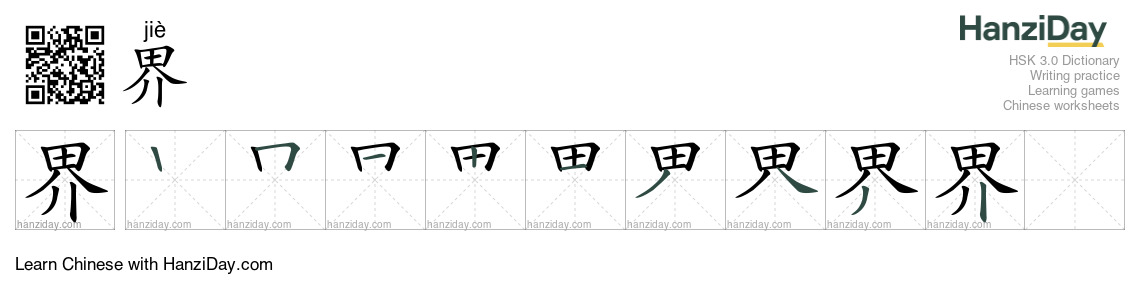
Practice the stroke order for 界
Use the stroke animation to follow the writing order, then practice the sequence with the interactive writing tool. After signing in, you can also create a printable worksheet from this entry within your current allowance.