


兄
Learn 只 — HSK 3.0 Level 3
只
Translation
- (char./m.) single, the only; measure word for birds and some animals, for one of certain paired things, for certain containers, or small boats
- (adv.) only, merely, just
Simplified
只
Traditional
衹
Strokes count
5
Words with 只 9
Same pronunciation 19
Similar pronunciation 108
Synonyms 34
Writing and worksheets
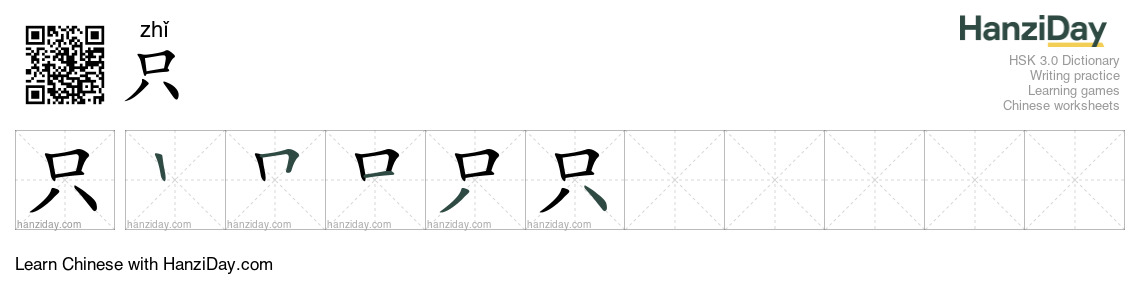
Stroke order
Games & Exercises 9
Find Hanzi
Find Hanzi is a playful exercise for learning Chinese. Spot characters, boost attention, download PDF, and enjoy studying Chinese through games!
Find Radical
Practice Chinese radicals online: choose the Hanzi containing the target component, use optional pinyin hints, and create printable PDF exercises.
Tone Trainer
Learn Mandarin tones online with the Chinese Tone Trainer. Practice tone recognition, pronunciation, and exercises for beginners and advanced learners.
Hanzi Connect
Match Hanzi with pinyin or identify words by sound. Use your own vocabulary or HSK 3.0/YCT levels. Play online after sign-in; printable PDFs with answers are for PRO.
Lost Stroke
Play online: find the missing stroke or radical, restore Chinese characters in order, and create printable PDF worksheets with pinyin and answers.
Calligraphy
Create calligraphy and custom Chinese character coloring pages with pinyin, stroke order, outline styles, and writing grids. Download a print-ready PDF for class or home.
Memo
Flip cards to match Chinese characters or pair Hanzi with Pinyin. Build a custom HSK 3.0 or YCT deck, play online, and create printable PDF cards.
Sudoku
Play Hanzi Sudoku online with 4×4, 6×6, or 9×9 grids, four difficulty levels, custom characters, and HSK 3.0/YCT sets. Create printable PDFs with answers.
Writing trainer
Practice Chinese character writing online with correct stroke order, outlines, a 3–2–1 preview, mistake-based hints, pinyin, and focused Hanzi review.






Examples of use 20
只
有
爸
爸
妈
妈
才
能
分
出
来
她
们
姐
妹
两
个
人
。
Only Mum and Dad can tell the sisters apart.
我
买
不
到
车
票
,
只
能
坐
船
回
家
了
。
I can't get a ticket, so I have to go home by boat.
只
有
不
断
提
升
自
己
的
决
策
能
力
,
才
能
真
正
为
自
己
的
人
生
做
主
。
Only by constantly improving one's decision-making ability can one truly make decisions for one's own life.
在
很
多
人
看
来
,
只
有
年
轻
人
才
会
网
上
购
物
,
其
实
不
少
老
年
人
也
会
。
In the eyes of many people, only young people can shop online, in fact so can many old people.
如
果
只
是
单
纯
地
主
张
阅
读
而
不
强
调
思
考
,
那
是
片
面
的
。
It is one-sided to advocate reading without emphasizing thinking.
事
实
证
明
这
只
是
我
们
美
好
的
主
观
愿
望
,
道
路
扩
建
的
速
度
远
远
跟
不
上
车
流
量
增
加
的
速
度
。
Facts have proved that this is just our good subjective wish, and the speed of road expansion is far behind the speed of traffic increase.
社
会
不
需
要
只
会
享
福
的
人
。
Society doesn't need people who can only enjoy happiness.
他
午
饭
只
吃
了
一
个
热
狗
。
He only had a hot dog for lunch.
猴
子
们
似
乎
只
弄
懂
了
主
人
前
面
说
的
一
个
“
三
”
,
觉
得
自
己
吃
了
亏
。
Monkeys seem to have only understood a "three" mentioned by their masters and feel that they have suffered losses.
给
大
卫
上
过
课
的
老
师
们
普
遍
反
映
他
的
表
现
很
好
,
只
是
偶
尔
会
迟
到
。
The teachers who taught David generally reported that he performed well, but occasionally he was late.
大
象
现
在
毫
无
抵
抗
能
力
,
只
要
我
在
它
身
体
的
重
要
部
位
咬
几
个
洞
,
它
就
没
命
了
。
The elephant has no resistance now. As long as I bite a few holes in important parts of its body, it will die.
虽
然
后
面
的
题
我
都
会
,
但
是
考
试
时
间
太
少
了
,
没
时
间
写
了
,
只
好
都
放
弃
了
。
Although I can do the following questions, there is too little time for the exam and I have no time to write, so I have to give up.
只
有
认
真
学
习
,
我
的
成
绩
才
能
提
高
。
Only by studying hard can my grades be improved.
你
只
要
填
写
你
的
年
龄
就
可
以
了
。
As long as you fill in your age, then it’s alright.
我
只
能
部
分
同
意
你
的
看
法
。
I can only partially agree with you.
给
他
上
过
课
的
老
师
们
普
遍
反
映
他
的
表
现
很
好
,
只
是
偶
尔
会
迟
到
。
Teachers who gave him lessons generally reported that he performed well, only occasionally being late.
他
有
几
百
个
朋
友
,
只
有
两
个
好
朋
友
。
He has several hundred friends, only have two good friends.
只
要
认
真
地
学
习
,
就
能
提
高
汉
语
水
平
。
As long as you study hard, you can improve your Chinese.
由
于
家
里
老
人
突
然
生
病
,
我
只
好
放
弃
出
国
。
I had to give up going abroad due to an old family member suddenly falling ill.
我
们
只
想
无
忧
无
虑
地
过
日
子
。
We just want to live carefree.
Learn 只 (zhǐ) in context
只 appears here with its available localized meaning and tone-marked pinyin zhǐ. Listen to the pronunciation and review any examples, illustrations, or lexical links shown for this entry.
Use the sections available on this page to compare characters, components, radicals, related words, matching pronunciation, synonyms, or antonyms. HanziDay shows only the information supported by this entry.
只 in HSK 3.0 Level 3
HanziDay organizes HSK 3.0 vocabulary around the new three-stage, nine-level framework. This entry belongs to Level 3; open the level list to study it alongside other vocabulary from the same stage.
Practice the stroke order for 只
Use the stroke animation to follow the writing order, then practice the sequence with the interactive writing tool. After signing in, you can also create a printable worksheet from this entry within your current allowance.