


而
面 : Face, Side, or Noodles
面 (miàn) can mean “a face, side, surface, aspect, or noodles and flour; it also classifies flat objects and meetings” in Chinese.
面
TOP-100
Frequency
The ranking is based on data from open sources.
HSK 3.0 · Level 2
HSK 3.0 · Level 5
Translation
- (m.) used for flat things (flags, mirrors, etc.); used for times to meet sb
- (n./adv./v.) face, side; (also: facade; aspect; surface; in persona; scope; orientation)
- (radical.) face
- (n./adj.) noodle; flour, wheat flour; powder; (dialect) soft and mealy
Simplified
面
Traditional
麵
Strokes count
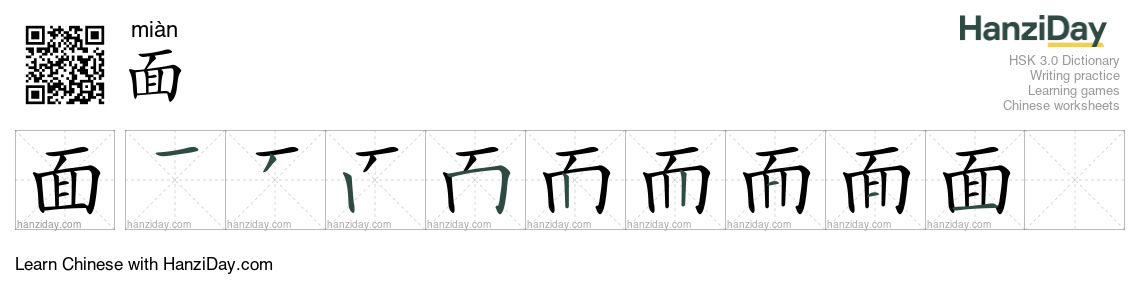
9

Words with 面 56
Same pronunciation 5
Similar pronunciation 23
Synonyms 26
Antonyms 2
Writing and worksheets
Stroke order
Games & Exercises 9
Find Hanzi
Find Hanzi is a playful exercise for learning Chinese. Spot characters, boost attention, download PDF, and enjoy studying Chinese through games!
Find Radical
Practice Chinese radicals online: choose the Hanzi containing the target component, use optional pinyin hints, and create printable PDF exercises.
Tone Trainer
Learn Mandarin tones online with the Chinese Tone Trainer. Practice tone recognition, pronunciation, and exercises for beginners and advanced learners.
Hanzi Connect
Match Hanzi with pinyin or identify words by sound. Use your own vocabulary or HSK 3.0/YCT levels. Play online after sign-in; printable PDFs with answers are for PRO.
Lost Stroke
Play online: find the missing stroke or radical, restore Chinese characters in order, and create printable PDF worksheets with pinyin and answers.
Calligraphy
Create calligraphy and custom Chinese character coloring pages with pinyin, stroke order, outline styles, and writing grids. Download a print-ready PDF for class or home.
Memo
Flip cards to match Chinese characters or pair Hanzi with Pinyin. Build a custom HSK 3.0 or YCT deck, play online, and create printable PDF cards.
Sudoku
Play Hanzi Sudoku online with 4×4, 6×6, or 9×9 grids, four difficulty levels, custom characters, and HSK 3.0/YCT sets. Create printable PDFs with answers.
Writing trainer
Practice Chinese character writing online with correct stroke order, outlines, a 3–2–1 preview, mistake-based hints, pinyin, and focused Hanzi review.







Examples of use 35
妈
妈
要
炒
面
,
爸
爸
要
汤
面
。
Mom wants fried noodles and Dad wants noodle soup.
家
里
面
不
太
热
。
It isn't too hot at home.
现
在
这
样
的
局
面
,
我
也
不
知
道
怎
么
办
了
。
In this situation, I don't know what to do.
晚
上
我
们
就
不
做
饭
了
,
我
带
你
去
外
面
尝
尝
小
吃
。
We won't cook dinner this evening. I'll take you out to try some snacks.
在
面
试
的
时
候
千
万
不
能
害
羞
,
应
该
努
力
表
现
出
自
己
的
优
点
。
Don't be shy during the interview, you should try your best to show your strengths.
如
果
只
是
单
纯
地
主
张
阅
读
而
不
强
调
思
考
,
那
是
片
面
的
。
It is one-sided to advocate reading without emphasizing thinking.
他
们
不
仅
要
观
色
、
闻
香
、
尝
味
、
赏
形
,
而
且
还
要
求
食
物
具
有
养
生
方
面
的
特
色
。
They not only want to watch the color, smell the fragrance, taste the taste and appreciate the shape, but also require the food to have the characteristics of keeping in good health.
这
个
面
条
软
软
的
,
真
好
吃
。
This noodle is soft and delicious.
中
午
在
外
面
吃
什
么
了
?
What did you eat out at noon?
我
喜
欢
吃
炒
面
,
也
喜
欢
吃
蛋
炒
饭
。
I like fried noodles and fried rice with eggs.
今
天
早
上
我
吃
了
一
个
面
包
。
I ate a loaf of bread this morning.
我
早
上
吃
了
半
个
面
包
。
I ate half a loaf of bread this morning.
星
期
五
中
午
老
师
常
常
吃
炒
面
。
The teacher often eats fried noodles at noon on Friday.
姐
姐
早
饭
喜
欢
吃
炒
面
。
My sister likes fried noodles for breakfast.
早
上
我
吃
了
一
片
面
包
。
I ate a piece of bread in the morning.
猴
子
们
似
乎
只
弄
懂
了
主
人
前
面
说
的
一
个
“
三
”
,
觉
得
自
己
吃
了
亏
。
Monkeys seem to have only understood a "three" mentioned by their masters and feel that they have suffered losses.
留
学
生
的
宿
舍
面
积
大
约
是
二
十
五
平
方
米
左
右
。
The dormitory area for overseas students is about 25 square meters.
如
果
你
想
买
到
他
们
的
面
包
,
就
要
早
一
点
去
。
If you want to buy their bread, you should go early.
商
店
里
的
东
西
比
外
面
商
店
的
贵
很
多
。
The things in the shop is much more expensive than the shops outside.
这
里
是
房
子
的
阳
面
,
采
光
好
。
This is the sunny side of the house, with good lighting.
我
买
了
一
面
镜
子
,
放
在
我
的
房
间
里
。
I bought a mirror and put it in my room.
我
和
朋
友
见
面
的
时
候
会
握
手
,
表
示
友
好
。
When I meet my friends, I shake hands to show friendship.
前
面
有
点
儿
堵
车
。
There is a traffic jam ahead.
房
间
里
比
外
面
暖
和
多
了
。
It's much warmer in the room than outside.
外
面
好
热
,
快
来
这
里
凉
快
一
下
。
It's hot outside. Come here and cool off.
外
面
好
热
,
快
到
这
里
来
凉
快
一
下
。
It's hot outside. Come here and cool off.
这
个
包
很
轻
,
里
面
没
什
么
东
西
。
This bag is very light and there is nothing in it.
马
路
对
面
新
开
了
一
家
照
相
馆
。
A new photo studio has opened across the road.
“
要
面
子
着
呢
,
从
来
没
有
辜
负
过
我
的
期
望
。
”
"I have to face up and never live up to my expectations."
班
上
有
一
位
同
学
对
花
粉
过
敏
,
一
位
对
面
粉
过
敏
,
另
一
位
对
花
生
过
敏
,
还
有
一
位
对
尘
土
过
敏
。
其
他
人
都
没
有
什
么
过
敏
。
One student in the class is allergic to pollen, one is allergic to flour, another is allergic to peanuts, and another is allergic to dust. No one else has any allergies.
希
望
以
后
能
再
见
面
。
I hope we will be able to see each other again in the future.
前
面
有
红
绿
灯
,
是
绿
灯
,
我
们
可
以
走
。
There are traffic lights ahead. It's a green light. We can go.
一
面
墙
a wall
空
中
飘
着
一
面
旗
。
There is a flag floating in the air.
你
们
一
共
见
过
几
面
?
Mummy pig took out a mirror.
Learn 面 (miàn) in context
面 appears here with its available localized meaning and tone-marked pinyin miàn. Listen to the pronunciation and review any examples, illustrations, or lexical links shown for this entry.
Use the sections available on this page to compare characters, components, radicals, related words, matching pronunciation, synonyms, or antonyms. HanziDay shows only the information supported by this entry.
面 in HSK 3.0 Level 2
HanziDay organizes HSK 3.0 vocabulary around the new three-stage, nine-level framework. This entry belongs to Level 2; open the level list to study it alongside other vocabulary from the same stage.
Practice the stroke order for 面
Use the stroke animation to follow the writing order, then practice the sequence with the interactive writing tool. After signing in, you can also create a printable worksheet from this entry within your current allowance.