


万
方 — Direction, Side, Method, or Square
方 (fāng) means a direction or side and can also mean a method, prescription, place, or square in Mandarin Chinese.
方
TOP-100
Frequency
The ranking is based on data from open sources.
HSK 3.0 · Level 5
Translation
- (n.) direction; side, party; prescription; (geometry) square
- (char.) method, way; region, place; upright, fair-minded
- (adj./m.) square; measure word for square things
- (adv.) at the time when; only, just
- (radical.) square
Radical
Simplified
方
Traditional
方
Strokes count
4

Words with 方 42
Same pronunciation 6
Similar pronunciation 17
Synonyms 11
Antonyms 1
Writing and worksheets
Stroke order
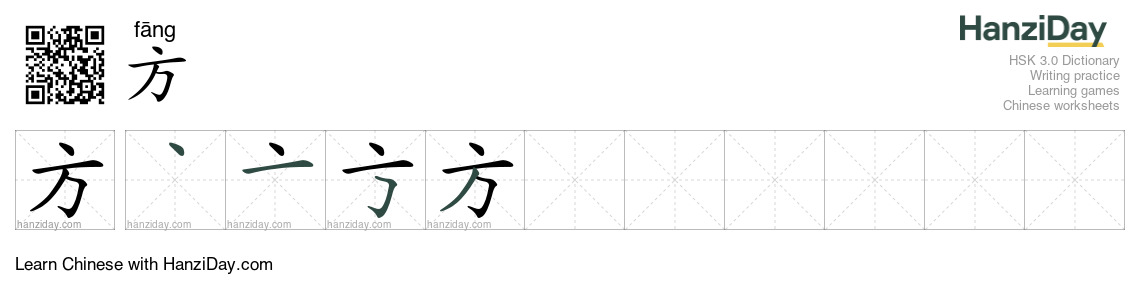
Games & Exercises 9
Find Hanzi
Find Hanzi is a playful exercise for learning Chinese. Spot characters, boost attention, download PDF, and enjoy studying Chinese through games!
Find Radical
Practice Chinese radicals online: choose the Hanzi containing the target component, use optional pinyin hints, and create printable PDF exercises.
Tone Trainer
Learn Mandarin tones online with the Chinese Tone Trainer. Practice tone recognition, pronunciation, and exercises for beginners and advanced learners.
Hanzi Connect
Match Hanzi with pinyin or identify words by sound. Use your own vocabulary or HSK 3.0/YCT levels. Play online after sign-in; printable PDFs with answers are for PRO.
Lost Stroke
Play online: find the missing stroke or radical, restore Chinese characters in order, and create printable PDF worksheets with pinyin and answers.
Calligraphy
Create calligraphy and custom Chinese character coloring pages with pinyin, stroke order, outline styles, and writing grids. Download a print-ready PDF for class or home.
Memo
Flip cards to match Chinese characters or pair Hanzi with Pinyin. Build a custom HSK 3.0 or YCT deck, play online, and create printable PDF cards.
Sudoku
Play Hanzi Sudoku online with 4×4, 6×6, or 9×9 grids, four difficulty levels, custom characters, and HSK 3.0/YCT sets. Create printable PDFs with answers.
Writing trainer
Practice Chinese character writing online with correct stroke order, outlines, a 3–2–1 preview, mistake-based hints, pinyin, and focused Hanzi review.









Examples of use 43
北
方
(n.) north; the north, northern part (of a country)
方
向
(n.) orientation, direction
平
方
(n.) square, square meter
双
方
(n.) both sides
立
方
(n./m.) (Math) cube; (short for) cubic (a block of something with six sides); (short for) cubic meter
秘
方
(n.) secret prescription
药
方
(n.) prescription
我
去
过
中
国
的
很
多
地
方
:
西
安
、
桂
林
、
北
京
,
等
等
。
I have been to many places in China: Xi'an, Guilin, Beijing, and so on.
可
是
,
经
过
测
验
计
算
发
现
,
以
大
树
输
送
管
道
的
尺
寸
产
生
的
毛
细
作
用
,
根
本
无
法
把
水
分
送
到
几
十
米
高
的
地
方
。
However, after testing and calculation, it was found that the capillary effect produced by the size of the big tree transportation pipeline could not send water to places tens of meters high at all.
不
要
从
高
的
地
方
往
下
跳
。
Don't jump from high places.
他
们
不
仅
要
观
色
、
闻
香
、
尝
味
、
赏
形
,
而
且
还
要
求
食
物
具
有
养
生
方
面
的
特
色
。
They not only want to watch the color, smell the fragrance, taste the taste and appreciate the shape, but also require the food to have the characteristics of keeping in good health.
如
果
有
不
懂
的
地
方
,
一
定
要
问
老
师
。
If there is something you don't understand, you must ask the teacher.
我
喜
欢
去
不
同
的
地
方
旅
游
,
了
解
当
地
人
的
生
活
。
I like to travel to different places and learn about the life of local people.
不
管
你
说
错
多
少
次
汉
语
,
你
还
是
要
坚
持
多
说
,
因
为
这
是
学
习
口
语
的
正
确
方
法
。
No matter how many times you make mistakes in Chinese, you should persist on speaking, because this is the correct way to learn spoken Chinese.
如
果
饿
了
,
我
们
就
找
个
地
方
吃
饭
。
If we are hungry, we will find a place to eat.
留
学
生
的
宿
舍
面
积
大
约
是
二
十
五
平
方
米
左
右
。
The dormitory area for overseas students is about 25 square meters.
这
个
地
方
最
美
的
季
节
是
春
季
。
The most beautiful season in this place is spring.
成
功
的
教
育
就
是
让
每
个
人
都
能
找
到
自
己
生
活
的
方
向
。
Successful education is to enable everyone to find their own direction in life.
我
家
小
区
的
旁
边
就
有
一
家
诊
所
,
看
医
生
很
方
便
。
There is a clinic next to my community, so it is very convenient to see a doctor.
请
问
,
这
里
有
没
有
打
印
的
地
方
?
Excuse me, is there any place to print here?
亚
洲
有
很
多
野
生
动
物
园
,
是
了
解
动
物
很
好
的
方
式
。
There are many safari parks in Asia, which is a good way to know animals.
在
中
国
的
北
方
,
冬
天
的
时
候
每
家
都
有
暖
气
。
In the north of China, every family has heating in winter.
请
问
,
这
里
附
近
有
停
车
的
地
方
吗
?
Excuse me, is there a parking place near here?
沙
浴
也
是
一
些
鸟
儿
喜
欢
的
保
养
方
式
。
Sand bath is also a favorite maintenance method for some birds.
他
们
走
的
方
向
正
好
是
相
反
的
:
一
个
向
东
,
一
个
向
西
。
They went in exactly opposite directions: one went east and the other went west.
这
个
地
方
的
雪
山
很
有
名
。
This place is famous for its snow-capped mountains.
你
有
什
么
学
语
法
的
好
方
法
吗
?
Do you have any good ways to learn grammar?
那
个
地
方
四
季
如
春
,
所
以
很
多
人
喜
欢
去
那
里
度
假
。
That place is like spring all the year round, so many people like to go there for vacation.
这
个
地
方
夏
天
多
雨
。
This place is rainy in summer.
我
很
喜
欢
上
海
这
个
地
方
。
I like Shanghai very much.
我
很
喜
欢
这
个
地
方
。
I like this place very much.
西
方
人
觉
得
汉
字
很
难
学
。
Westerners find Chinese characters difficult to learn.
概
括
来
说
,
就
是
以
方
便
为
原
则
。
To sum up, it is based on the principle of convenience.
我
打
算
今
年
寒
假
去
南
方
旅
游
。
I'm going to travel to the south this winter vacation.
她
早
睡
早
起
,
经
常
锻
炼
,
生
活
方
式
非
常
健
康
。
She goes to bed early and gets up early, exercises regularly, and has a very healthy lifestyle.
多
方
in many ways | from all sides
我
方
our side; we
校
方
the school (as a party in a contract, dispute etc) | the school authorities
良
方
good medicine | effective prescription | fig. good plan | effective strategy
西
方
the West | the Occident | Western countries
见
方
(measurement) (after a length) square (as in "10 feet square")
军
方
military
开
方
(medicine) to write out a prescription | (math.) to extract a root from a given quantity
方 has several functions. In 方向 (fāngxiàng) it relates to direction, in 方法 (fāngfǎ) to a method, and as a classifier it can count square-shaped objects.