


日
Learn 口 — HSK 3.0 Level 1
口
Translation
- (m.) (family member, knife, well, water in mouth, etc.)
- (n.) mouth (of human or animal); entrance, opening; edge of a knife; age of a draught animal
- (radical.) mouth
- (char.) one's taste; people, population; port; cut, crack, hole; gate way of the Great Wall
Simplified
口
Traditional
口
Strokes count
3

Words with 口 44
Similar pronunciation 11
Synonyms 12
Writing and worksheets
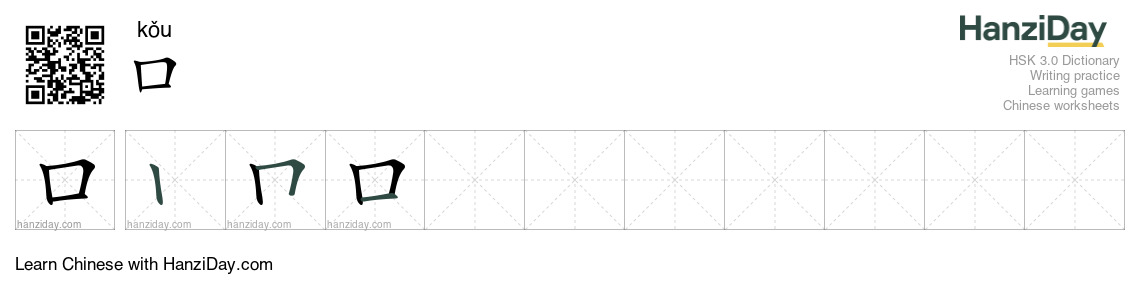
Stroke order
Games & Exercises 9
Find Hanzi
Find Hanzi is a playful exercise for learning Chinese. Spot characters, boost attention, download PDF, and enjoy studying Chinese through games!
Find Radical
Practice Chinese radicals online: choose the Hanzi containing the target component, use optional pinyin hints, and create printable PDF exercises.
Tone Trainer
Learn Mandarin tones online with the Chinese Tone Trainer. Practice tone recognition, pronunciation, and exercises for beginners and advanced learners.
Hanzi Connect
Match Hanzi with pinyin or identify words by sound. Use your own vocabulary or HSK 3.0/YCT levels. Play online after sign-in; printable PDFs with answers are for PRO.
Lost Stroke
Play online: find the missing stroke or radical, restore Chinese characters in order, and create printable PDF worksheets with pinyin and answers.
Calligraphy
Create calligraphy and custom Chinese character coloring pages with pinyin, stroke order, outline styles, and writing grids. Download a print-ready PDF for class or home.
Memo
Flip cards to match Chinese characters or pair Hanzi with Pinyin. Build a custom HSK 3.0 or YCT deck, play online, and create printable PDF cards.
Sudoku
Play Hanzi Sudoku online with 4×4, 6×6, or 9×9 grids, four difficulty levels, custom characters, and HSK 3.0/YCT sets. Create printable PDFs with answers.
Writing trainer
Practice Chinese character writing online with correct stroke order, outlines, a 3–2–1 preview, mistake-based hints, pinyin, and focused Hanzi review.






Examples of use 30
这
辆
车
是
从
日
本
进
口
的
。
This car is imported from Japan.
你
不
能
进
,
这
里
是
出
口
。
You can't enter. This is the exit.
我
的
日
语
口
语
不
好
。
My spoken Japanese is not good.
不
要
在
路
口
玩
,
小
心
汽
车
!
Don't play at the intersection, watch out for cars!
不
管
你
说
错
多
少
次
汉
语
,
你
还
是
要
坚
持
多
说
,
因
为
这
是
学
习
口
语
的
正
确
方
法
。
No matter how many times you make mistakes in Chinese, you should persist on speaking, because this is the correct way to learn spoken Chinese.
这
个
茶
是
要
出
口
到
很
多
国
家
的
。
This tea is to be exported to many countries.
绳
子
终
于
被
咬
断
了
,
巨
网
出
现
了
一
个
大
缺
口
。
The rope was finally bitten, and a big gap appeared in the giant net.
门
口
有
一
个
女
的
。
There is a woman at the door.
他
能
把
什
么
事
都
说
得
让
人
很
明
白
,
他
的
口
才
很
好
。
He can make everything clear, and his eloquence is very good.
这
个
咖
啡
是
美
国
进
口
的
。
This coffee is imported from America.
印
度
的
人
口
很
多
。
India has a large population.
我
的
口
语
很
好
,
九
十
分
。
My spoken English is very good, 90.
她
的
听
力
和
口
语
都
很
好
,
但
是
写
字
不
太
好
。
She is good at listening and speaking, but she is not very good at writing.
我
们
明
天
上
午
九
点
在
野
生
动
物
园
门
口
上
车
。
We'll take the bus at the gate of the safari park at nine tomorrow morning.
我
刚
做
完
运
动
,
有
点
口
渴
。
I just finished my exercise and I'm a little thirsty.
很
多
人
拿
着
鲜
花
站
在
门
口
。
Lots of people are standing at the door holding flowers.
门
口
有
五
个
人
。
There are five people at the door.
我
有
一
台
钢
琴
,
一
把
小
提
琴
,
一
支
口
琴
,
和
一
个
手
风
琴
。
I have a piano, a violin, a harmonica, and an accordion.
品
有
三
个
口
。
The character "product" is made up of three "mouths".
和
有
禾
和
口
。
The character "and" is made up of "grain" and "mouth".
门
口
是
哥
哥
和
姐
姐
。
At the door are my brother and sister.
我
努
力
使
自
己
的
口
气
缓
和
下
来
。
I tried to soften my tone.
我
家
有
五
口
人
。
There are five people in my family.
学
校
门
口
新
开
了
一
家
文
具
店
。
A new stationery store has opened at the school gate.
我
们
国
家
人
口
一
直
在
增
长
。
The population of our country has been increasing.
昨
天
妈
妈
没
有
在
小
学
门
口
看
见
你
。
Mother didn't see you at the primary school gate yesterday.
它
那
丰
富
的
色
彩
、
微
甜
的
口
感
,
至
今
仍
让
我
十
分
想
念
。
Its rich colors and slightly sweet taste still make me miss it very much.
门
口
有
人
。
There is someone at the door.
入
口
处
有
一
群
人
。
There is a group of people at the entrance.
妹
妹
没
在
练
习
口
语
。
My sister is not practicing her spoken English.
Learn 口 (kǒu) in context
口 appears here with its available localized meaning and tone-marked pinyin kǒu. Listen to the pronunciation and review any examples, illustrations, or lexical links shown for this entry.
Use the sections available on this page to compare characters, components, radicals, related words, matching pronunciation, synonyms, or antonyms. HanziDay shows only the information supported by this entry.
口 in HSK 3.0 Level 1
HanziDay organizes HSK 3.0 vocabulary around the new three-stage, nine-level framework. This entry belongs to Level 1; open the level list to study it alongside other vocabulary from the same stage.
Practice the stroke order for 口
Use the stroke animation to follow the writing order, then practice the sequence with the interactive writing tool. After signing in, you can also create a printable worksheet from this entry within your current allowance.