


问
向 — Toward, To, or Face
向 (xiàng) means “toward” or “to,” and as a verb to face or turn toward in Mandarin Chinese.
向
Translation
- (prep./adv.) against, towards, to; until now, all along
- (v.) to face, to turn towards; to have an unfair preference for
- (char.) preference, tendency, inclination
Simplified
向
Traditional
曏
Strokes count
6

Words with 向 25
Same pronunciation 9
Similar pronunciation 33
Synonyms 15
Writing and worksheets
Stroke order
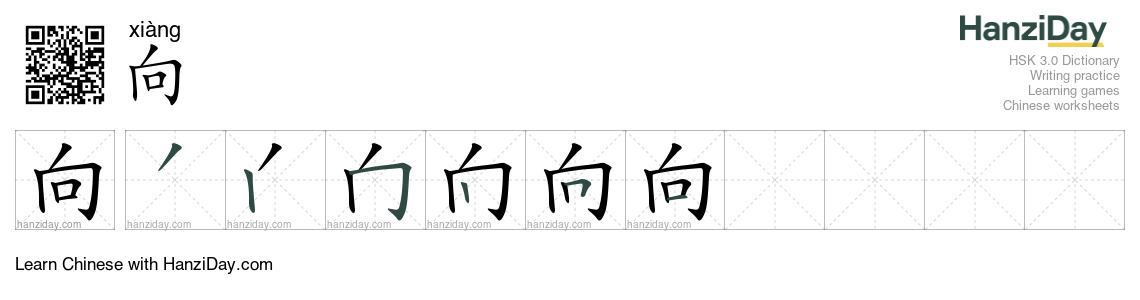
Games & Exercises 9
Find Hanzi
Find Hanzi is a playful exercise for learning Chinese. Spot characters, boost attention, download PDF, and enjoy studying Chinese through games!
Find Radical
Practice Chinese radicals online: choose the Hanzi containing the target component, use optional pinyin hints, and create printable PDF exercises.
Tone Trainer
Learn Mandarin tones online with the Chinese Tone Trainer. Practice tone recognition, pronunciation, and exercises for beginners and advanced learners.
Hanzi Connect
Match Hanzi with pinyin or identify words by sound. Use your own vocabulary or HSK 3.0/YCT levels. Play online after sign-in; printable PDFs with answers are for PRO.
Lost Stroke
Play online: find the missing stroke or radical, restore Chinese characters in order, and create printable PDF worksheets with pinyin and answers.
Calligraphy
Create calligraphy and custom Chinese character coloring pages with pinyin, stroke order, outline styles, and writing grids. Download a print-ready PDF for class or home.
Memo
Flip cards to match Chinese characters or pair Hanzi with Pinyin. Build a custom HSK 3.0 or YCT deck, play online, and create printable PDF cards.
Sudoku
Play Hanzi Sudoku online with 4×4, 6×6, or 9×9 grids, four difficulty levels, custom characters, and HSK 3.0/YCT sets. Create printable PDFs with answers.
Writing trainer
Practice Chinese character writing online with correct stroke order, outlines, a 3–2–1 preview, mistake-based hints, pinyin, and focused Hanzi review.









Examples of use 7
成
功
的
教
育
就
是
让
每
个
人
都
能
找
到
自
己
生
活
的
方
向
。
Successful education is to enable everyone to find their own direction in life.
从
我
的
家
向
东
有
山
。
From my house (facing) towards east, there is mountain.↵
讲
完
电
话
,
张
师
傅
还
没
忘
了
向
我
炫
耀
他
的
女
儿
。
After talking on the phone, Master Zhang didn't forget to show off his daughter to me.
他
们
走
的
方
向
正
好
是
相
反
的
:
一
个
向
东
,
一
个
向
西
。
They went in exactly opposite directions: one went east and the other went west.
一
部
电
影
,
开
始
虽
然
剧
情
平
平
常
常
,
如
果
最
后
半
个
小
时
能
使
我
们
感
动
,
我
们
依
然
会
向
别
人
推
荐
它
。
Although the plot of a movie is ordinary at first, if the last half hour can move us, we will still recommend it to others.
他
向
公
共
汽
车
跑
。
He runs towards the bus.
从
这
儿
往
东
走
,
然
后
向
右
转
。
Go east from here, then turn right.
Before a destination or person, 向 marks direction: 向前走 (xiàng qián zǒu) means “walk forward.” Other senses such as a tendency or long-standing orientation depend on context.