


Learn 象 in Chinese
Meaning of 象 (xiàng): (n.) elephant
象
TOP-500
Frequency
The ranking is based on data from open sources.
Translation
- (n.) elephant
- (char.) to imitate; appearance, image
Simplified
象
Traditional
象
Strokes count
11
Words with 象 13
Writing and worksheets
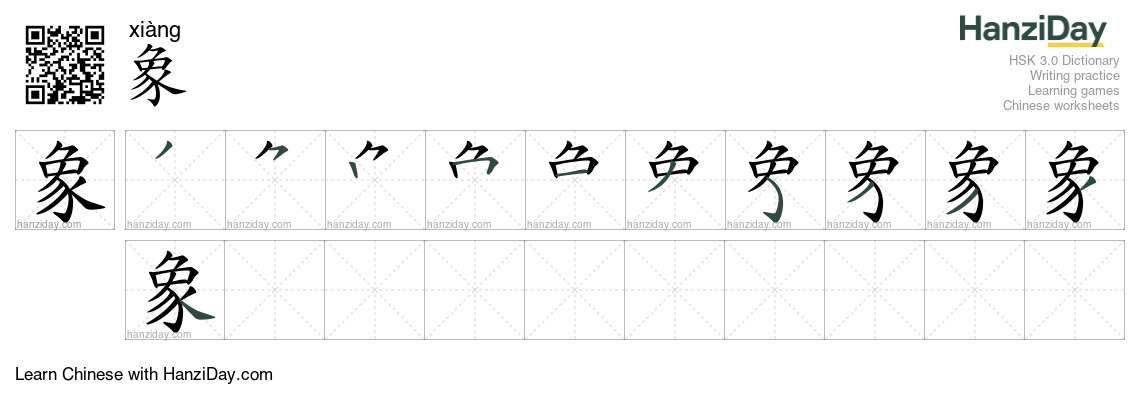
Stroke order
Games & Exercises 9
Find Hanzi
Find Hanzi is a playful exercise for learning Chinese. Spot characters, boost attention, download PDF, and enjoy studying Chinese through games!
Find Radical
Practice Chinese radicals online: choose the Hanzi containing the target component, use optional pinyin hints, and create printable PDF exercises.
Tone Trainer
Learn Mandarin tones online with the Chinese Tone Trainer. Practice tone recognition, pronunciation, and exercises for beginners and advanced learners.
Hanzi Connect
Match Hanzi with pinyin or identify words by sound. Use your own vocabulary or HSK 3.0/YCT levels. Play online after sign-in; printable PDFs with answers are for PRO.
Lost Stroke
Play online: find the missing stroke or radical, restore Chinese characters in order, and create printable PDF worksheets with pinyin and answers.
Calligraphy
Create calligraphy and custom Chinese character coloring pages with pinyin, stroke order, outline styles, and writing grids. Download a print-ready PDF for class or home.
Memo
Flip cards to match Chinese characters or pair Hanzi with Pinyin. Build a custom HSK 3.0 or YCT deck, play online, and create printable PDF cards.
Sudoku
Play Hanzi Sudoku online with 4×4, 6×6, or 9×9 grids, four difficulty levels, custom characters, and HSK 3.0/YCT sets. Create printable PDFs with answers.
Writing trainer
Practice Chinese character writing online with correct stroke order, outlines, a 3–2–1 preview, mistake-based hints, pinyin, and focused Hanzi review.









Examples of use 22
大
象
(n.) elephant
我
可
以
乘
大
象
不
注
意
,
进
到
大
象
鼻
子
里
去
。
I can take the elephant without paying attention and go into the elephant's nose.
大
象
不
留
神
落
入
了
打
猎
者
设
下
的
巨
网
中
。
The elephant accidentally fell into the huge net set by the hunters.
看
到
大
象
悲
惨
的
样
子
,
老
鼠
不
忍
下
手
。
Seeing the elephant's miserable appearance, the mouse couldn't bear to start.
一
天
,
他
让
士
兵
们
去
找
一
头
大
象
和
一
些
出
生
时
眼
睛
就
瞎
了
的
人
回
来
。
One day, he asked the soldiers to find an elephant and some people who were blind at birth.
老
鼠
乘
机
跑
进
大
象
的
鼻
子
中
,
准
备
实
施
它
的
计
划
。
The mouse took the opportunity to run into the elephant's nose, ready to carry out its plan.
它
开
始
用
锋
利
的
牙
齿
咬
缠
绕
着
大
象
的
网
和
绳
子
。
It began to bite the net and rope wrapped around the elephant with its sharp teeth.
它
是
那
么
弱
小
,
丝
毫
没
有
对
抗
大
象
的
力
量
。
It is so weak that it has no strength against elephants.
大
象
现
在
毫
无
抵
抗
能
力
,
只
要
我
在
它
身
体
的
重
要
部
位
咬
几
个
洞
,
它
就
没
命
了
。
The elephant has no resistance now. As long as I bite a few holes in important parts of its body, it will die.
大
象
又
悲
伤
又
害
怕
,
它
觉
得
死
亡
越
来
越
近
了
。
The elephant was sad and afraid. It felt that death was getting closer and closer.
大
象
愤
怒
地
说
:
“
你
这
个
愚
蠢
的
家
伙
。
”
The elephant said angrily, "you stupid fellow."
我
们
的
大
脑
究
竟
如
何
感
知
抽
象
艺
术
,
是
一
个
有
趣
的
话
题
。
How our brains perceive abstract art is an interesting topic.
高
峰
之
后
,
终
点
出
现
得
越
迅
速
,
这
件
事
留
给
我
们
的
印
象
就
越
深
刻
。
After the peak, the faster the end point appears, the more impressive it will leave us.
很
多
游
客
在
马
来
西
亚
度
假
以
后
,
都
对
马
来
西
亚
有
很
好
的
印
象
。
Many tourists have a good impression of Malaysia after their holidays in Malaysia.
演
出
开
始
时
人
们
认
为
很
有
魅
力
,
但
是
糟
糕
的
结
局
会
给
人
留
下
难
以
忘
记
的
坏
印
象
。
At the beginning of the performance, people think it is attractive, but the bad ending will leave an unforgettable bad impression.
例
如
,
做
节
目
时
,
与
开
幕
式
相
比
,
我
们
宁
可
把
更
多
的
精
力
集
中
在
闭
幕
式
上
,
这
样
可
以
加
强
观
众
对
节
目
的
印
象
。
For example, when doing a program, we would rather focus more on the closing ceremony than the opening ceremony, which can enhance the audience's impression of the program.
印
象
中
似
乎
没
有
什
么
押
金
,
全
凭
信
用
。
There seems to be no deposit in my impression, all by credit.
旅
游
类
书
籍
便
把
服
务
对
象
锁
定
为
外
国
人
。
Tourism books target foreigners.
我
父
亲
是
一
位
象
棋
教
练
。
My father is a chess coach.
狗
嘴
里
吐
不
出
象
牙
lit. no ivory comes from the mouth of a dog (idiom) | fig. one does not expect fine words from a scoundrel
盲
人
摸
象
blind people touch an elephant (idiom, from Nirvana sutra 大般涅槃經|大般涅盘经[da4 ban1 Nie4 pan2 jing1]); fig. unable to see the big picture | to mistake the part for the whole | unable to see the wood for the trees
曹
冲
称
象
(title of a famous Chinese story) Cao Chong weighed the elephant
Learn 象 (xiàng) in context
象 appears here with its available localized meaning and tone-marked pinyin xiàng. Listen to the pronunciation and review any examples, illustrations, or lexical links shown for this entry.
Use the sections available on this page to compare characters, components, radicals, related words, matching pronunciation, synonyms, or antonyms. HanziDay shows only the information supported by this entry.
Practice the stroke order for 象
Use the stroke animation to follow the writing order, then practice the sequence with the interactive writing tool. After signing in, you can also create a printable worksheet from this entry within your current allowance.