


两
Learn 两 — HSK 3.0 Level 1
两
TOP-500
Frequency
The ranking is based on data from open sources.
HSK 3.0 · Level 1
HSK 3.0 · Level 4
YCT 2
Translation
- (num.) two (used instead of 'er' in some cases); both (sides or parties); a couple of, a few
- (m.) 50 grams
Simplified
两
Traditional
兩
Strokes count
7
Words with 两 8
Same pronunciation 7
Similar pronunciation 23
Synonyms 1
Writing and worksheets
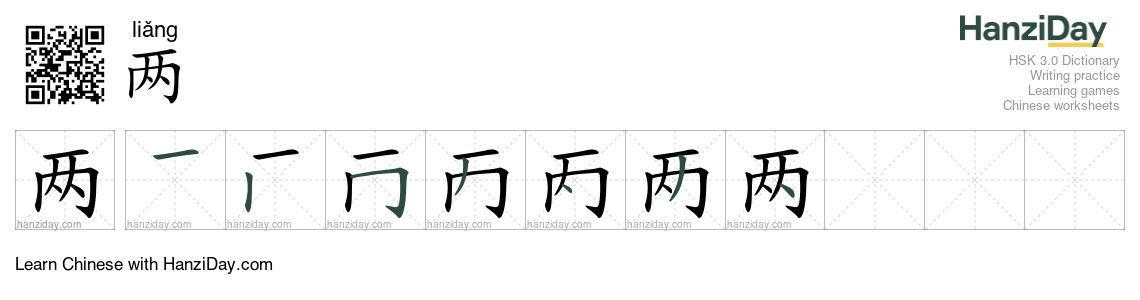
Stroke order
Games & Exercises 9
Find Hanzi
Find Hanzi is a playful exercise for learning Chinese. Spot characters, boost attention, download PDF, and enjoy studying Chinese through games!
Find Radical
Practice Chinese radicals online: choose the Hanzi containing the target component, use optional pinyin hints, and create printable PDF exercises.
Tone Trainer
Learn Mandarin tones online with the Chinese Tone Trainer. Practice tone recognition, pronunciation, and exercises for beginners and advanced learners.
Hanzi Connect
Match Hanzi with pinyin or identify words by sound. Use your own vocabulary or HSK 3.0/YCT levels. Play online after sign-in; printable PDFs with answers are for PRO.
Lost Stroke
Play online: find the missing stroke or radical, restore Chinese characters in order, and create printable PDF worksheets with pinyin and answers.
Calligraphy
Create calligraphy and custom Chinese character coloring pages with pinyin, stroke order, outline styles, and writing grids. Download a print-ready PDF for class or home.
Memo
Flip cards to match Chinese characters or pair Hanzi with Pinyin. Build a custom HSK 3.0 or YCT deck, play online, and create printable PDF cards.
Sudoku
Play Hanzi Sudoku online with 4×4, 6×6, or 9×9 grids, four difficulty levels, custom characters, and HSK 3.0/YCT sets. Create printable PDFs with answers.
Writing trainer
Practice Chinese character writing online with correct stroke order, outlines, a 3–2–1 preview, mistake-based hints, pinyin, and focused Hanzi review.







Examples of use 53
只
有
爸
爸
妈
妈
才
能
分
出
来
她
们
姐
妹
两
个
人
。
Only Mum and Dad can tell the sisters apart.
那
本
书
两
百
元
。
That book is two hundred yuan.
如
果
不
是
女
儿
反
驳
,
我
还
意
识
不
到
,
我
们
自
己
的
做
法
和
对
孩
子
的
要
求
实
行
的
是
两
套
标
准
,
那
便
是
对
自
己
宽
容
,
对
孩
子
严
厉
。
If it weren't for my daughter's rebuttal, I still didn't realize that our own practices and requirements for children are two sets of standards, that is, we are tolerant of ourselves and strict with children.
由
于
意
见
不
一
样
,
所
以
两
位
老
板
都
不
高
兴
。
Both bosses are unhappy because of their different opinions.
因
为
他
爸
妈
是
不
同
国
家
的
人
,
所
以
他
会
说
两
种
不
同
的
语
言
Because his parents are from different countries, he can speak two different languages
两
个
孩
子
上
学
不
用
接
送
,
做
作
业
不
用
督
促
。
Two children don't need to pick up and drop off when they go to school, and they don't need to
他
早
饭
吃
两
个
鸡
蛋
。
He eats two eggs for breakfast.
从
前
,
大
概
在
距
今
两
千
五
百
多
年
前
的
春
秋
时
期
,
有
一
个
人
叫
子
路
,
他
是
孔
子
最
年
长
的
学
生
。
Once upon a time, in the Spring and Autumn Period about 2,500 years ago, there was a man named Zilu, who was the oldest student of Confucius.
会
议
已
经
进
行
了
两
个
多
小
时
,
大
家
还
在
认
真
地
讨
论
这
个
问
题
。
The meeting has been going on for more than two hours, and everyone is still discussing this issue seriously.
我
有
两
件
大
衣
,
一
件
是
黑
色
的
,
另
一
件
是
咖
啡
色
的
。
I have two coats, one is black and the other is brown.
两
个
大
人
。
Two adults.
我
的
朋
友
有
两
只
猫
,
一
只
三
岁
,
一
只
五
岁
。
My friend has two cats, one is three years old and the other is five years old.
中
国
的
学
生
一
年
有
两
个
长
的
假
期
,
一
个
在
夏
天
,
一
个
在
冬
天
。
Chinese students have two long holidays a year, one in summer and one in winter.
从
2
0
世
纪
8
0
年
代
起
,
比
尔
•
盖
茨
每
年
都
要
进
行
两
次
为
期
一
周
的
“
闭
关
”
。
Since 1980s, Bill Gates has conducted two one-week "retreat" every year.
没
想
到
这
两
个
颜
色
放
在
一
起
怪
好
看
的
。
I didn't expect these two colours to look so unusually good together.
请
给
我
一
张
两
寸
的
照
片
。
Please give me a two-inch photo.
节
约
和
浪
费
这
两
个
词
的
意
思
是
相
反
的
。
The words economy and waste have opposite meanings.
我
的
学
校
一
共
有
一
千
两
百
个
学
生
。
There are twelve hundred students in my school.
那
个
明
星
这
两
年
很
火
,
我
经
常
在
电
视
上
看
到
他
。
That celebrity has been very popular in the past two years. I often see him on TV.
我
一
个
月
看
两
次
电
影
。
I watch movies twice a month.
上
海
有
两
个
飞
机
场
。
There are two airports in Shanghai.
呵
,
这
两
个
瓜
加
起
来
恐
怕
有
五
六
斤
了
。
Oh, I'm afraid these two melons add up to five or six pounds.
我
们
家
有
三
个
孩
子
,
两
个
男
孩
,
一
个
女
孩
。
There are three children in our family, two boys and one girl.
我
有
两
个
好
朋
友
。
I have two good friends.
我
们
班
有
两
个
张
老
师
。
Our class has two teachers called Mr Zhang.
我
们
做
作
业
做
了
两
个
小
时
了
,
我
们
休
息
一
下
吧
。
We have been doing our homework for two hours. Let's have a rest.
他
和
她
有
两
个
子
女
。
He and she have two children.
我
有
两
个
哥
哥
。
I have two older brothers.
他
有
几
百
个
朋
友
,
只
有
两
个
好
朋
友
。
He has several hundred friends, only have two good friends.
两
个
好
人
。
Two good people.
他
们
两
个
是
母
子
关
系
。
The two of them are mother and child.
三
个
小
时
快
乐
减
一
个
小
时
无
聊
等
于
两
个
小
时
快
乐
,
也
就
是
说
,
我
愉
快
地
度
过
了
两
个
小
时
。
Three hours of happiness minus one hour of boredom equals two hours of happiness, that is to say, I spent two hours happily.
我
有
两
个
新
老
师
,
一
个
姓
李
,
一
个
姓
王
。
I have two new teachers, one with the surname Li and the other with the surname Wang.
我
今
天
看
了
两
位
医
生
。
I saw two doctors today.
一
块
橡
皮
两
块
五
毛
钱
。
Two dollars and fifty cents for an eraser.
一
支
铅
笔
两
块
五
毛
钱
。
A pencil is two yuan and fifty cents.
我
们
花
了
两
千
元
买
了
这
台
咖
啡
机
。
We paid two thousand yuan for this coffee machine.
我
有
两
只
眼
睛
。
I have two eyes.
我
们
想
要
两
间
无
烟
房
。
We'd like two non-smoking rooms.
三
三
两
两
in twos and threes
三
番
两
次
repeatedly (idiom)
三
言
两
语
in a few words (idiom); expressed succinctly
两
全
其
美
to satisfy rival demands (idiom) | to get the best of both worlds | to have it both ways | to have one's cake and eat it too
两
岸
bilateral | both shores | both sides | both coasts | Taiwan and mainland
两
面
both sides
请
给
我
两
杯
红
酒
。
Two glasses of red wine, please
两
个
two units, two
两
个
星
期
。
Two weeks.
两
百
two hundred
两
本
书
two books
两
张
over and over again, repeatedly
两
点
建
议
I (want to) buy two stamps.
两
年
two pieces (of tickets, paper), two (tables, faces, etc.)
Learn 两 (liǎng) in context
两 appears here with its available localized meaning and tone-marked pinyin liǎng. Listen to the pronunciation and review any examples, illustrations, or lexical links shown for this entry.
Use the sections available on this page to compare characters, components, radicals, related words, matching pronunciation, synonyms, or antonyms. HanziDay shows only the information supported by this entry.
两 in HSK 3.0 Level 1
HanziDay organizes HSK 3.0 vocabulary around the new three-stage, nine-level framework. This entry belongs to Level 1; open the level list to study it alongside other vocabulary from the same stage.
Practice the stroke order for 两
Use the stroke animation to follow the writing order, then practice the sequence with the interactive writing tool. After signing in, you can also create a printable worksheet from this entry within your current allowance.