


三
Learn 二 — HSK 3.0 Level 1
二
Translation
- (num.) two, 2
- (radical.) two
- (char.) inconstant; different; (dialect) stupid
Radical
Simplified
二
Traditional
二
Strokes count
2
Words with 二 7
Same pronunciation 9
Similar pronunciation 24
Synonyms 4
Writing and worksheets
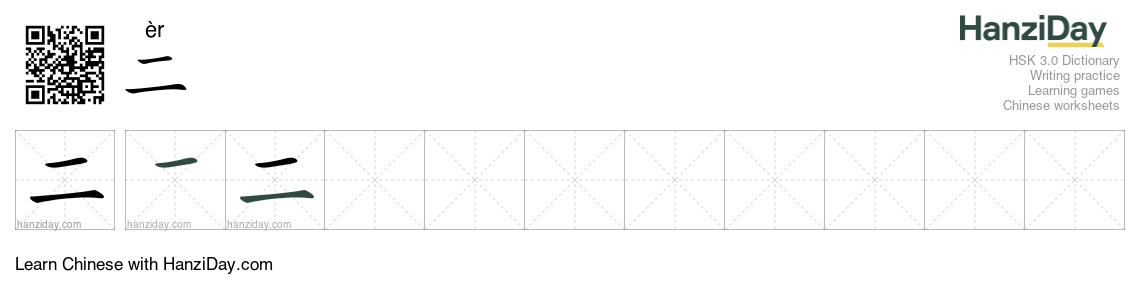
Stroke order
Games & Exercises 9
Find Hanzi
Find Hanzi is a playful exercise for learning Chinese. Spot characters, boost attention, download PDF, and enjoy studying Chinese through games!
Find Radical
Practice Chinese radicals online: choose the Hanzi containing the target component, use optional pinyin hints, and create printable PDF exercises.
Tone Trainer
Learn Mandarin tones online with the Chinese Tone Trainer. Practice tone recognition, pronunciation, and exercises for beginners and advanced learners.
Hanzi Connect
Match Hanzi with pinyin or identify words by sound. Use your own vocabulary or HSK 3.0/YCT levels. Play online after sign-in; printable PDFs with answers are for PRO.
Lost Stroke
Play online: find the missing stroke or radical, restore Chinese characters in order, and create printable PDF worksheets with pinyin and answers.
Calligraphy
Create calligraphy and custom Chinese character coloring pages with pinyin, stroke order, outline styles, and writing grids. Download a print-ready PDF for class or home.
Memo
Flip cards to match Chinese characters or pair Hanzi with Pinyin. Build a custom HSK 3.0 or YCT deck, play online, and create printable PDF cards.
Sudoku
Play Hanzi Sudoku online with 4×4, 6×6, or 9×9 grids, four difficulty levels, custom characters, and HSK 3.0/YCT sets. Create printable PDFs with answers.
Writing trainer
Practice Chinese character writing online with correct stroke order, outlines, a 3–2–1 preview, mistake-based hints, pinyin, and focused Hanzi review.






Examples of use 38
我
的
手
机
号
码
是
一
五
六
一
八
五
二
零
二
零
六
。
My mobile phone number is one five six one eight five two zero two six.
今
天
是
五
四
青
年
节
。
我
听
说
今
天
十
四
到
二
十
八
岁
的
青
年
放
半
天
假
,
今
天
你
有
假
吗
?
Today is May Fourth Youth Day. I heard that young people between the ages of fourteen and twenty-eight have half a day off today. Do you have a holiday today?
现
在
八
点
二
十
分
。
It's twenty minutes past eight.
一
五
六
九
八
五
九
三
二
四
七
One five six nine eight five nine three two four seven
一
八
五
六
二
七
四
三
七
八
二
One eight five six two seven four three seven eight two
爷
爷
经
历
过
第
二
次
世
界
大
战
,
因
此
他
希
望
世
界
永
远
和
平
。
Grandpa experienced the Second World War, so he hopes that the world will always be peaceful.
留
学
生
的
宿
舍
面
积
大
约
是
二
十
五
平
方
米
左
右
。
The dormitory area for overseas students is about 25 square meters.
一
年
级
在
二
年
级
的
左
边
。
The first grade is on the left of the second grade.
一
来
二
去
,
他
慢
慢
地
总
结
出
一
些
养
花
的
经
验
。
In the long run, he slowly summed up some experience in raising flowers.
这
条
围
巾
的
价
钱
是
二
十
五
元
。
The price of this scarf is twenty-five yuan.
听
说
他
从
四
岁
就
开
始
学
打
羽
毛
球
,
已
经
练
了
二
十
多
年
了
。
It is said that he has been learning to play badminton since he was four years old and has been practicing it for more than 20 years.
这
些
苹
果
差
不
多
二
十
块
钱
。
These apples cost almost twenty dollars.
实
践
证
明
,
第
二
种
人
得
到
的
总
是
比
第
一
种
人
更
多
。
Practice has proved that the second kind of people always get more than the first kind of people.
我
二
十
岁
I'm twenty years old
一
,
二
,
三
,
四
;
四
,
三
,
二
,
一
One, two, three, four; Four, three, two, one
我
女
儿
十
二
岁
了
。
My daughter is 12 years old.
我
明
年
二
十
一
岁
。
I will be twenty-one next year.
这
个
周
末
我
们
全
家
要
去
上
海
郊
区
二
日
游
。
My family will go on a two-day tour to the suburbs of Shanghai this weekend.
我
二
年
级
。
I'm in year two.
二
年
级
有
汉
语
课
吗
?
Are there any Chinese classes in year two?
翟
峰
和
妻
子
没
有
积
蓄
,
卖
房
卖
车
买
下
了
一
艘
二
手
船
,
翟
峰
叫
它
“
彩
虹
号
”
。
Zhai Feng and his wife had no savings, so they sold their houses and cars and bought a second-hand boat. Zhai Feng called it "Rainbow".
今
天
是
二
零
二
二
年
五
月
六
日
。
Today is May 6th, 2022.
二
十
twenty; 20
二
战
World War II
二
手
indirectly acquired | second-hand (information, equipment etc) | assistant
二
月
February | second month (of the lunar year)
十
二
twelve | 12
礼
拜
二
Tuesday
第
二
second | number two | next | secondary
第
二
天
next day | the morrow
第
二
次
the second time | second | number two
第
二
声
second tone in Mandarin | rising tone
周
二
Tuesday
我
妹
妹
正
在
读
中
学
二
年
级
。
My younger sister is in her second year of the middle school.
二
百
two hundred
二
楼
the second floor
第
二
个
the second one
喂
,
我
住
在
二
零
五
,
你
来
吗
?
(said over a phone call) Hello, I live in 205. Are you coming?
Learn 二 (èr) in context
二 appears here with its available localized meaning and tone-marked pinyin èr. Listen to the pronunciation and review any examples, illustrations, or lexical links shown for this entry.
Use the sections available on this page to compare characters, components, radicals, related words, matching pronunciation, synonyms, or antonyms. HanziDay shows only the information supported by this entry.
二 in HSK 3.0 Level 1
HanziDay organizes HSK 3.0 vocabulary around the new three-stage, nine-level framework. This entry belongs to Level 1; open the level list to study it alongside other vocabulary from the same stage.
Practice the stroke order for 二
Use the stroke animation to follow the writing order, then practice the sequence with the interactive writing tool. After signing in, you can also create a printable worksheet from this entry within your current allowance.