


学
Learn 字 — HSK 3.0 Level 1
字
TOP-500
Frequency
The ranking is based on data from open sources.
HSK 3.0 · Level 1
Translation
- (n.) courtesy name, second name
- (n.) character; pronunciation (of a word or character); name; receipt, IOU; wording; style of calligraphy; scripts
- (char.) (lit., of a girl) to be engaged, to be betrothed to
Simplified
字
Traditional
字
Strokes count
6

Words with 字 18
Same pronunciation 9
Similar pronunciation 54
Synonyms 15
Writing and worksheets
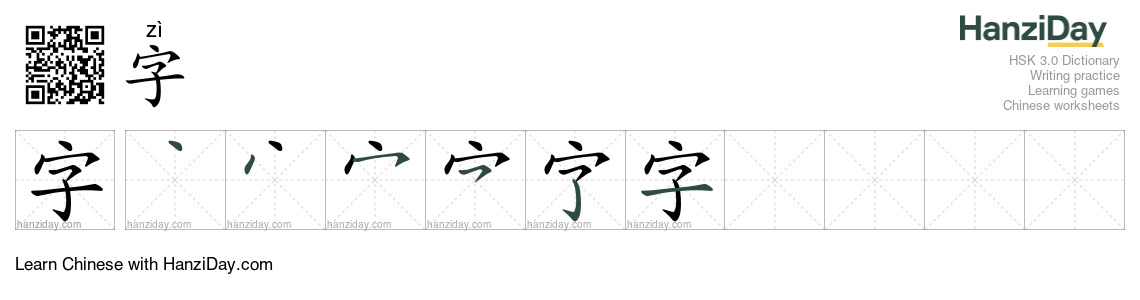
Stroke order
Games & Exercises 9
Find Hanzi
Find Hanzi is a playful exercise for learning Chinese. Spot characters, boost attention, download PDF, and enjoy studying Chinese through games!
Find Radical
Practice Chinese radicals online: choose the Hanzi containing the target component, use optional pinyin hints, and create printable PDF exercises.
Tone Trainer
Learn Mandarin tones online with the Chinese Tone Trainer. Practice tone recognition, pronunciation, and exercises for beginners and advanced learners.
Hanzi Connect
Match Hanzi with pinyin or identify words by sound. Use your own vocabulary or HSK 3.0/YCT levels. Play online after sign-in; printable PDFs with answers are for PRO.
Lost Stroke
Play online: find the missing stroke or radical, restore Chinese characters in order, and create printable PDF worksheets with pinyin and answers.
Calligraphy
Create calligraphy and custom Chinese character coloring pages with pinyin, stroke order, outline styles, and writing grids. Download a print-ready PDF for class or home.
Memo
Flip cards to match Chinese characters or pair Hanzi with Pinyin. Build a custom HSK 3.0 or YCT deck, play online, and create printable PDF cards.
Sudoku
Play Hanzi Sudoku online with 4×4, 6×6, or 9×9 grids, four difficulty levels, custom characters, and HSK 3.0/YCT sets. Create printable PDFs with answers.
Writing trainer
Practice Chinese character writing online with correct stroke order, outlines, a 3–2–1 preview, mistake-based hints, pinyin, and focused Hanzi review.






Examples of use 29
但
是
他
遗
憾
地
发
现
,
几
乎
没
有
一
本
英
文
书
能
充
分
解
释
汉
字
的
字
源
。
However, he regretted to find that almost no English book can fully explain the etymology of Chinese characters.
那
个
人
有
很
多
钱
,
可
以
穿
很
贵
的
皮
毛
,
有
很
多
金
子
,
可
是
不
会
写
字
。
That man has a lot of money, can wear expensive fur, has a lot of gold, but can't write.
我
不
会
读
这
个
字
。
I can't read this word.
我
认
识
的
中
文
字
不
多
,
所
以
读
中
文
报
纸
的
话
会
有
点
困
难
。
I don't know many Chinese characters, so it will be a little difficult to read Chinese newspapers.
我
会
说
汉
语
,
可
是
,
我
不
会
写
汉
字
。
I can speak Chinese, but I can't write Chinese characters.
济
南
的
泉
水
,
历
史
悠
久
,
最
早
的
文
字
记
载
可
以
推
到
3
0
0
0
多
年
前
。
The spring water in Jinan has a long history, and the earliest written records can be pushed back to more than 3,000 years ago.
她
的
名
字
是
小
月
。
Her name is Xiao Yue.
他
的
儿
子
一
岁
,
不
会
写
字
。
His son is one years old, can't write characters.
记
得
写
上
你
的
名
字
Remember to write your name.
她
的
听
力
和
口
语
都
很
好
,
但
是
写
字
不
太
好
。
She is good at listening and speaking, but she is not very good at writing.
一
个
偶
然
的
机
会
,
他
发
现
如
果
了
解
汉
字
的
来
源
和
演
变
过
程
,
再
学
习
它
就
变
得
轻
松
、
容
易
。
By chance, he found that if he understood the origin and evolution of Chinese characters, it would be easy to learn them .
爷
爷
常
常
用
毛
笔
给
我
写
信
,
爷
爷
的
毛
笔
字
写
得
好
极
了
!
Grandpa often writes to me with a brush, and his calligraphy is excellent!
工
作
的
时
候
,
经
常
写
几
十
个
字
,
就
到
院
中
去
转
转
,
看
看
这
棵
,
看
看
那
朵
。
When he works, he often writes dozens of words, then goes around the courtyard and looks at this tree and that flower.
虽
然
中
文
写
字
有
点
难
,
但
是
汉
字
非
常
有
趣
!
Although writing in Chinese is a bit difficult, Chinese characters are very interesting!
你
会
读
这
个
字
吗
?
Can you read this word?
你
写
字
太
马
虎
了
,
看
,
错
了
那
么
多
。
You are too careless in writing. Look, there are so many mistakes.
一
个
美
国
人
的
汉
字
情
缘
An American's Love in Chinese Characters
我
写
错
了
一
个
字
,
能
借
我
一
块
橡
皮
吗
?
I've written a character wrong, could you lend me a rubber?
西
方
人
觉
得
汉
字
很
难
学
。
Westerners find Chinese characters difficult to learn.
我
刚
刚
学
会
这
几
个
字
。
I just learned these words.
你
会
用
毛
笔
写
字
吗
?
Can you write with a brush?
这
个
字
太
难
写
了
,
我
记
不
住
。
This word is so difficult to write that I can't remember it.
字
清
楚
吗
?
Is the character clear?
他
在
学
中
文
,
因
为
他
喜
欢
学
汉
字
。
He is learning Chinese because he likes learning Chinese characters.
他
被
网
友
亲
切
地
称
呼
为
“
汉
字
叔
叔
”
。
He was affectionately called "Uncle Chinese Characters" by netizens.
我
喜
欢
用
铅
笔
写
字
。
I like to write using a pencil.
现
在
小
明
在
学
汉
字
。
Xiao Ming is learning Chinese characters now.
妹
妹
用
铅
笔
写
字
。
My sister writes with a pencil.
这
个
字
要
这
样
写
。
The word should be written like this.
Learn 字 (zì) in context
字 appears here with its available localized meaning and tone-marked pinyin zì. Listen to the pronunciation and review any examples, illustrations, or lexical links shown for this entry.
Use the sections available on this page to compare characters, components, radicals, related words, matching pronunciation, synonyms, or antonyms. HanziDay shows only the information supported by this entry.
字 in HSK 3.0 Level 1
HanziDay organizes HSK 3.0 vocabulary around the new three-stage, nine-level framework. This entry belongs to Level 1; open the level list to study it alongside other vocabulary from the same stage.
Practice the stroke order for 字
Use the stroke animation to follow the writing order, then practice the sequence with the interactive writing tool. After signing in, you can also create a printable worksheet from this entry within your current allowance.