


字
学 : Study, Learn, or School
学 (xué) can mean “to study, learn, or imitate; as a character, it can mean a school, field of learning, or knowledge” in Chinese.
学
TOP-100
Frequency
The ranking is based on data from open sources.
HSK 3.0 · Level 1
Translation
- (v.) study, learn; imitate, mimic
- (char.) subject of study, branch of learning (suffix); school, college; learning, knowledge
Radical
Simplified
学
Traditional
學
Strokes count
8

Words with 学 51
Same pronunciation 8
Similar pronunciation 8
Synonyms 4
Writing and worksheets
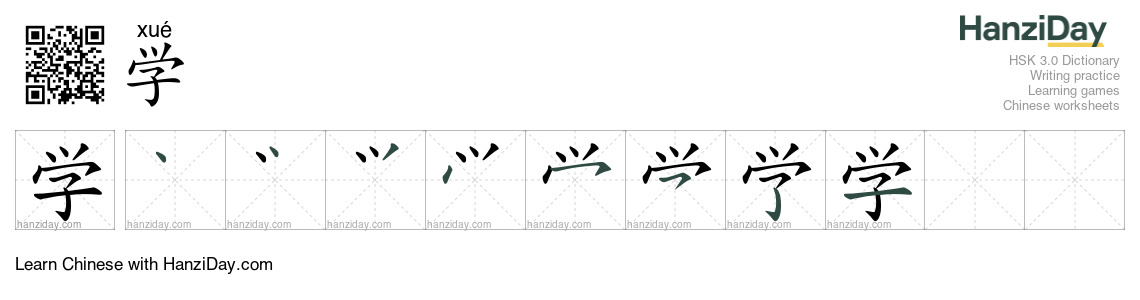
Stroke order
Games & Exercises 9
Find Hanzi
Find Hanzi is a playful exercise for learning Chinese. Spot characters, boost attention, download PDF, and enjoy studying Chinese through games!
Find Radical
Practice Chinese radicals online: choose the Hanzi containing the target component, use optional pinyin hints, and create printable PDF exercises.
Tone Trainer
Learn Mandarin tones online with the Chinese Tone Trainer. Practice tone recognition, pronunciation, and exercises for beginners and advanced learners.
Hanzi Connect
Match Hanzi with pinyin or identify words by sound. Use your own vocabulary or HSK 3.0/YCT levels. Play online after sign-in; printable PDFs with answers are for PRO.
Lost Stroke
Play online: find the missing stroke or radical, restore Chinese characters in order, and create printable PDF worksheets with pinyin and answers.
Calligraphy
Create calligraphy and custom Chinese character coloring pages with pinyin, stroke order, outline styles, and writing grids. Download a print-ready PDF for class or home.
Memo
Flip cards to match Chinese characters or pair Hanzi with Pinyin. Build a custom HSK 3.0 or YCT deck, play online, and create printable PDF cards.
Sudoku
Play Hanzi Sudoku online with 4×4, 6×6, or 9×9 grids, four difficulty levels, custom characters, and HSK 3.0/YCT sets. Create printable PDFs with answers.
Writing trainer
Practice Chinese character writing online with correct stroke order, outlines, a 3–2–1 preview, mistake-based hints, pinyin, and focused Hanzi review.








Examples of use 179
同
学
(n.) classmate, schoolmate
学
生
(n.) student
学
习
(v.) learn, study; follow the example of
学
校
(n.) school
她
有
八
个
中
国
同
学
。
She has eight Chinese classmates.
我
早
上
八
点
钟
上
学
。
I go to school at eight o'clock in the morning.
科
学
馆
每
天
八
点
不
开
门
。
The Science Museum is closed at eight every day.
爸
爸
妈
妈
都
很
关
心
我
们
的
学
习
和
身
体
。
Mom and Dad are very concerned about our study and health.
哲
学
家
们
对
本
体
的
问
题
各
抒
己
见
。
Philosophers have their own opinions on the issue of noumenon.
我
今
天
不
去
学
校
。
I am not going to school today.
网
球
场
离
学
校
不
远
。
The tennis court is not far from the school.
我
的
学
校
离
我
家
不
远
。
My school is not far from my home.
今
天
学
的
跳
舞
动
作
有
点
儿
难
,
我
恐
怕
做
得
不
太
标
准
,
在
比
赛
前
我
还
想
多
练
习
练
习
。
The dance moves I learned today are a bit difficult. I'm afraid I didn't do them very well. I want to practice more before the competition.
我
们
学
校
的
作
业
不
多
也
不
少
。
There is neither much nor much homework in our school.
三
岁
以
下
的
小
朋
友
不
上
学
。
Children under the age of three don't go to school.
部
分
留
学
生
寒
假
不
回
国
,
他
们
打
算
在
中
国
过
春
节
。
Some overseas students don't return home during winter vacation. They plan to spend the Spring Festival in China.
两
个
孩
子
上
学
不
用
接
送
,
做
作
业
不
用
督
促
。
Two children don't need to pick up and drop off when they go to school, and they don't need to
不
管
你
说
错
多
少
次
汉
语
,
你
还
是
要
坚
持
多
说
,
因
为
这
是
学
习
口
语
的
正
确
方
法
。
No matter how many times you make mistakes in Chinese, you should persist on speaking, because this is the correct way to learn spoken Chinese.
老
师
今
天
不
来
学
校
。
The teacher is not coming to school today.
小
云
,
妈
妈
叫
你
放
学
不
要
立
马
走
。
Xiaoyun, your mother told you not to leave immediately after school.
我
学
会
怎
样
点
菜
了
。
I learned how to order.
我
们
学
校
餐
厅
的
饭
菜
非
常
好
吃
。
The food in our school dining room is very delicious.
我
在
学
校
吃
午
饭
。
I have lunch at school.
学
校
的
午
饭
很
好
吃
。
Lunch at school is delicious.
我
太
吃
惊
了
!
我
同
学
竟
然
会
开
飞
机
!
I'm so surprised! My classmate can fly planes!
从
前
,
大
概
在
距
今
两
千
五
百
多
年
前
的
春
秋
时
期
,
有
一
个
人
叫
子
路
,
他
是
孔
子
最
年
长
的
学
生
。
Once upon a time, in the Spring and Autumn Period about 2,500 years ago, there was a man named Zilu, who was the oldest student of Confucius.
我
想
申
请
去
你
那
个
大
学
学
习
。
I want to apply to study at your university.
进
入
大
学
后
,
我
觉
得
自
己
就
像
是
一
只
解
放
了
的
小
鸟
。
After entering the university, I felt like a liberated bird.
班
上
同
学
这
个
学
期
的
进
步
都
很
大
。
All the students in the class have made great progress this term.
我
很
想
去
你
们
学
校
参
观
一
下
图
书
馆
,
听
说
那
儿
又
大
又
漂
亮
。
I really want to visit the library in your school. I heard it is big and beautiful.
长
大
后
我
想
当
一
个
科
学
家
。
I want to be a scientist when I grow up.
我
长
大
了
,
我
是
个
大
学
生
了
。
I have grown up, and I am a college student.
他
在
大
学
学
教
育
学
。
He studied pedagogy at the university.
老
师
说
我
这
个
学
期
进
步
很
大
。
The teacher said that I have made great progress this term.
我
哥
哥
在
武
汉
上
大
学
。
My brother goes to college in Wuhan.
请
你
讲
讲
你
在
大
学
里
的
日
子
,
好
吗
?
Would you please tell me something about your days in college?
他
有
大
学
学
历
。
He has a college degree.
姐
姐
下
个
月
要
去
大
学
报
到
了
。
My sister will report to the university next month.
这
里
的
留
学
生
大
约
有
三
百
个
。
There are approximately three hundred foreign exchange students here.
留
学
生
的
宿
舍
面
积
大
约
是
二
十
五
平
方
米
左
右
。
The dormitory area for overseas students is about 25 square meters.
建
伟
在
大
学
的
一
座
公
寓
楼
里
开
了
一
家
书
店
,
顺
便
卖
点
儿
文
具
、
电
池
、
小
日
用
品
等
。
Jianwei opened a bookstore in an apartment building of the university, selling stationery, batteries and small daily necessities by the way.
听
说
您
孙
子
已
经
读
大
学
了
,
时
间
过
得
真
快
啊
!
I heard that your grandson has gone to college. How time flies!
由
于
这
个
大
学
越
来
越
有
名
,
中
国
学
生
和
外
国
留
学
生
的
数
量
都
在
增
加
。
As the university becomes more and more famous, the number of Chinese students and foreign students is increasing.
他
想
要
在
上
海
上
大
学
。
He wants to go to university in Shanghai.
他
想
在
上
海
上
大
学
。
He wants to go to college in Shanghai.
今
年
我
要
上
大
学
了
。
I'm going to college this year.
你
的
中
文
学
得
怎
样
?
How are you getting on with Chinese?
你
想
学
理
科
的
话
,
有
很
多
课
程
都
可
以
,
比
如
物
理
,
化
学
,
等
等
。
If you want to study science, there are many courses, such as physics, chemistry and so on.
科
学
研
究
证
明
,
女
孩
子
对
衣
服
颜
色
的
选
择
往
往
与
她
们
的
性
格
有
关
。
Scientific research has proven that girls' choice of clothing colour is often related to their personality.
今
天
我
们
学
习
的
内
容
是
第
十
一
课
的
生
词
和
语
法
。
The content we are learning today is the new words and grammar from Lesson 11.
中
国
的
学
生
一
年
有
两
个
长
的
假
期
,
一
个
在
夏
天
,
一
个
在
冬
天
。
Chinese students have two long holidays a year, one in summer and one in winter.
他
是
舞
蹈
专
业
的
学
生
。
He is a dance major.
只
有
认
真
学
习
,
我
的
成
绩
才
能
提
高
。
Only by studying hard can my grades be improved.
我
请
你
来
看
我
们
学
校
的
运
动
会
。
I invite you to come to sports meeting in our school.
我
一
会
儿
要
去
接
我
的
外
孙
女
放
学
了
。
I'm going to pick up my granddaughter from school later.
请
报
名
参
加
活
动
的
同
学
们
都
来
填
一
下
这
张
表
格
。
Please can all the students who have signed up for this activity fill out this form.
我
最
喜
欢
的
科
目
是
数
学
。
My favorite subject is math.
今
年
我
们
要
学
一
门
新
的
外
语
。
We are going to learn a new foreign language this year.
他
的
中
文
学
好
了
,
他
的
自
信
心
也
有
了
。
His Chinese is better, and his self-confidence is better.
家
长
会
在
学
校
的
体
育
馆
开
。
The parents' meeting is held in the school gymnasium.
你
们
学
校
的
学
费
是
多
少
?
How much is the tuition fee in your school?
李
老
师
去
访
问
别
的
学
校
了
。
Miss Li has visited other schools.
今
天
你
是
最
后
一
个
到
学
校
的
!
You are the last one to arrive at school today!
我
是
坐
公
共
汽
车
去
学
校
的
。
I go to school by bus.
京
剧
是
一
种
优
美
的
传
统
艺
术
,
很
多
外
国
留
学
生
对
它
十
分
感
兴
趣
。
Peking Opera is a beautiful traditional art, and many foreign students are very interested in it.
一
个
偶
然
的
机
会
,
他
发
现
如
果
了
解
汉
字
的
来
源
和
演
变
过
程
,
再
学
习
它
就
变
得
轻
松
、
容
易
。
By chance, he found that if he understood the origin and evolution of Chinese characters, it would be easy to learn them .
随
着
中
国
经
济
的
发
展
,
越
来
越
多
留
学
生
选
择
来
中
国
留
学
。
With the development of China's economy, more and more overseas students choose to study in China.
老
师
的
学
生
来
信
了
,
她
很
高
兴
。
She was glad to hear from the teacher's students.
预
习
是
个
好
习
惯
,
它
能
帮
助
我
们
提
前
了
解
要
学
习
的
内
容
。
Preparing for a lesson is a good habit. It can help us find out what to learn in advance.
我
的
学
校
很
近
。
My school is very close.
我
的
学
校
一
共
有
一
千
两
百
个
学
生
。
There are twelve hundred students in my school.
我
的
数
学
考
得
还
可
以
。
I did OK in the math exam.
我
的
学
校
总
共
有
六
百
名
学
生
。
There are six hundred students in my school.
小
学
的
课
包
括
语
文
、
数
学
。
Classes in primary schools include Chinese and mathematics.
在
中
国
,
公
立
学
校
是
什
么
样
的
?
What are public schools like in China?
她
是
我
的
同
学
。
She is my classmate.
你
有
什
么
学
语
法
的
好
方
法
吗
?
Do you have any good ways to learn grammar?
她
的
女
儿
在
中
国
学
书
法
。
Her daughter is studying calligraphy in China.
你
几
点
去
学
校
?
What time do you go to school?
我
觉
得
又
要
学
说
又
要
学
写
有
点
儿
难
。
I find it a bit difficult to learn to write as well as to learn to learn.
周
日
,
我
按
小
学
生
的
作
息
时
间
七
点
起
床
。
On Sunday, I get up at seven o'clock according to the schedule of primary school students.
放
学
后
,
学
校
里
有
点
冷
清
。
After school, the school is a little deserted.
我
这
个
学
期
课
太
多
了
,
每
天
都
非
常
忙
。
I have too many classes this semester, and I am very busy every day.
学
校
每
年
都
会
举
办
中
国
文
化
节
。
The school holds Chinese Culture Festival every year.
我
们
的
班
都
是
根
据
学
员
的
具
体
情
况
设
置
的
。
Our classes are set up according to the specific situation of students.
对
不
起
,
我
今
天
放
学
后
没
空
。
Sorry, I'm not free after school today.
你
们
班
有
多
少
个
学
生
?
How many students does your class have?
你
们
学
校
有
多
少
个
学
生
?
How many students does your school have?
球
场
上
有
很
多
学
生
在
玩
球
。
There are many students playing ball on the court.
你
们
家
距
离
学
校
多
远
?
How far is your home from school?
听
说
他
从
四
岁
就
开
始
学
打
羽
毛
球
,
已
经
练
了
二
十
多
年
了
。
It is said that he has been learning to play badminton since he was four years old and has been practicing it for more than 20 years.
你
中
文
学
了
多
久
了
?
How long have you been learning Chinese?
学
语
言
有
很
多
好
处
。
Learning a language has many advantages.
他
来
中
国
后
,
学
了
很
多
中
文
。
He has learned a lot of Chinese since he came to China.
我
们
学
校
课
外
活
动
多
,
每
个
人
放
学
后
都
很
忙
。
There are many extracurricular activities in our school, and everyone is busy after school.
他
儿
子
在
学
校
上
小
班
。
His son is in a small class at school.
学
校
里
有
一
个
商
店
。
There is a shop in the school.
今
天
学
校
里
有
一
个
晚
会
。
There is a party at school today.
我
每
天
上
学
要
一
个
小
时
。
It takes me an hour to go to school every day.
作
为
一
个
中
学
生
As a high school student↵
我
是
一
个
小
学
生
I am a pupil
就
是
找
一
个
班
插
班
听
课
,
随
意
学
学
而
已
。
Is to find a class to attend classes and learn at will.
我
们
有
一
百
零
五
个
学
生
。
We have 105 students.
我
们
学
校
有
一
万
个
学
生
。
There are ten thousand students in our school.
小
朋
友
,
你
一
个
人
上
学
,
你
妈
妈
放
心
吗
?
Children, you go to school alone, does your mother rest assured?
她
每
个
星
期
三
都
有
科
学
课
。
She has science every Wednesday.
你
一
年
以
前
开
始
学
习
汉
语
了
吗
?
Did you start studying Mandarin a year beforehand?
我
想
学
习
高
级
汉
语
。
I want to learn advanced Chinese.
她
星
期
六
上
午
要
上
网
学
汉
语
。
She will go online to learn Chinese on Saturday morning.
只
要
认
真
地
学
习
,
就
能
提
高
汉
语
水
平
。
As long as you study hard, you can improve your Chinese.
其
实
,
学
习
汉
语
很
有
意
思
。
Actually, learning Chinese is very interesting.
学
习
汉
语
其
实
很
有
意
思
。
Learning Chinese is actually very interesting.
我
在
学
习
汉
语
和
日
语
。
I'm learning Chinese and Japanese.
她
学
得
比
我
好
。
She studies better than me.
姐
姐
打
排
球
打
得
很
好
,
她
在
学
校
放
学
后
常
常
上
排
球
课
。
My sister plays volleyball very well. She often has volleyball lessons after school.
我
和
朋
友
明
天
去
学
校
看
书
。
My friend and I will go to school to read tomorrow.
我
在
学
校
学
中
文
和
法
语
。
I study Chinese and French at school.
我
和
老
公
对
视
一
眼
,
这
么
小
的
孩
子
怎
么
学
会
了
背
后
议
论
人
。
My husband and I looked at each other. How did such a small child learn to talk about people behind his back?
她
和
其
他
志
愿
者
利
用
午
休
、
周
末
等
空
闲
时
间
给
学
生
们
指
导
和
培
训
。
She and other volunteers use their free time such as lunch break and weekend to guide and train the students.
你
和
谁
一
起
去
学
校
?
Who do you go to school with?
她
又
要
英
文
又
要
学
中
文
,
很
忙
。
She needs both English and Chinese, so she is very busy.
她
又
要
学
英
文
又
要
学
中
文
,
很
忙
。
She has to learn both English and Chinese, so she is very busy.
这
个
网
站
对
学
习
很
有
帮
助
。
This website is very helpful for learning.
西
方
人
觉
得
汉
字
很
难
学
。
Westerners find Chinese characters difficult to learn.
快
去
学
校
开
家
长
会
。
Go to the school and have a parent-teacher meeting.
我
们
偶
尔
也
要
学
会
勇
敢
地
拒
绝
别
人
。
We should learn to bravely reject others sometimes.
我
刚
刚
学
会
这
几
个
字
。
I just learned these words.
我
学
会
包
饺
子
了
。
I learned to make dumplings.
他
说
女
儿
念
了
硕
士
,
有
学
位
,
在
一
家
一
流
的
公
司
上
班
。
He said that his daughter has a master's degree and works in a first-class company.
学
校
门
口
新
开
了
一
家
文
具
店
。
A new stationery store has opened at the school gate.
他
上
午
去
学
开
车
了
。
He went to learn to drive this morning.
他
们
在
学
校
看
书
。
They are reading at school.
昨
天
妈
妈
没
有
在
小
学
门
口
看
见
你
。
Mother didn't see you at the primary school gate yesterday.
老
师
,
有
一
位
同
学
出
鼻
血
了
。
Teacher, a classmate has a nosebleed.
最
近
,
老
师
在
使
用
网
络
上
课
,
学
生
也
在
使
用
网
络
学
习
。
Recently, teachers use the internet for classes, and students also use the internet for learning.
我
太
激
动
了
!
我
终
于
申
请
到
奖
学
金
了
。
I'm so excited! I finally earned a scholarship.
我
们
每
天
为
了
通
过
考
试
而
努
力
学
习
。
We study hard every day in order to pass the exam.
我
学
中
文
学
了
一
年
了
。
I have studied Chinese for a year.
放
学
后
,
学
校
里
冷
冷
清
清
。
After school, the school is deserted.
科
学
馆
在
哪
里
?
Where is the Science Museum?
这
个
学
期
我
们
有
六
门
课
。
We have six courses this term.
这
个
学
期
我
们
要
上
六
门
课
。
We are going to have six courses this term.
你
喜
欢
中
国
文
学
吗
?
Do you like Chinese literature?
你
这
个
学
期
学
中
文
吗
?
Are you learning Chinese this term?
你
觉
得
中
文
难
学
吗
?
Do you find Chinese difficult to learn?
班
上
有
一
位
同
学
对
花
粉
过
敏
,
一
位
对
面
粉
过
敏
,
另
一
位
对
花
生
过
敏
,
还
有
一
位
对
尘
土
过
敏
。
其
他
人
都
没
有
什
么
过
敏
。
One student in the class is allergic to pollen, one is allergic to flour, another is allergic to peanuts, and another is allergic to dust. No one else has any allergies.
你
同
学
是
哪
国
人
?
Which country is your classmate from?
你
在
哪
个
学
院
学
习
?
Which college do you study in?
你
们
每
天
怎
么
去
学
校
?
How do you go to school every day?
你
为
什
么
要
学
中
文
?
Why do you want to learn Chinese?
祝
你
学
习
进
步
!
I wish you progress in your study!
你
喜
欢
学
什
么
科
目
?
What subjects do you like to study?
这
个
学
期
你
要
学
几
门
外
语
?
How many foreign languages are you going to learn this term?
你
初
学
棋
,
输
是
正
常
的
。
It is normal for you to lose when you are a beginner in chess.
我
现
在
去
学
校
。
I'm going to school now.
学
生
们
每
个
人
都
有
运
动
服
。
Each of the students has sportswear.
我
们
在
体
育
课
上
学
习
武
术
。
We learn martial arts in physical education class.
学
生
们
每
天
早
上
在
操
场
上
做
运
动
。
The students do sports on the playground every morning.
我
每
天
坐
校
车
上
学
。
I go to school by school bus every day.
我
坐
公
共
汽
车
上
学
。
I go to school by bus.
不
但
要
少
玩
电
脑
,
还
要
认
真
学
习
。
Not only need to play less of computer, but also need to study seriously.↵
他
为
什
么
学
中
文
?
Why does he learn Chinese?
放
学
后
,
我
们
在
什
么
地
方
见
?
Where shall we meet after school?
他
是
小
学
生
。
He is a pupil.
我
弟
弟
是
小
学
生
。
My little brother is a primary school student.
同
学
们
喜
欢
听
说
唱
音
乐
。
Students like to listen to rap music.
他
们
在
一
起
学
课
文
。
They study the text together.
他
在
学
中
文
,
因
为
他
喜
欢
学
汉
字
。
He is learning Chinese because he likes learning Chinese characters.
他
在
数
学
学
院
学
习
。
He studies at the School of Mathematics.
我
在
中
国
留
学
。
I am studying abroad in China.
我
喜
欢
科
学
课
。
I like science.
小
孩
子
喜
欢
快
乐
地
学
习
。
Children like to learn happily
现
在
小
明
在
学
汉
字
。
Xiao Ming is learning Chinese characters now.
学
生
们
在
看
手
机
。
The students are looking at their mobile phones.
这
个
网
站
对
学
习
有
帮
助
。
This website is helpful for learning.
学
校
旁
边
有
一
个
中
国
银
行
。
There is a Bank of China next to the school.
学
中
文
真
有
意
思
!
Learning Chinese is really interesting!
上
学
to go to school | to attend school
大
学
the Great Learning, one of the Four Books 四書|四书[Si4 shu1] in Confucianism
Learn 学 (xué) in context
学 appears here with its available localized meaning and tone-marked pinyin xué. Listen to the pronunciation and review any examples, illustrations, or lexical links shown for this entry.
Use the sections available on this page to compare characters, components, radicals, related words, matching pronunciation, synonyms, or antonyms. HanziDay shows only the information supported by this entry.
学 in HSK 3.0 Level 1
HanziDay organizes HSK 3.0 vocabulary around the new three-stage, nine-level framework. This entry belongs to Level 1; open the level list to study it alongside other vocabulary from the same stage.
Practice the stroke order for 学
Use the stroke animation to follow the writing order, then practice the sequence with the interactive writing tool. After signing in, you can also create a printable worksheet from this entry within your current allowance.