


餐
养 : Raise, Support, or Recuperate
养 (yǎng) can mean “to raise animals, support dependents, give birth, recuperate, maintain, cultivate, acquire, or let hair grow” in Chinese.
养
TOP-1000
Frequency
The ranking is based on data from open sources.
HSK 3.0 · Level 3
Translation
- (v./adj.) keep (pets), raise; support; give birth to; recuperate; maintain; refine; acquire; grow (hair); adoptive
Simplified
养
Traditional
養
Strokes count
9

Words with 养 22
Same pronunciation 6
Similar pronunciation 32
Synonyms 5
Antonyms 3
Writing and worksheets
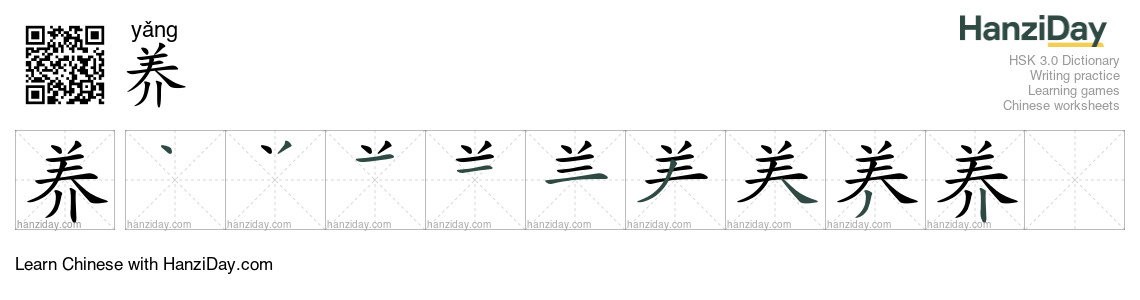
Stroke order
Games & Exercises 9
Find Hanzi
Find Hanzi is a playful exercise for learning Chinese. Spot characters, boost attention, download PDF, and enjoy studying Chinese through games!
Find Radical
Practice Chinese radicals online: choose the Hanzi containing the target component, use optional pinyin hints, and create printable PDF exercises.
Tone Trainer
Learn Mandarin tones online with the Chinese Tone Trainer. Practice tone recognition, pronunciation, and exercises for beginners and advanced learners.
Hanzi Connect
Match Hanzi with pinyin or identify words by sound. Use your own vocabulary or HSK 3.0/YCT levels. Play online after sign-in; printable PDFs with answers are for PRO.
Lost Stroke
Play online: find the missing stroke or radical, restore Chinese characters in order, and create printable PDF worksheets with pinyin and answers.
Calligraphy
Create calligraphy and custom Chinese character coloring pages with pinyin, stroke order, outline styles, and writing grids. Download a print-ready PDF for class or home.
Memo
Flip cards to match Chinese characters or pair Hanzi with Pinyin. Build a custom HSK 3.0 or YCT deck, play online, and create printable PDF cards.
Sudoku
Play Hanzi Sudoku online with 4×4, 6×6, or 9×9 grids, four difficulty levels, custom characters, and HSK 3.0/YCT sets. Create printable PDFs with answers.
Writing trainer
Practice Chinese character writing online with correct stroke order, outlines, a 3–2–1 preview, mistake-based hints, pinyin, and focused Hanzi review.









Examples of use 24
养
成
(v.) form, cultivate
培
养
(v.) to foster, to train, to develop; to cultivate
所
以
,
鸟
儿
非
常
爱
惜
羽
毛
,
每
天
都
会
花
很
长
时
间
来
保
养
自
己
的
“
羽
衣
”
。
Therefore, birds cherish feathers very much and spend a long time maintaining their "feather clothes" every day.
他
们
不
仅
要
观
色
、
闻
香
、
尝
味
、
赏
形
,
而
且
还
要
求
食
物
具
有
养
生
方
面
的
特
色
。
They not only want to watch the color, smell the fragrance, taste the taste and appreciate the shape, but also require the food to have the characteristics of keeping in good health.
可
除
非
是
那
些
好
种
易
活
、
自
己
会
奋
斗
的
花
草
,
否
则
他
是
不
养
的
。
But unless it is those flowers and plants that are easy to live and struggle for themselves, he will not raise them.
可
除
非
是
那
些
好
种
易
活
、
自
己
会
奋
斗
的
花
草
,
否
则
他
是
不
养
的
。
But unless it is those flowers and plants that are easy to live and struggle for themselves, he will not raise them.
我
们
要
多
吃
有
营
养
的
食
物
。
We should eat more nutritious food.
有
的
人
家
喜
欢
种
草
、
养
花
、
种
竹
子
,
有
的
人
家
则
喜
欢
用
大
盆
养
金
鱼
。
Some people like to plant grass, flowers and bamboo, while others like to raise goldfish in big pots.
我
们
应
该
养
成
好
的
习
惯
。
We should form good habits.
沙
浴
也
是
一
些
鸟
儿
喜
欢
的
保
养
方
式
。
Sand bath is also a favorite maintenance method for some birds.
一
来
二
去
,
他
慢
慢
地
总
结
出
一
些
养
花
的
经
验
。
In the long run, he slowly summed up some experience in raising flowers.
我
要
继
续
把
对
手
培
养
好
。
I will continue to train my opponents well.
由
于
人
们
在
一
周
内
的
营
养
摄
入
和
饮
食
模
式
会
影
响
到
他
们
的
体
重
变
化
,
因
此
节
食
者
的
体
重
会
在
一
周
内
上
下
波
动
。
Because people's nutrient intake and diet patterns will affect their weight changes during the week, dieters' weight will fluctuate up and down during the week.
这
种
“
出
汗
”
是
为
了
运
输
养
分
。
This "sweating" is to transport nutrients.
娇
生
惯
养
pampered and spoiled since childhood
母
乳
喂
养
breastfeeding
涵
养
to cultivate (personal qualities) | (of forests etc) to support; to provide a suitable environment for the replenishment of (natural resources: groundwater, animals, plants etc)
养
子
adopted son | foster son
养
家
to support a family | to raise a family
养
病
to recuperate | to convalesce | to take care of one's health after illness
养
路
provide maintenance for a road or railroad
我
在
院
子
里
养
了
三
只
兔
子
。
I keep three rabbits in the yard.
这
马
太
野
了
,
不
好
养
。
This horse is too wild to keep.
养
儿
方
知
父
母
恩
One never knows the love of our parents until one has his/her own child.
Learn 养 (yǎng) in context
养 appears here with its available localized meaning and tone-marked pinyin yǎng. Listen to the pronunciation and review any examples, illustrations, or lexical links shown for this entry.
Use the sections available on this page to compare characters, components, radicals, related words, matching pronunciation, synonyms, or antonyms. HanziDay shows only the information supported by this entry.
养 in HSK 3.0 Level 3
HanziDay organizes HSK 3.0 vocabulary around the new three-stage, nine-level framework. This entry belongs to Level 3; open the level list to study it alongside other vocabulary from the same stage.
Practice the stroke order for 养
Use the stroke animation to follow the writing order, then practice the sequence with the interactive writing tool. After signing in, you can also create a printable worksheet from this entry within your current allowance.