耕
(v.) to plow; to work (for a living), to be bent on
Words with 耗
5
消
耗
(v./n.) consume, use up; consumption
耗
费
(v.) to consume, to spend
噩
耗
(n.) grievous news, sad news (of the death of one's beloved)
耗
时
(adj./v.) time-consuming; take a period of (amount of time)
能
耗
(n.) energy consumption
Same pronunciation
15
号
(n./m.) order, number; size; date; person of a given type; (used to indicate the number of people) | (n./v.) order; brass wind instrument; bugle call; sign, signal mark; (TCM) to feel (the pulse); to give a number to | (n.) assumed name, literary name; name, title; (old) business house, firm | (v.) to howl, roar; to wail
好
(adj.) suitable; well; easy; done; OK, right | (v.) to like, to love, be fond of, be apt to | (adv.) quite, very | (adj.) good; kind, friendly; healthy
恏
to desire
昦
variant of 昊[hao4]
浩
(char.) great, vast, grand; a great many
淏
(literary) (of water) limpid
澔
grand | vast (of water)
灏
vast (of water)
皓
variant of 皓[hao4]
皞
bright | brilliant
秏
variant of 耗[hao4]
薃
Cyperus amuricus
鄗
ancient place name
镐
bright | place name | stove
颢
(literary) white and shining
Similar pronunciation
16
好
(adj.) suitable; well; easy; done; OK, right | (v.) to like, to love, be fond of, be apt to | (adv.) quite, very | (adj.) good; kind, friendly; healthy
号
(n./m.) order, number; size; date; person of a given type; (used to indicate the number of people) | (n./v.) order; brass wind instrument; bugle call; sign, signal mark; (TCM) to feel (the pulse); to give a number to | (n.) assumed name, literary name; name, title; (old) business house, firm | (v.) to howl, roar; to wail
号
roar | cry | CL:個|个[ge4]
嗥
to howl (like a wolf)
嚆
sound | noise
嚎
howl | bawl
壕
moat | (military) trench
毫
(adv./m.) (in the negative) in the least; (unit of length) hao (= 1/3 decimillimetre); (unit of weight) hao (= 0.005 grams) | (char.) fine tapering animal hair; writing brush; milli-
濠
trench
蒿
celery wormwood (Artemisia carvifolia) | to give off | to weed
薅
to weed | to grip or clutch
蚝
oyster
諕
to intimidate
譹
to shout | to roar | to terrify | swiftly
豪
(char.) person of extraordinary powers or endowments; bold and unconstrained; rich and powerful; bullying; proud
郝
ancient place name | surname Hao
Synonyms
50
分
(m.) minute (unit of time); unit of length, area or weight; unit of interest rate; unit for expressing fractions and percentages | (n.) point, mark; fraction; one-tenth; one tenth (of units of the metric system) | (v.) divide, separate; distribute or allot (to); differentiate, tell apart | (n.) part, component; scope of one's duty or right; factor concerning luck or talent or affection | (m.) fen, the monetary unit of China
叫
(v.) to shout; to name, to be called; to call or summon | (v.) (of animals) to cry, to scream | (v.) to make ...(do...); to ask, to order; to permit, to allow | (prep.) by (introducing the agent in a passive sentence)
开
(v.) open; switch on; be on; drive; have (a meeting); write out; to prescribe | (m.) carat, karat (measurement of purity of gold) | (v.) open up, reclaim; (of flowers) open out; come loose; run, set up; lift (a ban, restriction) | (v.) to pay (wages); to fire (sb.); (of water) to be boiled; to divide into | (v.) used after a verb to indicate separation or departure, the beginning of an action, spreading, capacity, resignation or popularity
给
(v.) give, grant; make...suffer; make, allow, let | (prep.) for, to (indicating the recipient of an action); (followed by 我 in imperative sentences, indicating emphasis) | (prep.) to (after a verb indicating handing over of sth.); by, with (in passive sentences) | (char.) to supply, to provide; abundant, ample, well provided for
等
(v.) wait | (n./m.) grade, rank; kind, type | (char.) equal in number or degree | (conj.) until, when | (aux.) and so on, and so forth, etc.; indicating the end of an enumeration
信
(n.) letter; message, news | (v./adv.) believe; profess faith in (a religion); at will, without a plan | (char.) true, real; trustworthy; evidence; trust, faith; fuse
被
(n./prep.) quilt; by (used to indicate the passive voice) | (char.) to cover (with); to suffer (from)
气
(n./v.) gas; air; breath; to get angry; to enrage, to make...angry | (radical.) steam | (n.) (TCM) qi, chi (an active principle forming part of any living thing in the traditional culture) | (char.) weather; smell; spirit, morale; airs, manners; bullying, insult
传
(v.) to transfer, to pass on, to transmit, to spread | (v.) to conduct, to express, to be contagious, to summon | (n.) biography; commentaries on classics; used in titles of story or novel
减
弱
to weaken; to diminish
压
缩
(v.) compress, condense, reduce
啦
sentence-final particle, contraction of 了啊, indicating exclamation | particle placed after each item in a list of examples
泡
(v.) to steep, to soak, to brew; (of a man) to court, to flirt with, to pick up (a woman) | (adj.) (dialect) spongy | (v.) to kill (the time), to loaf about | (n.) bubble; bubble-shaped thing | (char./m.) something soft and puffy; (dialect) small lake; measure word for the number of excretions (slightly vulgar)
砍
(v.) cut, chop, hack; (dialect) to throw sth. at... | (v.) to cut down, to cut off, to bargain
线
索
(n.) clue, thread, clew
削
(v.) pare with a knife, cut, chop | (char.) (used in a compound word or phrase) to pare, to whittle; to reduce; to remove
削
减
(v.) cut (down), reduce, slash
削
弱
(v.) weaken, cripple, abate
延
缓
(v.) delay, postpone, put off
延
误
(v.) to incur loss through delay, to delay resulting in some kind of loss
提
前
(adv.) in advance, ahead of schedule | (v.) bring forward (a date)
产
(char.) to generate, to produce, to yield; product | (v.) to give birth to, to bear, to be delivered of | (char.) property, estate | (v.) to make, to manufacture, to create
储
(v.) to store up, to save | (n.) person who will take the throne, heir
哺
(v.) feed, nurse (a baby) | (char.) (lit.) food being chewed in one's mouth
提
早
ahead of schedule | sooner than planned | to bring forward (to an earlier time)
耗 appears here with its available localized meaning and tone-marked pinyin hào. Listen to the pronunciation and review any examples, illustrations, or lexical links shown for this entry.
Use the sections available on this page to compare characters, components, radicals, related words, matching pronunciation, synonyms, or antonyms. HanziDay shows only the information supported by this entry.
耗 in HSK 3.0 Levels 7–9
HanziDay organizes HSK 3.0 vocabulary around the new three-stage, nine-level framework. This entry belongs to Levels 7–9; open the level list to study it alongside other vocabulary from the same stage.
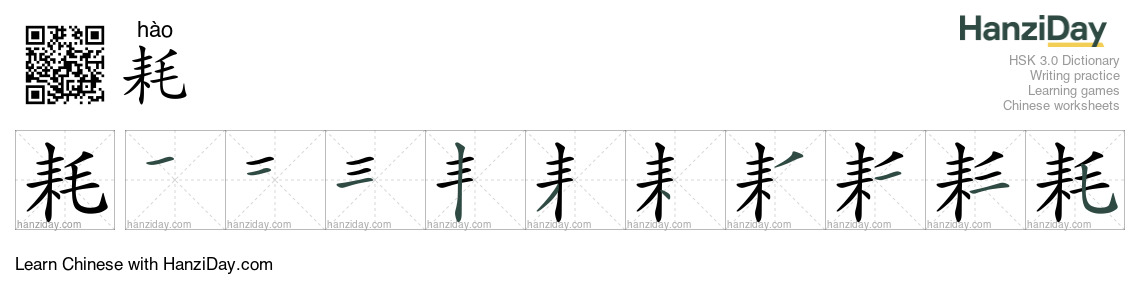
Practice the stroke order for 耗
Use the stroke animation to follow the writing order, then practice the sequence with the interactive writing tool. After signing in, you can also create a printable worksheet from this entry within your current allowance.