


龙
Learn 老 — HSK 3.0 Level 3
老
TOP-500
Frequency
The ranking is based on data from open sources.
HSK 3.0 · Level 3
HSK 3.0 · Level 4
YCT 4
Translation
- (adj.) old, aged; of long standing, old fashioned, outdated; former, original; (of colors) dark; (of vegetable) overgrown; (of food) overcooked
- (adv.) often, regularly; for a long time; very
- (radical.) old
- (char.) old people; experienced; (prefix for) names of animals, plants, surnames
Simplified
老
Traditional
老
Strokes count
6
Words with 老 24
Same pronunciation 9
Similar pronunciation 23
Synonyms 99
Antonyms 6
Writing and worksheets
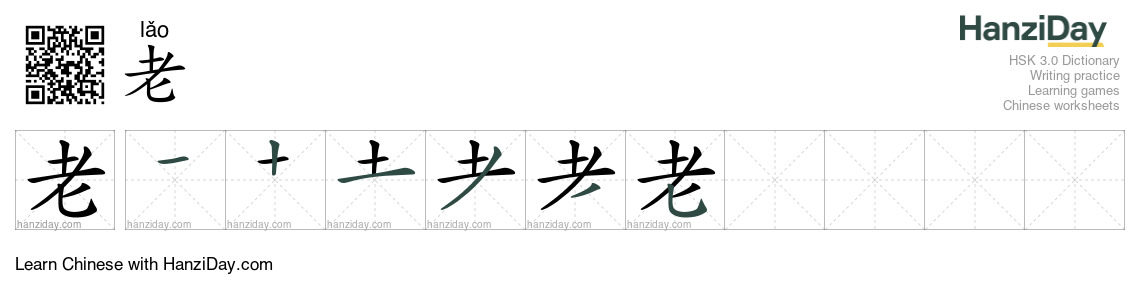
Stroke order
Games & Exercises 9
Find Hanzi
Find Hanzi is a playful exercise for learning Chinese. Spot characters, boost attention, download PDF, and enjoy studying Chinese through games!
Find Radical
Practice Chinese radicals online: choose the Hanzi containing the target component, use optional pinyin hints, and create printable PDF exercises.
Tone Trainer
Learn Mandarin tones online with the Chinese Tone Trainer. Practice tone recognition, pronunciation, and exercises for beginners and advanced learners.
Hanzi Connect
Match Hanzi with pinyin or identify words by sound. Use your own vocabulary or HSK 3.0/YCT levels. Play online after sign-in; printable PDFs with answers are for PRO.
Lost Stroke
Play online: find the missing stroke or radical, restore Chinese characters in order, and create printable PDF worksheets with pinyin and answers.
Calligraphy
Create calligraphy and custom Chinese character coloring pages with pinyin, stroke order, outline styles, and writing grids. Download a print-ready PDF for class or home.
Memo
Flip cards to match Chinese characters or pair Hanzi with Pinyin. Build a custom HSK 3.0 or YCT deck, play online, and create printable PDF cards.
Sudoku
Play Hanzi Sudoku online with 4×4, 6×6, or 9×9 grids, four difficulty levels, custom characters, and HSK 3.0/YCT sets. Create printable PDFs with answers.
Writing trainer
Practice Chinese character writing online with correct stroke order, outlines, a 3–2–1 preview, mistake-based hints, pinyin, and focused Hanzi review.









Examples of use 93
老
舍
很
有
爱
心
,
更
懂
得
快
乐
要
分
享
。
Lao She is very caring and knows how to share happiness.
马
老
师
的
电
话
号
码
是
一
三
九
零
五
五
七
九
八
四
三
Teacher Ma's telephone number is one three nine zero five five seven nine eight four three
老
板
,
能
不
能
稍
微
便
宜
一
点
儿
,
再
打
个
八
折
吧
!
Boss, can you make it a little cheaper and make another 20% discount?
我
们
的
爸
爸
是
老
师
。
Our father is a teacher.
请
你
把
这
本
书
交
给
王
老
师
,
好
吗
?
Would you please give this book to Miss Wang?
老
师
跟
我
讲
道
理
,
他
要
我
明
白
为
什
么
不
可
以
这
样
做
。
The teacher reasoned with me. He asked me to understand why I couldn't do this.
老
师
,
不
好
意
思
,
我
没
有
表
格
,
你
能
给
我
一
张
吗
?
Teacher, I'm sorry, I don't have a form. Can you give me one?
我
做
错
了
事
,
老
师
警
告
我
说
,
以
后
一
定
不
可
以
再
这
样
了
。
I did something wrong, and the teacher warned me that I must not do it again in the future.
老
师
不
好
。
The teacher is not good.
张
老
师
出
去
了
,
不
在
办
公
室
。
Miss Zhang is out, not in the office.
马
老
师
不
在
家
。
Miss Ma is not at home.
由
于
意
见
不
一
样
,
所
以
两
位
老
板
都
不
高
兴
。
Both bosses are unhappy because of their different opinions.
看
到
大
象
悲
惨
的
样
子
,
老
鼠
不
忍
下
手
。
Seeing the elephant's miserable appearance, the mouse couldn't bear to start.
今
天
老
张
开
会
的
时
候
不
停
地
看
手
机
,
可
能
有
什
么
重
要
的
事
情
吧
。
Today, Lao Zhang kept looking at his mobile phone during the meeting. Maybe there is something important.
在
很
多
人
看
来
,
只
有
年
轻
人
才
会
网
上
购
物
,
其
实
不
少
老
年
人
也
会
。
In the eyes of many people, only young people can shop online, in fact so can many old people.
如
果
有
不
懂
的
地
方
,
一
定
要
问
老
师
。
If there is something you don't understand, you must ask the teacher.
老
师
今
天
不
来
学
校
。
The teacher is not coming to school today.
很
多
老
年
人
喜
欢
在
这
里
喝
茶
。
Many old people like to drink tea here.
星
期
五
中
午
老
师
常
常
吃
炒
面
。
The teacher often eats fried noodles at noon on Friday.
他
忽
然
发
现
远
处
蹲
着
一
只
大
老
虎
。
He suddenly found a big tiger crouching in the distance.
给
大
卫
上
过
课
的
老
师
们
普
遍
反
映
他
的
表
现
很
好
,
只
是
偶
尔
会
迟
到
。
The teachers who taught David generally reported that he performed well, but occasionally he was late.
请
大
家
严
格
按
照
老
师
的
要
求
按
时
完
成
作
业
,
这
对
提
高
汉
语
水
平
有
帮
助
。
Please finish your homework on time in strict accordance with the teacher's requirements, this would help to improve your Chinese.
老
师
说
我
这
个
学
期
进
步
很
大
。
The teacher said that I have made great progress this term.
动
物
园
里
有
老
虎
和
大
熊
猫
。
There are tigers and giant pandas in the zoo.
老
鼠
乘
机
跑
进
大
象
的
鼻
子
中
,
准
备
实
施
它
的
计
划
。
The mouse took the opportunity to run into the elephant's nose, ready to carry out its plan.
老
师
给
我
写
了
一
些
大
概
的
建
议
,
我
觉
得
很
有
帮
助
。
The teacher wrote me some general suggestions, which I think is very helpful.
我
看
她
总
是
笑
着
回
答
老
师
的
问
题
。
In my opinion, she always answers the teacher's questions with a smile.
这
位
是
我
的
老
师
。
This is my teacher.
通
过
老
人
的
介
绍
,
鲍
全
从
龙
王
那
儿
求
到
了
治
病
救
人
的
白
玉
壶
。
Through the introduction of the old man, Bao Quan asked the Dragon King for a white jade pot to cure diseases and save people.
我
们
的
老
师
姓
陈
吗
?
Is our teacher's last name Chen?
那
是
他
的
汉
语
老
师
。
That's his Chinese teacher.
我
们
的
老
师
是
中
国
人
。
Our teacher is Chinese.
一
个
教
室
是
汉
语
老
师
的
。
One classroom belongs to the Chinese teacher.
今
天
老
师
上
课
的
问
题
我
答
对
了
!
I answered the teacher's question correctly today!
他
是
我
最
尊
重
的
一
个
老
师
。
He is one of the teachers I respect the most.
我
的
老
家
风
景
如
画
。
My hometown is picturesque.
她
是
一
位
有
名
的
老
师
。
She is a famous teacher.
老
鼠
是
山
神
的
宠
物
,
它
厌
倦
了
宠
物
的
生
活
,
也
很
厌
恶
宠
物
这
个
角
色
。
Mouse is the pet of mountain god. It is tired of pet life and hates the role of pet.
那
个
不
是
我
的
新
老
师
。
That one is not my new teacher.
李
老
师
去
访
问
别
的
学
校
了
。
Miss Li has visited other schools.
我
很
喜
欢
新
来
的
美
术
老
师
,
现
在
美
术
课
是
我
最
喜
欢
的
课
了
。
I like the new art teacher very much. Now art class is my favorite class.
老
鼠
发
觉
它
对
山
神
的
承
诺
是
多
么
草
率
。
The mouse realized how hasty his promise to the mountain god was.
他
是
我
的
日
语
老
师
。
He is my Japanese teacher.
你
的
新
老
师
姓
李
,
是
吗
?
Your new teacher's last name is Li, is that right?
那
是
我
们
的
老
师
。
That's our teacher.
我
们
的
姐
姐
是
老
师
,
Our sister is a teacher,
我
把
手
机
它
老
人
家
伺
候
得
好
好
的
。
I took good care of my mobile phone.
老
师
的
学
生
来
信
了
,
她
很
高
兴
。
She was glad to hear from the teacher's students.
给
他
上
过
课
的
老
师
们
普
遍
反
映
他
的
表
现
很
好
,
只
是
偶
尔
会
迟
到
。
Teachers who gave him lessons generally reported that he performed well, only occasionally being late.
他
是
一
个
来
自
中
国
的
老
师
。
He is a teacher from China.
小
丽
请
假
了
,
为
了
去
见
她
的
老
朋
友
。
Xiaoli asked for leave in order to meet her old friend.
以
前
有
一
个
中
国
老
师
,
他
教
过
我
一
点
儿
功
夫
,
我
表
演
给
你
看
看
。
I used to have a Chinese teacher who taught me a little kung fu. I'll show you.
每
年
我
都
回
老
家
过
年
。
Every year I go back to my hometown for the New Year.
她
们
都
是
新
老
师
。
h v j g c g chjhjkj
对
不
起
,
老
师
,
我
没
听
懂
。
Sorry, sir, I didn't understand.
老
李
家
今
天
来
了
很
多
人
。
Many people came to Lao Li's family today.
老
师
为
我
们
日
夜
工
作
,
付
出
了
很
多
。
The teacher worked day and night for us and paid a lot.
老
师
让
我
参
加
了
一
个
武
术
俱
乐
部
。
The teacher made me join a martial arts club.
我
有
五
个
汉
语
老
师
。
I have five Chinese teachers.
我
们
班
有
五
个
老
师
。
Our class has five teachers.
我
们
班
有
两
个
张
老
师
。
Our class has two teachers called Mr Zhang.
我
们
班
来
了
一
个
新
老
师
。
A new teacher came to our class.
我
有
两
个
新
老
师
,
一
个
姓
李
,
一
个
姓
王
。
I have two new teachers, one with the surname Li and the other with the surname Wang.
你
老
师
有
一
个
哥
哥
。
Your teacher has a brother.
老
师
有
四
个
新
朋
友
。
The teacher has four new friends.
四
个
老
师
。
Four teachers.
老
师
很
好
。
The teacher is very well.
由
于
家
里
老
人
突
然
生
病
,
我
只
好
放
弃
出
国
。
I had to give up going abroad due to an old family member suddenly falling ill.
老
师
好
hello, teacher
老
师
你
好
!
Hello, teacher!
他
非
常
想
念
老
家
和
亲
人
。
He misses his hometown and relatives very much.
我
和
老
公
对
视
一
眼
,
这
么
小
的
孩
子
怎
么
学
会
了
背
后
议
论
人
。
My husband and I looked at each other. How did such a small child learn to talk about people behind his back?
这
个
春
节
你
回
老
家
过
吗
?
Have you been back to your hometown this Spring Festival?
老
师
们
今
天
下
午
要
开
会
。
The teachers will have a meeting this afternoon.
马
老
师
在
家
。
Miss Ma is at home.
马
老
师
在
家
吗
?
Is Miss Ma at home?
今
天
老
师
有
没
有
提
这
件
事
?
Did the teacher mention it today?
翻
来
覆
去
瞎
折
腾
,
心
烦
意
乱
得
无
法
容
忍
,
白
天
又
老
是
犯
困
。
Tossing and turning, intolerably upset, and always sleepy during the day.
她
是
老
师
。
She is a teacher.
我
相
信
老
师
,
也
相
信
自
己
!
I believe in teachers and myself!
请
问
是
李
老
师
吗
?
May I ask, is this Teacher Li?
我
们
去
问
老
师
吧
。
Let's ask the teacher.
李
小
姐
是
老
师
。
Miss Li is a teacher.
你
爷
爷
是
老
师
吗
?
Is your grandfather a teacher?
老
师
,
有
一
位
同
学
出
鼻
血
了
。
Teacher, a classmate has a nosebleed.
他
是
英
国
老
师
。
He is a British teacher.
最
近
,
老
师
在
使
用
网
络
上
课
,
学
生
也
在
使
用
网
络
学
习
。
Recently, teachers use the internet for classes, and students also use the internet for learning.
您
为
什
么
选
择
老
师
这
个
职
业
?
Why did you choose this teaching career?
老
师
说
从
这
里
上
台
,
从
那
里
下
台
。
The teacher said to go on stage from here and step down from there.
我
喜
欢
主
动
问
老
师
问
题
。
I like to take the initiative to ask teachers questions.
那
是
老
师
。
That's the teacher.
你
找
到
王
老
师
了
吗
?
Have you found Miss Wang?
老
鼠
几
乎
耗
费
了
全
部
力
气
。
The mouse spent almost all its strength.
Learn 老 (lǎo) in context
老 appears here with its available localized meaning and tone-marked pinyin lǎo. Listen to the pronunciation and review any examples, illustrations, or lexical links shown for this entry.
Use the sections available on this page to compare characters, components, radicals, related words, matching pronunciation, synonyms, or antonyms. HanziDay shows only the information supported by this entry.
老 in HSK 3.0 Level 3
HanziDay organizes HSK 3.0 vocabulary around the new three-stage, nine-level framework. This entry belongs to Level 3; open the level list to study it alongside other vocabulary from the same stage.
Practice the stroke order for 老
Use the stroke animation to follow the writing order, then practice the sequence with the interactive writing tool. After signing in, you can also create a printable worksheet from this entry within your current allowance.