


迸
Learn 进 — HSK 3.0 Level 2
进
Translation
- (v.) enter; march forward; submit; recruit, receive; (after a verb) go into, go in
Radical
Simplified
进
Traditional
進
Strokes count
7

Words with 进 27
Same pronunciation 22
Similar pronunciation 28
Synonyms 1
Antonyms 3
Writing and worksheets
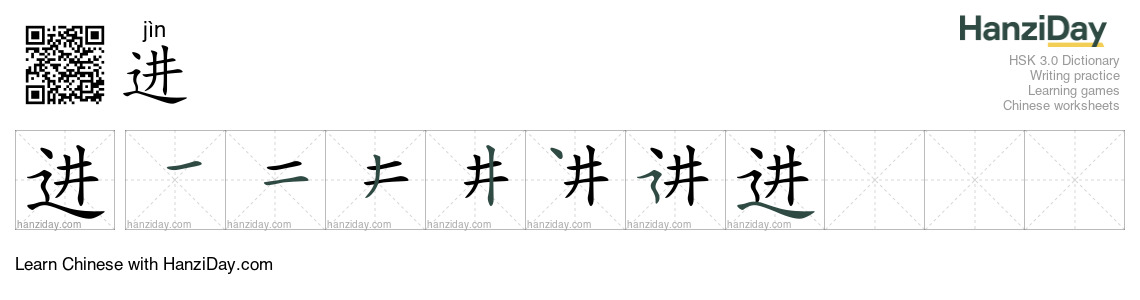
Stroke order
Games & Exercises 9
Find Hanzi
Find Hanzi is a playful exercise for learning Chinese. Spot characters, boost attention, download PDF, and enjoy studying Chinese through games!
Find Radical
Practice Chinese radicals online: choose the Hanzi containing the target component, use optional pinyin hints, and create printable PDF exercises.
Tone Trainer
Learn Mandarin tones online with the Chinese Tone Trainer. Practice tone recognition, pronunciation, and exercises for beginners and advanced learners.
Hanzi Connect
Match Hanzi with pinyin or identify words by sound. Use your own vocabulary or HSK 3.0/YCT levels. Play online after sign-in; printable PDFs with answers are for PRO.
Lost Stroke
Play online: find the missing stroke or radical, restore Chinese characters in order, and create printable PDF worksheets with pinyin and answers.
Calligraphy
Create calligraphy and custom Chinese character coloring pages with pinyin, stroke order, outline styles, and writing grids. Download a print-ready PDF for class or home.
Memo
Flip cards to match Chinese characters or pair Hanzi with Pinyin. Build a custom HSK 3.0 or YCT deck, play online, and create printable PDF cards.
Sudoku
Play Hanzi Sudoku online with 4×4, 6×6, or 9×9 grids, four difficulty levels, custom characters, and HSK 3.0/YCT sets. Create printable PDFs with answers.
Writing trainer
Practice Chinese character writing online with correct stroke order, outlines, a 3–2–1 preview, mistake-based hints, pinyin, and focused Hanzi review.







Examples of use 40
这
辆
车
是
从
日
本
进
口
的
。
This car is imported from Japan.
利
用
大
数
据
对
一
个
病
种
进
行
细
致
的
监
测
,
意
义
是
不
言
而
喻
的
。
The significance of using big data to monitor a disease carefully is self-evident.
你
不
能
进
,
这
里
是
出
口
。
You can't enter. This is the exit.
进
入
美
国
的
时
候
,
有
一
些
东
西
是
不
能
带
的
。
When you enter America, there are some things you can't take with you.
我
可
以
乘
大
象
不
注
意
,
进
到
大
象
鼻
子
里
去
。
I can take the elephant without paying attention and go into the elephant's nose.
运
动
健
身
要
循
序
渐
进
,
不
要
急
于
求
成
。
Exercise and fitness should be carried out step by step, and don't rush for success.
当
大
导
演
进
一
步
询
问
原
因
时
,
当
地
人
的
回
答
令
他
受
益
终
生
。
When the director asked further why, the local people's answers benefited him all his life.
会
议
已
经
进
行
了
两
个
多
小
时
,
大
家
还
在
认
真
地
讨
论
这
个
问
题
。
The meeting has been going on for more than two hours, and everyone is still discussing this issue seriously.
进
入
大
学
后
,
我
觉
得
自
己
就
像
是
一
只
解
放
了
的
小
鸟
。
After entering the university, I felt like a liberated bird.
班
上
同
学
这
个
学
期
的
进
步
都
很
大
。
All the students in the class have made great progress this term.
老
师
说
我
这
个
学
期
进
步
很
大
。
The teacher said that I have made great progress this term.
老
鼠
乘
机
跑
进
大
象
的
鼻
子
中
,
准
备
实
施
它
的
计
划
。
The mouse took the opportunity to run into the elephant's nose, ready to carry out its plan.
从
2
0
世
纪
8
0
年
代
起
,
比
尔
•
盖
茨
每
年
都
要
进
行
两
次
为
期
一
周
的
“
闭
关
”
。
Since 1980s, Bill Gates has conducted two one-week "retreat" every year.
这
个
咖
啡
是
美
国
进
口
的
。
This coffee is imported from America.
经
过
艰
苦
的
试
验
,
电
影
拍
摄
技
术
逐
渐
改
进
、
成
熟
。
After hard experiments, the film shooting technology gradually improved and matured.
把
几
条
沙
丁
鱼
的
天
敌
鲇
鱼
放
进
装
鱼
的
设
备
中
。
Put a few catfish, the natural enemy of sardines, into the fish loading equipment.
我
已
经
住
进
新
家
了
。
I have already moved into the new house.
进
去
时
,
我
要
出
示
什
么
东
西
吗
?
Shall I show you anything when I go in?
祝
你
学
习
进
步
!
I wish you progress in your study!
请
进
!
Come in!
前
进
to go forward | to forge ahead | to advance | onward
请
进
"please come in"
跳
进
to plunge into | to jump into
进
来
to come in
进
去
to go in
进
献
to offer as tribute
进
站
(of a train, bus etc) to pull into a station; to arrive at a stop | (of a person) to enter a station | to visit a website | to formally begin a temporary postdoctoral research position (China has postdoctoral research "stations" 博士後流動站|博士后流动站[bo2 shi4 hou4 liu2 dong4 zhan4] where postdocs conduct research for a limited period.)
进
货
to acquire stock | to replenish stock
进
门
to enter a door | to go in | to learn the basics of a subject | to join one's husband's household upon marriage
你
一
进
门
,
我
就
看
见
你
了
。
The very moment you came in, I saw you.
我
进
去
的
时
候
,
会
议
正
在
进
行
。
When I went in, the meeting was in progress.
妈
妈
把
礼
物
放
进
袜
子
里
。
Mother put the gifts into stockings.
双
方
各
进
一
球
。
Both of the two sides got one goal respectively.
火
车
进
站
了
。
The train has drawn into the station.
脑
子
进
水
了
have water flowed into one's mind (means there is something wrong in one's mind or have said/done something silly or abnormal)
我
们
进
去
吧
。
Let's go inside.
可
以
进
来
吗
?
May I come in?
进
步
很
大
make great progress
进
屋
前
请
脱
鞋
。
Before coming into the house, please take off your shoes.
财
源
广
进
(auspicious words) Money and treasures will be plentiful, make plenty of money
Learn 进 (jìn) in context
进 appears here with its available localized meaning and tone-marked pinyin jìn. Listen to the pronunciation and review any examples, illustrations, or lexical links shown for this entry.
Use the sections available on this page to compare characters, components, radicals, related words, matching pronunciation, synonyms, or antonyms. HanziDay shows only the information supported by this entry.
进 in HSK 3.0 Level 2
HanziDay organizes HSK 3.0 vocabulary around the new three-stage, nine-level framework. This entry belongs to Level 2; open the level list to study it alongside other vocabulary from the same stage.
Practice the stroke order for 进
Use the stroke animation to follow the writing order, then practice the sequence with the interactive writing tool. After signing in, you can also create a printable worksheet from this entry within your current allowance.