


山
Learn 出 — HSK 3.0 Level 2
出
Translation
- (v.) go out, to exceed, give out, to produce, to occur, to happen, to publish, put forth
- (char.) to appear, be present; to expend, to pay
- (v.) (used after a verb indicating) going out, appearing, finishing
- (m.) (measure word for plays or chapters of classical novels, or pieces in a drama)
Radical
Simplified
出
Traditional
出
Strokes count
5

Words with 出 75
Same pronunciation 5
Similar pronunciation 45
Synonyms 1
Antonyms 4
Writing and worksheets
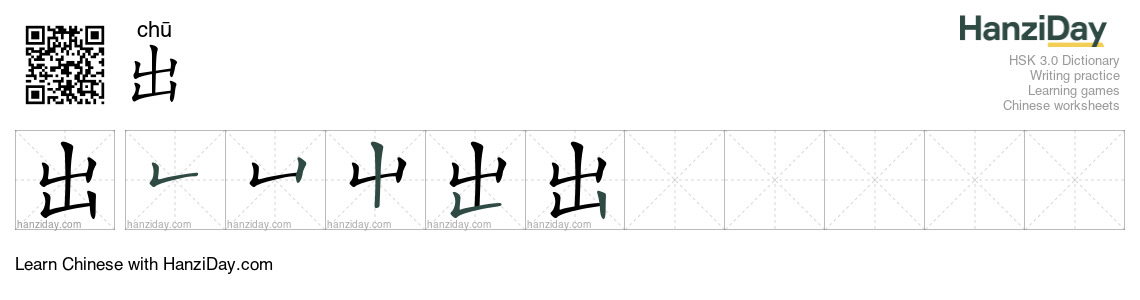
Stroke order
Games & Exercises 9
Find Hanzi
Find Hanzi is a playful exercise for learning Chinese. Spot characters, boost attention, download PDF, and enjoy studying Chinese through games!
Find Radical
Practice Chinese radicals online: choose the Hanzi containing the target component, use optional pinyin hints, and create printable PDF exercises.
Tone Trainer
Learn Mandarin tones online with the Chinese Tone Trainer. Practice tone recognition, pronunciation, and exercises for beginners and advanced learners.
Hanzi Connect
Match Hanzi with pinyin or identify words by sound. Use your own vocabulary or HSK 3.0/YCT levels. Play online after sign-in; printable PDFs with answers are for PRO.
Lost Stroke
Play online: find the missing stroke or radical, restore Chinese characters in order, and create printable PDF worksheets with pinyin and answers.
Calligraphy
Create calligraphy and custom Chinese character coloring pages with pinyin, stroke order, outline styles, and writing grids. Download a print-ready PDF for class or home.
Memo
Flip cards to match Chinese characters or pair Hanzi with Pinyin. Build a custom HSK 3.0 or YCT deck, play online, and create printable PDF cards.
Sudoku
Play Hanzi Sudoku online with 4×4, 6×6, or 9×9 grids, four difficulty levels, custom characters, and HSK 3.0/YCT sets. Create printable PDFs with answers.
Writing trainer
Practice Chinese character writing online with correct stroke order, outlines, a 3–2–1 preview, mistake-based hints, pinyin, and focused Hanzi review.







Examples of use 60
出
席
(v.) to attend, be present at a banquet, etc.
只
有
爸
爸
妈
妈
才
能
分
出
来
她
们
姐
妹
两
个
人
。
Only Mum and Dad can tell the sisters apart.
我
和
爸
爸
妈
妈
今
天
出
去
看
灯
会
了
。
My parents and I went out to watch the lantern show today.
妈
妈
不
在
家
,
她
和
爸
爸
出
门
了
。
Mum is not home. She and Dad have gone out.
那
么
多
人
,
弟
弟
一
下
子
就
把
爸
爸
找
出
来
了
,
弟
弟
的
眼
力
真
好
!
So many people, my brother found out my father at once, and my brother's eyesight is really good!
爸
爸
不
在
家
,
他
出
去
了
。
Dad is not at home. He is out.
他
怕
万
一
选
错
了
,
要
付
出
很
大
的
时
间
成
本
和
经
济
成
本
。
He is afraid that if he makes a wrong choice, he will pay a lot of time and economic costs.
也
许
有
人
认
为
,
在
这
种
情
况
下
根
本
不
可
能
分
辨
出
来
。
Some people may think that it is impossible to distinguish in this case.
妈
妈
有
一
个
出
国
的
机
会
,
去
日
本
工
作
,
可
是
她
没
去
。
Mother had a chance to go abroad and work in Japan, but she didn't go.
你
不
能
进
,
这
里
是
出
口
。
You can't enter. This is the exit.
在
面
试
的
时
候
千
万
不
能
害
羞
,
应
该
努
力
表
现
出
自
己
的
优
点
。
Don't be shy during the interview, you should try your best to show your strengths.
奶
奶
喜
欢
在
家
里
,
不
喜
欢
外
出
。
Grandma prefers being at home to going out.
张
老
师
出
去
了
,
不
在
办
公
室
。
Miss Zhang is out, not in the office.
到
期
限
造
不
出
箭
,
他
就
活
该
受
罚
了
。
If he can't make an arrow by the deadline, he deserves to be punished.
明
天
刮
大
风
,
我
不
想
出
门
。
It will be windy tomorrow, so I don't want to go out.
这
个
茶
是
要
出
口
到
很
多
国
家
的
。
This tea is to be exported to many countries.
我
们
今
天
要
出
去
吃
饭
。
We're going out for dinner today.
李
先
生
是
坐
出
租
车
去
饭
店
的
吗
?
Does Mr. Li go to the hotel by taxi?
一
天
,
他
让
士
兵
们
去
找
一
头
大
象
和
一
些
出
生
时
眼
睛
就
瞎
了
的
人
回
来
。
One day, he asked the soldiers to find an elephant and some people who were blind at birth.
绳
子
终
于
被
咬
断
了
,
巨
网
出
现
了
一
个
大
缺
口
。
The rope was finally bitten, and a big gap appeared in the giant net.
高
峰
之
后
,
终
点
出
现
得
越
迅
速
,
这
件
事
留
给
我
们
的
印
象
就
越
深
刻
。
After the peak, the faster the end point appears, the more impressive it will leave us.
鸟
虫
发
出
的
声
音
让
我
的
听
觉
无
法
停
下
。
The sound of birds and insects makes my hearing unable to stop.
近
年
来
,
市
场
上
出
现
了
一
种
新
的
电
子
产
品
,
名
为
“
光
闹
钟
”
。
In recent years, a new electronic product named "Light Alarm Clock" has appeared in the market.
我
是
在
这
家
医
院
出
生
的
。
I was born in this hospital.
从
你
的
日
程
表
上
就
可
以
看
出
你
有
多
忙
了
。
I can tell how busy you are from your schedule.
演
出
开
始
时
人
们
认
为
很
有
魅
力
,
但
是
糟
糕
的
结
局
会
给
人
留
下
难
以
忘
记
的
坏
印
象
。
At the beginning of the performance, people think it is attractive, but the bad ending will leave an unforgettable bad impression.
一
来
二
去
,
他
慢
慢
地
总
结
出
一
些
养
花
的
经
验
。
In the long run, he slowly summed up some experience in raising flowers.
第
一
班
每
天
上
午
十
点
出
发
。
First flight departs at ten in the morning.
你
们
打
算
几
点
出
发
?
What time are you going to leave?
小
丽
,
周
末
你
一
般
跟
小
刚
出
去
看
电
影
吗
?
Xiaoli, do you usually go out to the movies with Xiaogang on weekends?
妈
妈
出
去
买
东
西
了
。
Mom went shopping.
老
师
为
我
们
日
夜
工
作
,
付
出
了
很
多
。
The teacher worked day and night for us and paid a lot.
由
于
家
里
老
人
突
然
生
病
,
我
只
好
放
弃
出
国
。
I had to give up going abroad due to an old family member suddenly falling ill.
当
消
费
者
走
到
相
应
货
架
时
,
仪
器
会
发
出
提
示
音
,
以
免
消
费
者
错
过
商
品
。
When the consumer walks to the corresponding shelf, the instrument will sound a prompt to avoid the consumer missing the goods.
王
先
生
这
几
天
没
有
出
现
。
Mr. Wang hasn't appeared these days.
我
今
天
下
午
有
空
,
我
想
出
去
买
一
些
东
西
。
I'm free this afternoon. I want to go out and do some shopping.
九
月
中
旬
的
一
天
早
晨
,
詹
森
照
常
提
前
出
门
赶
在
早
高
峰
之
前
去
交
通
部
。
One morning in mid-September, Zhan Sen went out early as usual to go to the Ministry of Transportation before the morning rush hour.
警
察
要
求
他
拿
出
护
照
看
看
。
The policeman asked him to show his passport.
你
看
到
自
己
婴
儿
时
期
的
一
张
照
片
,
你
能
认
出
自
己
吗
?
You see a picture of yourself as a baby. Can you recognize yourself?
昨
天
晚
上
我
看
了
一
场
演
出
。
I saw a performance last night.
我
马
上
出
来
了
,
你
在
哪
里
?
I'll be right out. Where are you?
老
师
,
有
一
位
同
学
出
鼻
血
了
。
Teacher, a classmate has a nosebleed.
我
感
冒
了
,
嗓
子
坏
了
,
说
不
出
话
了
。
I have a cold, my throat is broken, and I can't speak.
我
要
出
去
散
步
了
。
I'm going out for a walk.
进
去
时
,
我
要
出
示
什
么
东
西
吗
?
Shall I show you anything when I go in?
等
待
今
年
1
1
月
的
北
风
,
北
风
南
下
之
时
,
他
们
将
再
次
出
发
。
Waiting for the north wind in November this year, when the north wind goes south, they will set off again.
公
元
前
2
6
0
年
,
赵
括
带
兵
出
战
。
In 260 BC, Zhao Kuo led troops to battle.
我
们
出
去
玩
儿
吧
。
Let's go out and have fun.
一
些
新
职
业
的
出
现
,
需
要
新
型
人
才
的
加
入
。
The emergence of some new occupations requires the addition of new talents.
这
种
“
出
汗
”
是
为
了
运
输
养
分
。
This "sweating" is to transport nutrients.
出
问
题
to have sth go wrong | to have a problem arise | to give problems
出
汗
to perspire | to sweat
出
界
to cross a border | (sport) to go out of bounds
出
错
to make a mistake | error
出
题
to draw up the theme (for discussion)
出
站
departure (from a station)
这
位
作
家
已
经
出
了
三
本
书
了
。
This writer has published three books.
天
太
热
了
,
这
么
一
会
就
出
了
一
身
汗
。
The weather was so hot that I was sweating all over in such a short time.
他
生
日
当
天
出
了
车
祸
。
On the same day of his birthday he had a car accident.
我
过
后
才
知
道
他
已
经
出
国
了
Only later did I know that he had gone abroad.
Learn 出 (chū) in context
出 appears here with its available localized meaning and tone-marked pinyin chū. Listen to the pronunciation and review any examples, illustrations, or lexical links shown for this entry.
Use the sections available on this page to compare characters, components, radicals, related words, matching pronunciation, synonyms, or antonyms. HanziDay shows only the information supported by this entry.
出 in HSK 3.0 Level 2
HanziDay organizes HSK 3.0 vocabulary around the new three-stage, nine-level framework. This entry belongs to Level 2; open the level list to study it alongside other vocabulary from the same stage.
Practice the stroke order for 出
Use the stroke animation to follow the writing order, then practice the sequence with the interactive writing tool. After signing in, you can also create a printable worksheet from this entry within your current allowance.