


丁
Learn 了 in Chinese
Meaning of 了 (liǎo): (v.) understand, know clearly
了
TOP-5
Frequency
The ranking is based on data from open sources.
Translation
- (v.) understand, know clearly
- (par.) used after a verb or an adj to indicate the completion of an action, or the end of a sentence for a change of situation
- (v.) (used in conjunction with de5 or bu4, after a verb) can
- (v./adv.) to end, to conclude; (lit.) (not...) at all
Radical
Simplified
了
Traditional
了
Strokes count
2
Words with 了 16
Writing and worksheets
Stroke order
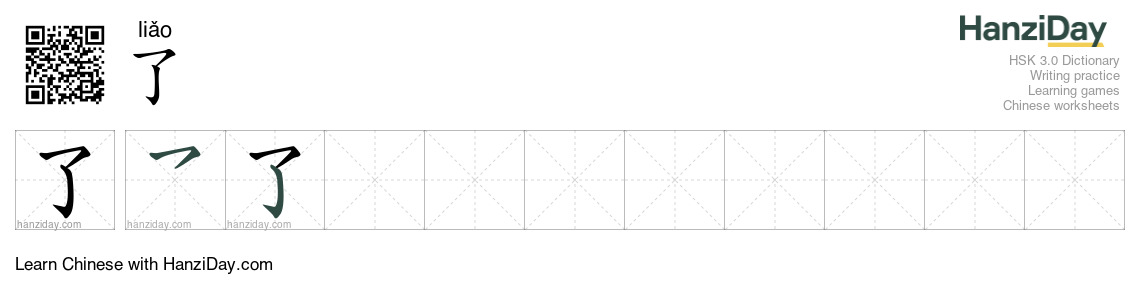
Games & Exercises 9
Find Hanzi
Find Hanzi is a playful exercise for learning Chinese. Spot characters, boost attention, download PDF, and enjoy studying Chinese through games!
Find Radical
Practice Chinese radicals online: choose the Hanzi containing the target component, use optional pinyin hints, and create printable PDF exercises.
Tone Trainer
Learn Mandarin tones online with the Chinese Tone Trainer. Practice tone recognition, pronunciation, and exercises for beginners and advanced learners.
Hanzi Connect
Match Hanzi with pinyin or identify words by sound. Use your own vocabulary or HSK 3.0/YCT levels. Play online after sign-in; printable PDFs with answers are for PRO.
Lost Stroke
Play online: find the missing stroke or radical, restore Chinese characters in order, and create printable PDF worksheets with pinyin and answers.
Calligraphy
Create calligraphy and custom Chinese character coloring pages with pinyin, stroke order, outline styles, and writing grids. Download a print-ready PDF for class or home.
Memo
Flip cards to match Chinese characters or pair Hanzi with Pinyin. Build a custom HSK 3.0 or YCT deck, play online, and create printable PDF cards.
Sudoku
Play Hanzi Sudoku online with 4×4, 6×6, or 9×9 grids, four difficulty levels, custom characters, and HSK 3.0/YCT sets. Create printable PDFs with answers.
Writing trainer
Practice Chinese character writing online with correct stroke order, outlines, a 3–2–1 preview, mistake-based hints, pinyin, and focused Hanzi review.






Examples of use 16
了
解
(v.) know, comprehend, understand; investigate, inquire about, try to find out
一
目
了
然
(idiom.) obvious at a glance
看
了
这
本
书
以
后
,
我
对
中
国
的
文
化
了
解
了
很
多
。
After reading this book, I learned a lot about Chinese culture.
这
么
一
大
盘
!
我
吃
不
了
。
Such a big market! I can't eat.
如
果
每
天
五
点
起
床
,
我
可
受
不
了
。
If I get up at five every day, I can't stand it.
如
果
不
吃
巧
克
力
,
我
可
能
受
不
了
。
If I don't eat chocolate, I may not be able to stand it.
我
的
工
作
经
验
比
较
少
,
恐
怕
完
成
不
了
那
个
工
作
。
I'm afraid I can't finish the job because I don't have much work experience.
我
做
错
了
事
,
老
师
警
告
我
说
,
以
后
一
定
不
可
以
再
这
样
了
。
I did something wrong, and the teacher warned me that I must not do it again in the future.
鱼
上
岸
后
,
过
不
了
多
久
就
会
死
去
。
After the fish come ashore, it won't be long before they die.
由
于
一
半
的
人
都
没
有
来
,
我
们
今
天
的
会
开
不
了
了
。
As half of the people didn't come, we couldn't hold the meeting today.
我
喜
欢
去
不
同
的
地
方
旅
游
,
了
解
当
地
人
的
生
活
。
I like to travel to different places and learn about the life of local people.
新
年
到
了
,
人
们
都
回
家
过
年
,
大
人
给
孩
子
发
红
包
,
买
新
衣
。
When the New Year comes, people go home for the New Year. Adults give red envelopes to their children and buy new clothes.
亚
洲
有
很
多
野
生
动
物
园
,
是
了
解
动
物
很
好
的
方
式
。
There are many safari parks in Asia, which is a good way to know animals.
一
个
偶
然
的
机
会
,
他
发
现
如
果
了
解
汉
字
的
来
源
和
演
变
过
程
,
再
学
习
它
就
变
得
轻
松
、
容
易
。
By chance, he found that if he understood the origin and evolution of Chinese characters, it would be easy to learn them .
预
习
是
个
好
习
惯
,
它
能
帮
助
我
们
提
前
了
解
要
学
习
的
内
容
。
Preparing for a lesson is a good habit. It can help us find out what to learn in advance.
明
了
to understand clearly | to be clear about | plain | clear | also written 明瞭|明了[ming2 liao3]
Learn 了 (liǎo) in context
了 appears here with its available localized meaning and tone-marked pinyin liǎo. Listen to the pronunciation and review any examples, illustrations, or lexical links shown for this entry.
Use the sections available on this page to compare characters, components, radicals, related words, matching pronunciation, synonyms, or antonyms. HanziDay shows only the information supported by this entry.
Practice the stroke order for 了
Use the stroke animation to follow the writing order, then practice the sequence with the interactive writing tool. After signing in, you can also create a printable worksheet from this entry within your current allowance.