


十
干 — Dry, Empty, or In Vain
干 (gān) can mean dry, empty, dried food, or to do something in vain in Mandarin Chinese.
干
TOP-500
Frequency
The ranking is based on data from open sources.
HSK 3.0 · Level 4
HSK 3.0 · Level 5
Translation
- (v.) do, work; do... as a profession, work as...
- (adj.) dry; empty, void; adoptive
- (adv.) in vain
- (n.) dried food
- (char.) without water; hollowly, without real meaning; to offend, to interfere; to concern; heavenly stem
- (radical.) dry
- (char.) trunk, main part; cadre; able; capability
Radical
Simplified
干
Traditional
乾
Strokes count
3

Words with 干 23
Same pronunciation 18
Similar pronunciation 18
Synonyms 2
Antonyms 1
Writing and worksheets
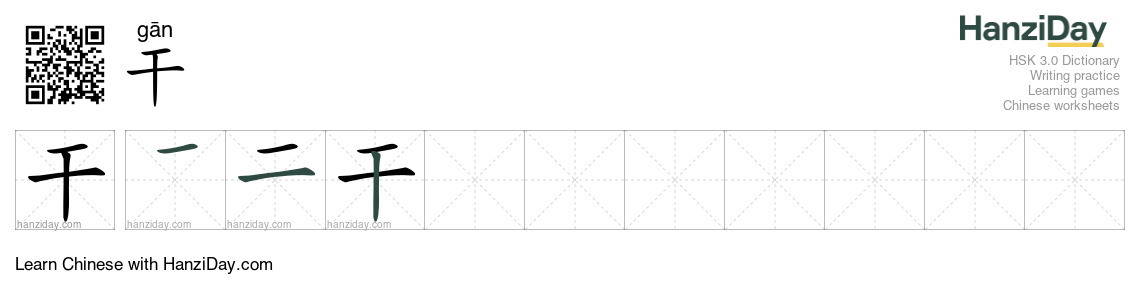
Stroke order
Games & Exercises 9
Find Hanzi
Find Hanzi is a playful exercise for learning Chinese. Spot characters, boost attention, download PDF, and enjoy studying Chinese through games!
Find Radical
Practice Chinese radicals online: choose the Hanzi containing the target component, use optional pinyin hints, and create printable PDF exercises.
Tone Trainer
Learn Mandarin tones online with the Chinese Tone Trainer. Practice tone recognition, pronunciation, and exercises for beginners and advanced learners.
Hanzi Connect
Match Hanzi with pinyin or identify words by sound. Use your own vocabulary or HSK 3.0/YCT levels. Play online after sign-in; printable PDFs with answers are for PRO.
Lost Stroke
Play online: find the missing stroke or radical, restore Chinese characters in order, and create printable PDF worksheets with pinyin and answers.
Calligraphy
Create calligraphy and custom Chinese character coloring pages with pinyin, stroke order, outline styles, and writing grids. Download a print-ready PDF for class or home.
Memo
Flip cards to match Chinese characters or pair Hanzi with Pinyin. Build a custom HSK 3.0 or YCT deck, play online, and create printable PDF cards.
Sudoku
Play Hanzi Sudoku online with 4×4, 6×6, or 9×9 grids, four difficulty levels, custom characters, and HSK 3.0/YCT sets. Create printable PDFs with answers.
Writing trainer
Practice Chinese character writing online with correct stroke order, outlines, a 3–2–1 preview, mistake-based hints, pinyin, and focused Hanzi review.






Examples of use 15
你
家
厨
房
真
干
净
,
你
是
不
是
每
天
都
打
扫
?
Your kitchen is really clean. Do you clean it every day?
这
么
多
天
不
下
雨
,
土
地
都
干
了
。
After so many days without rain, the land has dried up.
大
家
都
认
为
这
里
很
干
净
。
Everybody thinks it's very clean here.
你
想
要
咸
的
饼
干
还
是
甜
的
?
Do you want salty biscuits or sweet ones?
快
把
你
的
脏
鞋
子
洗
干
净
。
Quickly wash your dirty shoes.
你
看
你
的
房
间
,
怎
么
这
么
乱
,
快
收
拾
干
净
吧
。
Look at your room. Why is it so messy? Quickly tidy and clean it up.
今
天
早
上
洗
的
衣
服
还
没
有
干
。
The laundry this morning hasn't dried yet.
有
的
花
喜
干
,
就
别
多
浇
水
;
有
的
花
喜
欢
潮
湿
的
环
境
,
就
别
放
在
太
阳
地
里
。
Some flowers like to dry, don't water more; Some flowers like humid environment, so don't put them in the sun.
这
里
的
冬
天
很
干
燥
。
The winter here is very dry.
这
个
房
间
很
干
净
。
This room is clean.
你
有
干
毛
巾
吗
?
Do you have any dry towels?
运
动
服
还
没
有
干
。
The sportswear hasn't dried yet.
干
杯
!
让
我
们
一
起
加
油
!
Cheers! Let's work hard together!
你
正
在
干
什
么
?
What are you doing now?
他
活
着
的
时
候
,
干
了
太
多
的
活
儿
。
When he was alive he worked extremely hard.
With the reading gān, 干 can mean “dry” or “empty,” as in 干衣服 (gān yīfu), “dry clothes.” The common verb reading gàn, “do” or “work,” is separate.