


画
Learn 书 — HSK 3.0 Level 1
书
TOP-500
Frequency
The ranking is based on data from open sources.
HSK 3.0 · Level 1
Translation
- (n./v.) book; style of calligraphy; document; letter; to write
Radical
Simplified
书
Traditional
書
Strokes count
4

Words with 书 21
Same pronunciation 23
Similar pronunciation 40
Synonyms 13
Writing and worksheets
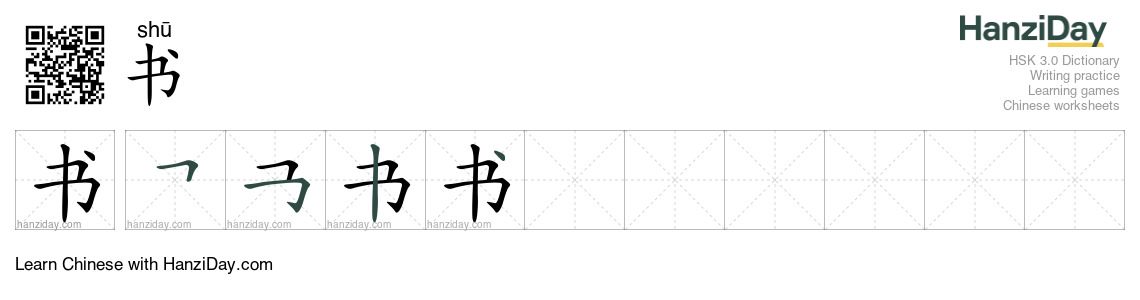
Stroke order
Games & Exercises 9
Find Hanzi
Find Hanzi is a playful exercise for learning Chinese. Spot characters, boost attention, download PDF, and enjoy studying Chinese through games!
Find Radical
Practice Chinese radicals online: choose the Hanzi containing the target component, use optional pinyin hints, and create printable PDF exercises.
Tone Trainer
Learn Mandarin tones online with the Chinese Tone Trainer. Practice tone recognition, pronunciation, and exercises for beginners and advanced learners.
Hanzi Connect
Match Hanzi with pinyin or identify words by sound. Use your own vocabulary or HSK 3.0/YCT levels. Play online after sign-in; printable PDFs with answers are for PRO.
Lost Stroke
Play online: find the missing stroke or radical, restore Chinese characters in order, and create printable PDF worksheets with pinyin and answers.
Calligraphy
Create calligraphy and custom Chinese character coloring pages with pinyin, stroke order, outline styles, and writing grids. Download a print-ready PDF for class or home.
Memo
Flip cards to match Chinese characters or pair Hanzi with Pinyin. Build a custom HSK 3.0 or YCT deck, play online, and create printable PDF cards.
Sudoku
Play Hanzi Sudoku online with 4×4, 6×6, or 9×9 grids, four difficulty levels, custom characters, and HSK 3.0/YCT sets. Create printable PDFs with answers.
Writing trainer
Practice Chinese character writing online with correct stroke order, outlines, a 3–2–1 preview, mistake-based hints, pinyin, and focused Hanzi review.





Examples of use 64
这
本
书
是
我
最
爱
看
的
之
一
。
This book is one of my favourites.
我
爸
爸
是
教
书
的
。
My father teaches.
这
本
书
太
有
意
思
了
!
This book is so interesting!
那
本
书
你
看
完
了
吗
?
Have you finished reading that book?
我
把
这
本
书
看
了
一
遍
。
I read the book once.
这
本
书
是
谁
的
?
(phr.) Whose book is this?
这
本
书
是
新
的
。
This book is new.
桌
子
上
边
有
一
本
书
。
There is a book on the desk.
这
本
书
给
你
。
This book is for you.
我
的
书
包
里
有
三
本
笔
记
本
。
There are three notebooks in my schoolbag.
请
你
把
这
本
书
交
给
王
老
师
,
好
吗
?
Would you please give this book to Miss Wang?
你
喜
欢
这
本
书
吗
?
Do you like this book?
我
手
上
有
一
本
书
。
I have a book in my hand.
那
本
书
两
百
元
。
That book is two hundred yuan.
看
了
这
本
书
以
后
,
我
对
中
国
的
文
化
了
解
了
很
多
。
After reading this book, I learned a lot about Chinese culture.
但
是
他
遗
憾
地
发
现
,
几
乎
没
有
一
本
英
文
书
能
充
分
解
释
汉
字
的
字
源
。
However, he regretted to find that almost no English book can fully explain the etymology of Chinese characters.
我
买
了
一
件
衣
服
,
一
个
书
包
;
另
外
,
我
还
买
了
一
本
书
。
I bought a dress, a schoolbag; In addition, I also bought a book.
这
本
书
极
其
复
杂
。
This book is extremely complicated.
星
期
一
我
要
去
书
店
买
课
本
。
I'm going to the bookstore to buy textbooks on Monday.
我
买
这
本
书
花
了
十
块
。
I spent ten yuan on this book.
不
要
打
扰
别
人
看
书
。
Don't disturb others' reading.
你
这
样
躺
着
看
书
对
眼
睛
不
好
,
快
坐
起
来
!
It's not good for your eyes to read lying down like this. Sit up quickly!
请
大
家
把
书
合
上
。
Please close your books.
我
很
想
去
你
们
学
校
参
观
一
下
图
书
馆
,
听
说
那
儿
又
大
又
漂
亮
。
I really want to visit the library in your school. I heard it is big and beautiful.
我
的
书
很
多
,
你
有
大
点
儿
的
盒
子
吗
?
I have a lot of books. Do you have a bigger box?
建
伟
在
大
学
的
一
座
公
寓
楼
里
开
了
一
家
书
店
,
顺
便
卖
点
儿
文
具
、
电
池
、
小
日
用
品
等
。
Jianwei opened a bookstore in an apartment building of the university, selling stationery, batteries and small daily necessities by the way.
这
是
我
的
书
。
This is my book.
我
的
书
包
是
红
色
的
。
My school bag is red.
家
里
所
有
的
书
我
都
看
过
了
。
I have read all the books at home.
姐
姐
在
用
平
板
电
脑
看
电
子
书
,
弟
弟
在
白
板
上
画
画
,
我
们
的
狗
在
地
板
上
睡
觉
。
My sister is reading e-books on her tablet, my brother is drawing on the whiteboard, and our dog is sleeping on the floor.
每
天
要
看
四
十
分
钟
的
书
。
Read books for forty minutes every day.
我
们
可
以
把
书
邮
寄
到
你
的
家
。
We can mail the book to your home.
妈
妈
很
喜
欢
中
国
的
书
画
。
Mother likes Chinese painting and calligraphy very much.
他
是
书
店
的
店
员
。
He is a shop assistant in a bookstore.
图
书
馆
在
餐
厅
的
前
边
。
The library is in front of the dining room.
你
和
我
女
儿
一
样
,
斯
斯
文
文
的
,
一
看
就
读
过
书
,
心
眼
儿
好
。
You, like my daughter, are gentle. You have read books and have a good heart.
你
的
客
厅
里
怎
么
到
处
是
书
啊
?
Why are there books all over your living room?
你
的
书
包
为
什
么
是
这
个
样
子
的
?
Why is your schoolbag like this?
她
喜
欢
在
下
雨
的
日
子
在
书
店
里
看
书
。
She likes reading in the bookstore on rainy days.
那
些
书
都
是
我
的
。
Those books are all mine.
他
的
电
脑
在
他
的
书
包
里
。
His computer is in his schoolbag.
她
的
女
儿
在
中
国
学
书
法
。
Her daughter is studying calligraphy in China.
我
们
下
午
三
点
在
书
店
见
,
好
吗
?
Let's meet at the bookstore at three o'clock in the afternoon, shall we?
这
里
附
近
不
但
有
美
术
展
览
,
而
且
有
电
影
院
和
图
书
馆
。
There is not only an art exhibition nearby here, but also a cinema and library.
正
常
来
说
,
他
每
周
三
都
会
去
图
书
馆
。
Normally, he goes to the library every Wednesday.
弟
弟
明
年
六
岁
了
,
要
开
始
读
书
了
。
My brother will be six years old next year and will start going to school.
我
在
读
书
呢
。
I am reading.
读
书
使
我
快
乐
。
Reading makes me happy.
走
路
去
图
书
馆
,
最
多
十
五
分
钟
。
It takes fifteen minutes to walk to the library at most.
书
包
里
有
很
多
书
。
There are many books in the schoolbag.
他
有
很
多
证
书
,
所
以
他
很
快
找
到
了
工
作
。
He had many certificates, so he found a job quickly.
我
和
朋
友
明
天
去
学
校
看
书
。
My friend and I will go to school to read tomorrow.
我
和
妈
妈
一
起
看
书
。
Me and mum read books together.
我
看
一
会
儿
书
。
I read a book for a while.
我
们
一
般
会
看
看
书
,
听
听
音
乐
。
We usually read books and listen to music.
他
们
在
学
校
看
书
。
They are reading at school.
他
们
喜
欢
一
边
听
歌
,
一
边
看
书
。
They like to read while listening to songs.
图
书
馆
里
有
中
国
书
法
作
品
。
There are Chinese calligraphy works in the library.
你
对
中
国
书
画
感
兴
趣
吗
?
Are you interested in Chinese painting and calligraphy?
我
想
买
一
些
中
文
书
。
I want to buy some Chinese books.
我
可
以
把
这
些
书
给
你
邮
寄
过
去
。
I can mail these books to you.
旅
游
类
书
籍
便
把
服
务
对
象
锁
定
为
外
国
人
。
Tourism books target foreigners.
书
包
在
桌
子
上
边
。
The schoolbag is on the table.
我
每
天
晚
上
看
半
个
小
时
书
。
I read for half an hour every night.
Learn 书 (shū) in context
书 appears here with its available localized meaning and tone-marked pinyin shū. Listen to the pronunciation and review any examples, illustrations, or lexical links shown for this entry.
Use the sections available on this page to compare characters, components, radicals, related words, matching pronunciation, synonyms, or antonyms. HanziDay shows only the information supported by this entry.
书 in HSK 3.0 Level 1
HanziDay organizes HSK 3.0 vocabulary around the new three-stage, nine-level framework. This entry belongs to Level 1; open the level list to study it alongside other vocabulary from the same stage.
Practice the stroke order for 书
Use the stroke animation to follow the writing order, then practice the sequence with the interactive writing tool. After signing in, you can also create a printable worksheet from this entry within your current allowance.