


甩
Learn 用 — HSK 3.0 Level 3
用
Translation
- (v./n.) to use; to eat or drink; (usu. in the negative) to need; usefulness; expenses
- (radical.) use
- (prep.) with; hence, therefore (ancient Chinese, in letter writing)
Simplified
用
Traditional
用
Strokes count
5
Words with 用 54
Same pronunciation 3
Similar pronunciation 37
Synonyms 21
Antonyms 2
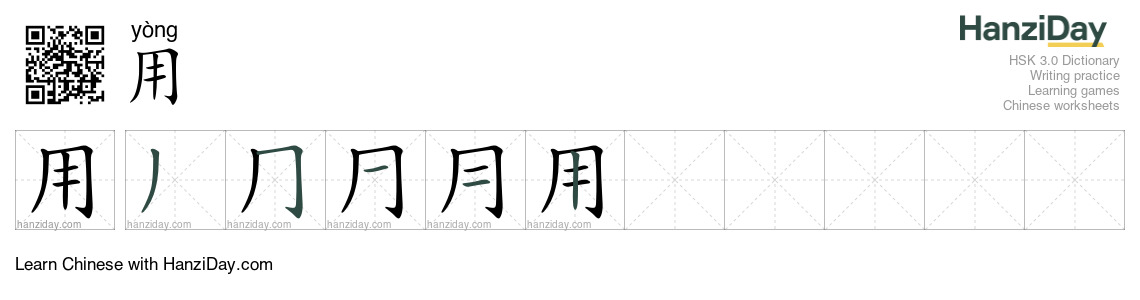
Writing and worksheets
Stroke order
Games & Exercises 9
Find Hanzi
Find Hanzi is a playful exercise for learning Chinese. Spot characters, boost attention, download PDF, and enjoy studying Chinese through games!
Find Radical
Practice Chinese radicals online: choose the Hanzi containing the target component, use optional pinyin hints, and create printable PDF exercises.
Tone Trainer
Learn Mandarin tones online with the Chinese Tone Trainer. Practice tone recognition, pronunciation, and exercises for beginners and advanced learners.
Hanzi Connect
Match Hanzi with pinyin or identify words by sound. Use your own vocabulary or HSK 3.0/YCT levels. Play online after sign-in; printable PDFs with answers are for PRO.
Lost Stroke
Play online: find the missing stroke or radical, restore Chinese characters in order, and create printable PDF worksheets with pinyin and answers.
Calligraphy
Create calligraphy and custom Chinese character coloring pages with pinyin, stroke order, outline styles, and writing grids. Download a print-ready PDF for class or home.
Memo
Flip cards to match Chinese characters or pair Hanzi with Pinyin. Build a custom HSK 3.0 or YCT deck, play online, and create printable PDF cards.
Sudoku
Play Hanzi Sudoku online with 4×4, 6×6, or 9×9 grids, four difficulty levels, custom characters, and HSK 3.0/YCT sets. Create printable PDFs with answers.
Writing trainer
Practice Chinese character writing online with correct stroke order, outlines, a 3–2–1 preview, mistake-based hints, pinyin, and focused Hanzi review.






Examples of use 38
可
是
,
经
过
测
验
计
算
发
现
,
以
大
树
输
送
管
道
的
尺
寸
产
生
的
毛
细
作
用
,
根
本
无
法
把
水
分
送
到
几
十
米
高
的
地
方
。
However, after testing and calculation, it was found that the capillary effect produced by the size of the big tree transportation pipeline could not send water to places tens of meters high at all.
买
东
西
不
用
在
川
流
不
息
的
人
群
中
奔
走
,
仅
需
登
录
网
站
,
动
几
下
手
指
,
下
几
道
指
令
就
可
以
把
东
西
买
回
家
。
You don't have to run in the endless stream of people to buy things, just log on to the website, move your fingers and give instructions to buy things home.
我
好
多
了
,
不
用
看
大
夫
了
。
I'm much better. I don't need to see a doctor.
利
用
大
数
据
对
一
个
病
种
进
行
细
致
的
监
测
,
意
义
是
不
言
而
喻
的
。
The significance of using big data to monitor a disease carefully is self-evident.
不
用
谢
!
You're welcome!
在
其
他
粮
食
不
足
的
情
况
下
,
用
橡
子
喂
猴
子
倒
是
个
办
法
。
In other cases of food shortage, feeding monkeys with acorns is a way.
为
了
保
护
动
物
,
最
好
不
要
穿
用
动
物
的
毛
皮
做
的
衣
服
In order to protect animals, it is best not to wear clothes made of animal fur.
有
人
纳
闷
儿
,
猫
为
什
么
能
快
速
跳
跃
起
来
,
瞄
准
都
不
用
,
一
下
就
能
拍
到
苍
蝇
?
Some people wonder why cats can jump up quickly without aiming, and they can shoot flies at once.
一
个
人
的
信
用
很
重
要
,
你
不
可
以
说
到
做
不
到
。
A person's credit is very important, you can't say you can't do it.
两
个
孩
子
上
学
不
用
接
送
,
做
作
业
不
用
督
促
。
Two children don't need to pick up and drop off when they go to school, and they don't need to
如
果
你
能
节
约
钱
,
不
随
便
在
淘
宝
上
买
东
西
,
你
的
生
活
费
一
定
是
够
用
的
。
If you can save money and not buy things casually on Taobao, your living expenses will be enough.
你
觉
得
吃
水
果
对
减
肥
有
作
用
吗
?
Do you think eating fruit is effective in helping you lose weight?
我
现
在
会
用
汉
语
打
电
话
了
。
I can make phone calls in Chinese now.
它
开
始
用
锋
利
的
牙
齿
咬
缠
绕
着
大
象
的
网
和
绳
子
。
It began to bite the net and rope wrapped around the elephant with its sharp teeth.
有
的
人
家
喜
欢
种
草
、
养
花
、
种
竹
子
,
有
的
人
家
则
喜
欢
用
大
盆
养
金
鱼
。
Some people like to plant grass, flowers and bamboo, while others like to raise goldfish in big pots.
建
伟
在
大
学
的
一
座
公
寓
楼
里
开
了
一
家
书
店
,
顺
便
卖
点
儿
文
具
、
电
池
、
小
日
用
品
等
。
Jianwei opened a bookstore in an apartment building of the university, selling stationery, batteries and small daily necessities by the way.
姐
姐
在
用
平
板
电
脑
看
电
子
书
,
弟
弟
在
白
板
上
画
画
,
我
们
的
狗
在
地
板
上
睡
觉
。
My sister is reading e-books on her tablet, my brother is drawing on the whiteboard, and our dog is sleeping on the floor.
我
们
要
做
对
社
会
有
用
的
人
。
We should be useful to society.
我
可
以
使
用
你
的
电
脑
吗
?
Can I use your computer?
你
肚
子
疼
的
时
候
,
喝
点
热
水
,
可
能
管
用
。
When you have a stomachache, drink some hot water, which may help.
这
是
我
的
的
信
用
卡
的
卡
号
。
This is the card number of my credit card.
爷
爷
常
常
用
毛
笔
给
我
写
信
,
爷
爷
的
毛
笔
字
写
得
好
极
了
!
Grandpa often writes to me with a brush, and his calligraphy is excellent!
他
用
了
全
身
的
力
气
,
才
把
我
的
行
李
全
部
搬
到
宿
舍
。
He used all his strength to move all my suitcases to the dormitory.
请
用
汉
语
说
你
的
名
字
。
Please say your name in Chinese.
她
用
了
很
多
时
间
才
做
好
。
It took her a lot of time to finish it.
她
和
其
他
志
愿
者
利
用
午
休
、
周
末
等
空
闲
时
间
给
学
生
们
指
导
和
培
训
。
She and other volunteers use their free time such as lunch break and weekend to guide and train the students.
这
个
东
西
很
有
用
。
This thing is very useful.
我
认
为
中
医
很
有
用
。
I think Chinese medicine is very useful.
这
位
朋
友
很
会
利
用
“
登
门
槛
效
应
”
来
处
理
问
题
。
This friend is very good at using the "threshold effect" to deal with problems.
你
会
用
毛
笔
写
字
吗
?
Can you write with a brush?
最
近
,
老
师
在
使
用
网
络
上
课
,
学
生
也
在
使
用
网
络
学
习
。
Recently, teachers use the internet for classes, and students also use the internet for learning.
我
付
完
款
就
可
以
用
了
吧
?
Can I use it after I pay?
印
象
中
似
乎
没
有
什
么
押
金
,
全
凭
信
用
。
There seems to be no deposit in my impression, all by credit.
你
不
用
谢
我
!
You don't have to thank me!
我
喜
欢
用
铅
笔
写
字
。
I like to write using a pencil.
我
喜
欢
用
铅
笔
画
画
儿
。
I like to draw using pencil.
妹
妹
用
铅
笔
写
字
。
My sister writes with a pencil.
在
中
国
,
结
婚
时
常
用
红
色
,
因
为
它
代
表
喜
庆
。
In China, red is often used when getting married, because it represents happiness.
Learn 用 (yòng) in context
用 appears here with its available localized meaning and tone-marked pinyin yòng. Listen to the pronunciation and review any examples, illustrations, or lexical links shown for this entry.
Use the sections available on this page to compare characters, components, radicals, related words, matching pronunciation, synonyms, or antonyms. HanziDay shows only the information supported by this entry.
用 in HSK 3.0 Level 3
HanziDay organizes HSK 3.0 vocabulary around the new three-stage, nine-level framework. This entry belongs to Level 3; open the level list to study it alongside other vocabulary from the same stage.
Practice the stroke order for 用
Use the stroke animation to follow the writing order, then practice the sequence with the interactive writing tool. After signing in, you can also create a printable worksheet from this entry within your current allowance.