


友
Learn 发 — HSK 3.0 Level 3
发
TOP-50
Frequency
The ranking is based on data from open sources.
HSK 3.0 · Level 3
Translation
- (n.) hair
- (v.) send
- (m.) measure word for bullet, shot
- (v.) to shoot or emit; to produce or generate; to express or utter; to make a fortune; to become or turn; to show or present (feelings); to feel; (of food) rise, expand
- (char.) to develop or expand; to diffuse or spread; to reveal or expose; to leave; to trigger or provoke; to set to work
Radical
Simplified
发
Traditional
發
Strokes count
5
Words with 发 78
Same pronunciation 3
Similar pronunciation 17
Synonyms 3
Writing and worksheets
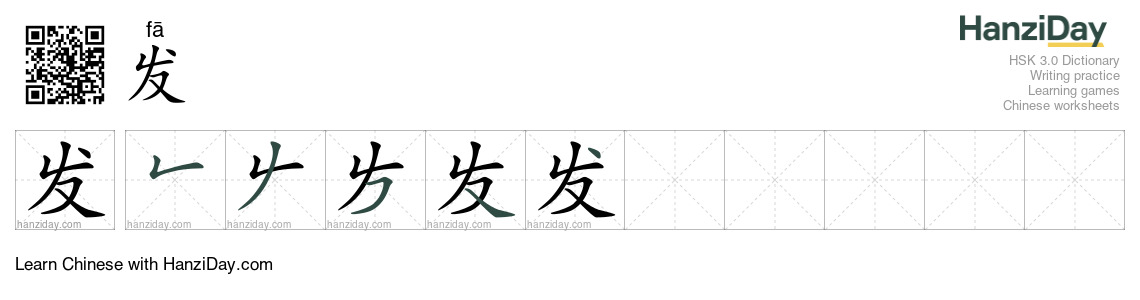
Stroke order
Games & Exercises 9
Find Hanzi
Find Hanzi is a playful exercise for learning Chinese. Spot characters, boost attention, download PDF, and enjoy studying Chinese through games!
Find Radical
Practice Chinese radicals online: choose the Hanzi containing the target component, use optional pinyin hints, and create printable PDF exercises.
Tone Trainer
Learn Mandarin tones online with the Chinese Tone Trainer. Practice tone recognition, pronunciation, and exercises for beginners and advanced learners.
Hanzi Connect
Match Hanzi with pinyin or identify words by sound. Use your own vocabulary or HSK 3.0/YCT levels. Play online after sign-in; printable PDFs with answers are for PRO.
Lost Stroke
Play online: find the missing stroke or radical, restore Chinese characters in order, and create printable PDF worksheets with pinyin and answers.
Calligraphy
Create calligraphy and custom Chinese character coloring pages with pinyin, stroke order, outline styles, and writing grids. Download a print-ready PDF for class or home.
Memo
Flip cards to match Chinese characters or pair Hanzi with Pinyin. Build a custom HSK 3.0 or YCT deck, play online, and create printable PDF cards.
Sudoku
Play Hanzi Sudoku online with 4×4, 6×6, or 9×9 grids, four difficulty levels, custom characters, and HSK 3.0/YCT sets. Create printable PDFs with answers.
Writing trainer
Practice Chinese character writing online with correct stroke order, outlines, a 3–2–1 preview, mistake-based hints, pinyin, and focused Hanzi review.








Examples of use 27
头
发
(n.) hair
发
型
(n.) hair style
可
是
,
经
过
测
验
计
算
发
现
,
以
大
树
输
送
管
道
的
尺
寸
产
生
的
毛
细
作
用
,
根
本
无
法
把
水
分
送
到
几
十
米
高
的
地
方
。
However, after testing and calculation, it was found that the capillary effect produced by the size of the big tree transportation pipeline could not send water to places tens of meters high at all.
但
是
他
遗
憾
地
发
现
,
几
乎
没
有
一
本
英
文
书
能
充
分
解
释
汉
字
的
字
源
。
However, he regretted to find that almost no English book can fully explain the etymology of Chinese characters.
虽
然
这
件
事
发
生
在
上
个
世
纪
,
但
是
人
们
永
远
都
不
能
忘
记
那
段
历
史
。
Although this happened in the last century, people can never forget that history.
他
忽
然
发
现
远
处
蹲
着
一
只
大
老
虎
。
He suddenly found a big tiger crouching in the distance.
新
年
到
了
,
人
们
都
回
家
过
年
,
大
人
给
孩
子
发
红
包
,
买
新
衣
。
When the New Year comes, people go home for the New Year. Adults give red envelopes to their children and buy new clothes.
鸟
虫
发
出
的
声
音
让
我
的
听
觉
无
法
停
下
。
The sound of birds and insects makes my hearing unable to stop.
老
鼠
发
觉
它
对
山
神
的
承
诺
是
多
么
草
率
。
The mouse realized how hasty his promise to the mountain god was.
一
个
偶
然
的
机
会
,
他
发
现
如
果
了
解
汉
字
的
来
源
和
演
变
过
程
,
再
学
习
它
就
变
得
轻
松
、
容
易
。
By chance, he found that if he understood the origin and evolution of Chinese characters, it would be easy to learn them .
随
着
中
国
经
济
的
发
展
,
越
来
越
多
留
学
生
选
择
来
中
国
留
学
。
With the development of China's economy, more and more overseas students choose to study in China.
我
们
应
该
以
那
些
敢
说
真
话
的
人
为
镜
子
,
这
样
才
能
及
时
发
现
自
己
的
缺
点
。
We should take those who dare to tell the truth as mirrors, so as to find our shortcomings in time.
你
们
打
算
几
点
出
发
?
What time are you going to leave?
我
发
现
在
难
得
的
寂
静
中
工
作
是
那
么
美
好
。
I find it wonderful to work in rare silence.
最
近
几
年
,
我
们
国
家
发
展
得
非
常
好
。
In recent years, our country has developed very well.
妈
妈
每
天
坐
首
发
班
车
下
班
回
家
。
Mother takes the first bus home from work every day.
当
消
费
者
走
到
相
应
货
架
时
,
仪
器
会
发
出
提
示
音
,
以
免
消
费
者
错
过
商
品
。
When the consumer walks to the corresponding shelf, the instrument will sound a prompt to avoid the consumer missing the goods.
他
轻
轻
地
推
开
了
门
,
发
现
房
间
里
没
有
人
。
He gently pushed open the door and found no one in the room.
我
把
合
同
发
给
你
了
。
I sent you the contract.
请
你
详
细
地
跟
我
说
说
发
生
了
什
么
。
Please tell me in detail what happened.
发
生
什
么
事
了
?
What happened?
你
给
他
发
短
信
了
吗
?
Did you text him?
等
待
今
年
1
1
月
的
北
风
,
北
风
南
下
之
时
,
他
们
将
再
次
出
发
。
Waiting for the north wind in November this year, when the north wind goes south, they will set off again.
直
发
straight hair
长
发
long hair
黑
发
black hair
短
发
short hair, crop
Learn 发 (fā) in context
发 appears here with its available localized meaning and tone-marked pinyin fā. Listen to the pronunciation and review any examples, illustrations, or lexical links shown for this entry.
Use the sections available on this page to compare characters, components, radicals, related words, matching pronunciation, synonyms, or antonyms. HanziDay shows only the information supported by this entry.
发 in HSK 3.0 Level 3
HanziDay organizes HSK 3.0 vocabulary around the new three-stage, nine-level framework. This entry belongs to Level 3; open the level list to study it alongside other vocabulary from the same stage.
Practice the stroke order for 发
Use the stroke animation to follow the writing order, then practice the sequence with the interactive writing tool. After signing in, you can also create a printable worksheet from this entry within your current allowance.