


他
它 — “It” in Chinese
它 (tā) is the written Mandarin pronoun “it,” used for nonhuman referents such as things and animals.
它
Translation
- (pro.) it
- (pro.) it (the traditional Chinese refers to a thing or an animal)
Radical
Simplified
它
Traditional
它
Strokes count
5
Words with 它 1
Same pronunciation 11
Similar pronunciation 21
Writing and worksheets
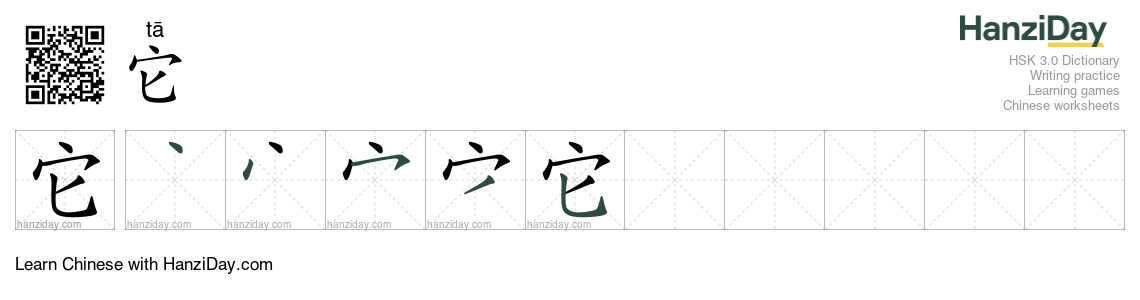
Stroke order
Games & Exercises 9
Find Hanzi
Find Hanzi is a playful exercise for learning Chinese. Spot characters, boost attention, download PDF, and enjoy studying Chinese through games!
Find Radical
Practice Chinese radicals online: choose the Hanzi containing the target component, use optional pinyin hints, and create printable PDF exercises.
Tone Trainer
Learn Mandarin tones online with the Chinese Tone Trainer. Practice tone recognition, pronunciation, and exercises for beginners and advanced learners.
Hanzi Connect
Match Hanzi with pinyin or identify words by sound. Use your own vocabulary or HSK 3.0/YCT levels. Play online after sign-in; printable PDFs with answers are for PRO.
Lost Stroke
Play online: find the missing stroke or radical, restore Chinese characters in order, and create printable PDF worksheets with pinyin and answers.
Calligraphy
Create calligraphy and custom Chinese character coloring pages with pinyin, stroke order, outline styles, and writing grids. Download a print-ready PDF for class or home.
Memo
Flip cards to match Chinese characters or pair Hanzi with Pinyin. Build a custom HSK 3.0 or YCT deck, play online, and create printable PDF cards.
Sudoku
Play Hanzi Sudoku online with 4×4, 6×6, or 9×9 grids, four difficulty levels, custom characters, and HSK 3.0/YCT sets. Create printable PDFs with answers.
Writing trainer
Practice Chinese character writing online with correct stroke order, outlines, a 3–2–1 preview, mistake-based hints, pinyin, and focused Hanzi review.









Examples of use 34
这
件
毛
衣
大
小
正
好
,
不
过
我
不
喜
欢
它
的
颜
色
。
This sweater is just the right size, but I don't like its color.
老
鼠
乘
机
跑
进
大
象
的
鼻
子
中
,
准
备
实
施
它
的
计
划
。
The mouse took the opportunity to run into the elephant's nose, ready to carry out its plan.
它
开
始
用
锋
利
的
牙
齿
咬
缠
绕
着
大
象
的
网
和
绳
子
。
It began to bite the net and rope wrapped around the elephant with its sharp teeth.
它
是
那
么
弱
小
,
丝
毫
没
有
对
抗
大
象
的
力
量
。
It is so weak that it has no strength against elephants.
大
象
现
在
毫
无
抵
抗
能
力
,
只
要
我
在
它
身
体
的
重
要
部
位
咬
几
个
洞
,
它
就
没
命
了
。
The elephant has no resistance now. As long as I bite a few holes in important parts of its body, it will die.
大
象
又
悲
伤
又
害
怕
,
它
觉
得
死
亡
越
来
越
近
了
。
The elephant was sad and afraid. It felt that death was getting closer and closer.
虽
然
汉
语
的
词
语
很
多
,
但
是
我
们
有
很
多
办
法
来
记
住
它
们
Although there are many words in Mandarin, we have many ways to remember them
你
从
高
处
往
下
蹦
,
跌
倒
了
,
脸
上
留
下
的
疤
痕
掩
盖
了
它
。
You jumped down from a height and fell down, and the scar on your face covered it.
老
鼠
是
山
神
的
宠
物
,
它
厌
倦
了
宠
物
的
生
活
,
也
很
厌
恶
宠
物
这
个
角
色
。
Mouse is the pet of mountain god. It is tired of pet life and hates the role of pet.
老
鼠
发
觉
它
对
山
神
的
承
诺
是
多
么
草
率
。
The mouse realized how hasty his promise to the mountain god was.
我
把
手
机
它
老
人
家
伺
候
得
好
好
的
。
I took good care of my mobile phone.
京
剧
是
一
种
优
美
的
传
统
艺
术
,
很
多
外
国
留
学
生
对
它
十
分
感
兴
趣
。
Peking Opera is a beautiful traditional art, and many foreign students are very interested in it.
一
个
偶
然
的
机
会
,
他
发
现
如
果
了
解
汉
字
的
来
源
和
演
变
过
程
,
再
学
习
它
就
变
得
轻
松
、
容
易
。
By chance, he found that if he understood the origin and evolution of Chinese characters, it would be easy to learn them .
预
习
是
个
好
习
惯
,
它
能
帮
助
我
们
提
前
了
解
要
学
习
的
内
容
。
Preparing for a lesson is a good habit. It can help us find out what to learn in advance.
看
看
熊
猫
,
它
有
什
么
特
点
呢
?
Look at the panda. What are its characteristics?
一
部
电
影
,
开
始
虽
然
剧
情
平
平
常
常
,
如
果
最
后
半
个
小
时
能
使
我
们
感
动
,
我
们
依
然
会
向
别
人
推
荐
它
。
Although the plot of a movie is ordinary at first, if the last half hour can move us, we will still recommend it to others.
翟
峰
和
妻
子
没
有
积
蓄
,
卖
房
卖
车
买
下
了
一
艘
二
手
船
,
翟
峰
叫
它
“
彩
虹
号
”
。
Zhai Feng and his wife had no savings, so they sold their houses and cars and bought a second-hand boat. Zhai Feng called it "Rainbow".
它
觉
得
那
样
未
免
太
过
残
忍
。
It felt that it was too cruel.
它
那
丰
富
的
色
彩
、
微
甜
的
口
感
,
至
今
仍
让
我
十
分
想
念
。
Its rich colors and slightly sweet taste still make me miss it very much.
她
有
时
拿
起
剪
刀
给
它
们
剪
剪
叶
子
。
She sometimes picks up scissors and cuts their leaves.
在
中
国
,
结
婚
时
常
用
红
色
,
因
为
它
代
表
喜
庆
。
In China, red is often used when getting married, because it represents happiness.
其
它
(adjective) other
它
是
一
只
小
猫
。
It's a little kitty.
等
我
把
它
搞
定
了
再
告
诉
你
。
Wait, I will tell you when I get it done.
这
花
有
毒
,
不
要
碰
它
。
This flower is poisonous, don't touch it.
小
狗
高
兴
地
摇
着
它
的
尾
巴
。
The puppy frisked its tail.
我
们
要
实
事
求
是
地
看
待
它
的
使
用
范
围
。
We should view the extent of its application in a practical and realistic standpoint.
我
喜
欢
耐
用
的
手
机
,
哪
怕
它
很
不
好
看
。
I like the mobile phones which are durable even if they look ugly.
他
的
钥
匙
掉
进
下
水
道
了
,
只
好
用
钩
子
把
它
钩
上
来
。
His key dropped into the drain pipe and he had to pick it up with a hook.
这
件
大
衣
有
问
题
,
我
想
把
它
退
了
。
There are some problems with this coat and I want to return it.
公
司
的
广
告
传
递
着
它
的
价
值
理
念
。
A company's advertisement transmits its values and beliefs.
我
不
喜
欢
这
段
相
声
,
它
一
点
儿
都
不
好
笑
。
I don't like this crosstalk, it's not at all funny.
这
件
上
衣
大
减
价
,
因
此
我
就
把
它
买
下
了
。
The price of this coat was considerably reduced, therefore, I bought it.
我
知
道
小
猫
在
哪
儿
,
它
在
桌
子
下
面
。
I know where the kitten is. It is under the table.
In 我不喜欢它的颜色。 (Wǒ bù xǐhuan tā de yánsè.) — “I don’t like its color.” — 它 refers back to a nonhuman noun.
In traditional writing, 牠 may be used specifically for animals, while 它 is used for things; both are pronounced tā.