


Learn 便 — HSK 3.0 Level 5
便
TOP-500
Frequency
The ranking is based on data from open sources.
HSK 3.0 · Level 5
Translation
- (char.) convenient, appropriate; informal, casual; soon afterwards, then; excretion
- (char.) advantageous; (lit.) bulging
Radical
Simplified
便
Traditional
便
Strokes count
9

Words with 便 15
Same pronunciation 14
Similar pronunciation 24
Synonyms 14
Writing and worksheets
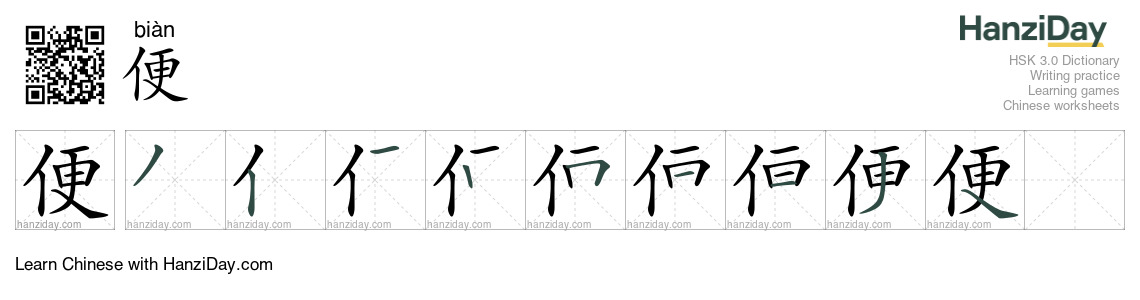
Stroke order
Games & Exercises 9
Find Hanzi
Find Hanzi is a playful exercise for learning Chinese. Spot characters, boost attention, download PDF, and enjoy studying Chinese through games!
Find Radical
Practice Chinese radicals online: choose the Hanzi containing the target component, use optional pinyin hints, and create printable PDF exercises.
Tone Trainer
Learn Mandarin tones online with the Chinese Tone Trainer. Practice tone recognition, pronunciation, and exercises for beginners and advanced learners.
Hanzi Connect
Match Hanzi with pinyin or identify words by sound. Use your own vocabulary or HSK 3.0/YCT levels. Play online after sign-in; printable PDFs with answers are for PRO.
Lost Stroke
Play online: find the missing stroke or radical, restore Chinese characters in order, and create printable PDF worksheets with pinyin and answers.
Calligraphy
Create calligraphy and custom Chinese character coloring pages with pinyin, stroke order, outline styles, and writing grids. Download a print-ready PDF for class or home.
Memo
Flip cards to match Chinese characters or pair Hanzi with Pinyin. Build a custom HSK 3.0 or YCT deck, play online, and create printable PDF cards.
Sudoku
Play Hanzi Sudoku online with 4×4, 6×6, or 9×9 grids, four difficulty levels, custom characters, and HSK 3.0/YCT sets. Create printable PDFs with answers.
Writing trainer
Practice Chinese character writing online with correct stroke order, outlines, a 3–2–1 preview, mistake-based hints, pinyin, and focused Hanzi review.





Examples of use 22
方
便
(adj.) handy, convenient; appropriate, proper | (v.) to facilitate, to make easier for; to go to the restroom; to have money to spare
便
利
(adj./v.) convenient, easy; to facilitate
便
饭
(n.) simple meal, ordinary meal
粪
便
(n.) excrement and urine
不
要
随
便
阅
读
别
人
的
日
记
。
Don't read other people's diaries casually.
成
功
不
是
随
随
便
便
就
能
取
得
的
。
Success can't be achieved casually.
如
果
不
是
女
儿
反
驳
,
我
还
意
识
不
到
,
我
们
自
己
的
做
法
和
对
孩
子
的
要
求
实
行
的
是
两
套
标
准
,
那
便
是
对
自
己
宽
容
,
对
孩
子
严
厉
。
If it weren't for my daughter's rebuttal, I still didn't realize that our own practices and requirements for children are two sets of standards, that is, we are tolerant of ourselves and strict with children.
如
果
你
能
节
约
钱
,
不
随
便
在
淘
宝
上
买
东
西
,
你
的
生
活
费
一
定
是
够
用
的
。
If you can save money and not buy things casually on Taobao, your living expenses will be enough.
建
伟
在
大
学
的
一
座
公
寓
楼
里
开
了
一
家
书
店
,
顺
便
卖
点
儿
文
具
、
电
池
、
小
日
用
品
等
。
Jianwei opened a bookstore in an apartment building of the university, selling stationery, batteries and small daily necessities by the way.
我
家
小
区
的
旁
边
就
有
一
家
诊
所
,
看
医
生
很
方
便
。
There is a clinic next to my community, so it is very convenient to see a doctor.
“
精
诚
所
至
,
金
石
为
开
”
这
一
成
语
也
便
由
此
流
传
下
来
。
The idiom "Where you go sincerely, the stone opens" has been handed down from this.
概
括
来
说
,
就
是
以
方
便
为
原
则
。
To sum up, it is based on the principle of convenience.
旅
游
类
书
籍
便
把
服
务
对
象
锁
定
为
外
国
人
。
Tourism books target foreigners.
不
便
inconvenient | inappropriate | unsuitable | short of cash
便
秘
constipation | Taiwan pr. [bian4bi4]
便
衣
civilian clothes; plain clothes | plainclothesman
大
便
to defecate | excrement; feces
小
便
urine | to urinate | (euphemism) penis or vulva
其
实
地
上
本
没
有
路
,
走
的
人
多
了
,
也
便
成
了
路
。
-
-
鲁
迅
At the beginning the Earth had no roads, but as many men pass one way; a road is made. - Lu Xun
洗
手
的
时
候
,
日
子
从
水
盆
里
过
去
;
吃
饭
的
时
候
,
日
子
从
饭
碗
里
过
去
;
默
默
时
,
便
从
凝
然
的
双
眼
前
过
去
。
The day flows away through the sink when I wash my hands, wears off in the bowl when I eat my meal, and passes away before my day-dreaming gaze as I reflect in silence. - Zhu Ziqing
塑
料
被
注
入
模
子
后
,
便
放
在
一
边
让
它
慢
慢
凝
结
硬
化
。
After the plastic was poured into the mold, it was left to set until it became solid and hard gradually.
那
人
便
是
李
先
生
。
That is Mr. Li.
Learn 便 (biàn) in context
便 appears here with its available localized meaning and tone-marked pinyin biàn. Listen to the pronunciation and review any examples, illustrations, or lexical links shown for this entry.
Use the sections available on this page to compare characters, components, radicals, related words, matching pronunciation, synonyms, or antonyms. HanziDay shows only the information supported by this entry.
便 in HSK 3.0 Level 5
HanziDay organizes HSK 3.0 vocabulary around the new three-stage, nine-level framework. This entry belongs to Level 5; open the level list to study it alongside other vocabulary from the same stage.
Practice the stroke order for 便
Use the stroke animation to follow the writing order, then practice the sequence with the interactive writing tool. After signing in, you can also create a printable worksheet from this entry within your current allowance.