


未
末 — End, Powder, or Opera Role
末 (mò) can mean the end or tip, powder and fine particles, or a supporting opera role in Mandarin Chinese.
末
TOP-2000
Frequency
The ranking is based on data from open sources.
HSK 3.0 · Level 4
Translation
- (char.) end; last stage; minor details that are not important
- (n.) (with "er") powder, dust; a type of character of a middle-aged man (in traditional Chinese opera)
Simplified
末
Traditional
末
Strokes count
5

Words with 末 4
Same pronunciation 29
Similar pronunciation 22
Synonyms 2
Antonyms 5
Writing and worksheets
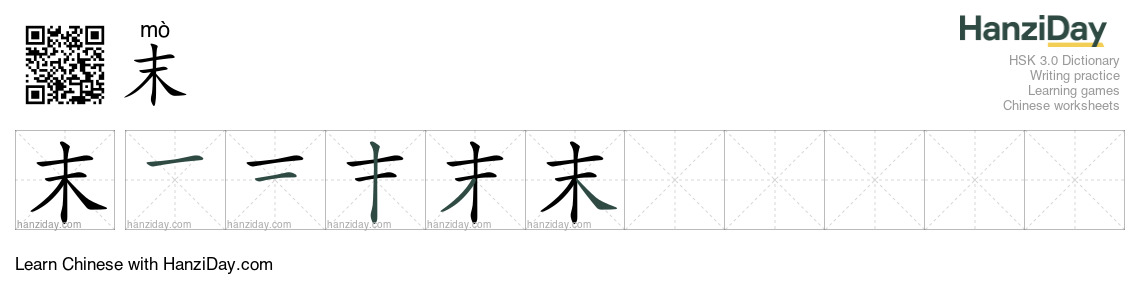
Stroke order
Games & Exercises 9
Find Hanzi
Find Hanzi is a playful exercise for learning Chinese. Spot characters, boost attention, download PDF, and enjoy studying Chinese through games!
Find Radical
Practice Chinese radicals online: choose the Hanzi containing the target component, use optional pinyin hints, and create printable PDF exercises.
Tone Trainer
Learn Mandarin tones online with the Chinese Tone Trainer. Practice tone recognition, pronunciation, and exercises for beginners and advanced learners.
Hanzi Connect
Match Hanzi with pinyin or identify words by sound. Use your own vocabulary or HSK 3.0/YCT levels. Play online after sign-in; printable PDFs with answers are for PRO.
Lost Stroke
Play online: find the missing stroke or radical, restore Chinese characters in order, and create printable PDF worksheets with pinyin and answers.
Calligraphy
Create calligraphy and custom Chinese character coloring pages with pinyin, stroke order, outline styles, and writing grids. Download a print-ready PDF for class or home.
Memo
Flip cards to match Chinese characters or pair Hanzi with Pinyin. Build a custom HSK 3.0 or YCT deck, play online, and create printable PDF cards.
Sudoku
Play Hanzi Sudoku online with 4×4, 6×6, or 9×9 grids, four difficulty levels, custom characters, and HSK 3.0/YCT sets. Create printable PDFs with answers.
Writing trainer
Practice Chinese character writing online with correct stroke order, outlines, a 3–2–1 preview, mistake-based hints, pinyin, and focused Hanzi review.









Examples of use 19
小
丽
,
周
末
你
一
般
跟
小
刚
出
去
看
电
影
吗
?
Xiaoli, do you usually go out to the movies with Xiaogang on weekends?
这
个
周
末
我
们
全
家
要
去
上
海
郊
区
二
日
游
。
My family will go on a two-day tour to the suburbs of Shanghai this weekend.
我
们
这
个
周
末
一
起
去
野
餐
吧
?
Shall we have a picnic together this weekend?
下
个
周
末
我
带
你
去
公
园
玩
,
好
不
好
?
I'll take you to the park next weekend, OK?
她
和
其
他
志
愿
者
利
用
午
休
、
周
末
等
空
闲
时
间
给
学
生
们
指
导
和
培
训
。
She and other volunteers use their free time such as lunch break and weekend to guide and train the students.
这
个
周
末
我
们
全
家
要
去
游
乐
场
玩
。
My family will go to the playground this weekend.
我
去
奶
奶
家
过
周
末
。
I'm going to Grandma's for the weekend.
上
个
周
末
你
做
了
什
么
?
What did you do last weekend?
这
个
周
末
妹
妹
要
过
三
岁
生
日
了
。
My sister will have her third birthday this weekend.
周
末
你
有
什
么
打
算
?
What are your plans for the weekend?
你
周
末
一
般
做
些
什
么
?
What do you usually do on weekends?
我
这
个
周
末
过
得
还
不
错
!
I had a good weekend!
世
界
末
日
end of the world
年
末
end of the year
强
弩
之
末
lit. an arrow at the end of its flight (idiom) | fig. spent force
本
末
倒
置
lit. to invert root and branch (idiom); fig. confusing cause and effect | to stress the incidental over the fundamental | to put the cart before the horse
清
末
民
初
the late Qing and early Republic, i.e. China around 1911
公
园
里
每
个
周
末
都
有
演
出
。
There are performances every weekend in the park.
一
转
眼
,
又
到
学
期
末
了
。
In a second it is again the end of the semester.
Learn 末 (mò) in context
末 appears here with its available localized meaning and tone-marked pinyin mò. Listen to the pronunciation and review any examples, illustrations, or lexical links shown for this entry.
Use the sections available on this page to compare characters, components, radicals, related words, matching pronunciation, synonyms, or antonyms. HanziDay shows only the information supported by this entry.
末 in HSK 3.0 Level 4
HanziDay organizes HSK 3.0 vocabulary around the new three-stage, nine-level framework. This entry belongs to Level 4; open the level list to study it alongside other vocabulary from the same stage.
Practice the stroke order for 末
Use the stroke animation to follow the writing order, then practice the sequence with the interactive writing tool. After signing in, you can also create a printable worksheet from this entry within your current allowance.