


甩
电 : Electricity, Shock, or Telegram
电 (diàn) can mean “electricity, an electric shock, lightning, or a telegram; as a verb, it can mean to shock or telegraph” in Chinese.
电
TOP-500
Frequency
The ranking is based on data from open sources.
HSK 3.0 · Level 3
HSK 3.0 · Level 5
Translation
- (n.) electricity
- (v.) get an electric shock; (formal) send a telegram
- (char.) lightning; telegram
Simplified
电
Traditional
電
Strokes count
5

Words with 电 31
Same pronunciation 19
Similar pronunciation 18
Synonyms 3
Writing and worksheets
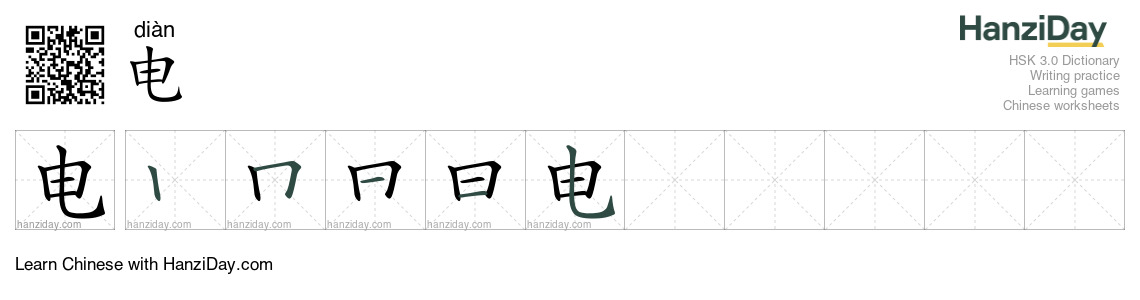
Stroke order
Games & Exercises 9
Find Hanzi
Find Hanzi is a playful exercise for learning Chinese. Spot characters, boost attention, download PDF, and enjoy studying Chinese through games!
Find Radical
Practice Chinese radicals online: choose the Hanzi containing the target component, use optional pinyin hints, and create printable PDF exercises.
Tone Trainer
Learn Mandarin tones online with the Chinese Tone Trainer. Practice tone recognition, pronunciation, and exercises for beginners and advanced learners.
Hanzi Connect
Match Hanzi with pinyin or identify words by sound. Use your own vocabulary or HSK 3.0/YCT levels. Play online after sign-in; printable PDFs with answers are for PRO.
Lost Stroke
Play online: find the missing stroke or radical, restore Chinese characters in order, and create printable PDF worksheets with pinyin and answers.
Calligraphy
Create calligraphy and custom Chinese character coloring pages with pinyin, stroke order, outline styles, and writing grids. Download a print-ready PDF for class or home.
Memo
Flip cards to match Chinese characters or pair Hanzi with Pinyin. Build a custom HSK 3.0 or YCT deck, play online, and create printable PDF cards.
Sudoku
Play Hanzi Sudoku online with 4×4, 6×6, or 9×9 grids, four difficulty levels, custom characters, and HSK 3.0/YCT sets. Create printable PDFs with answers.
Writing trainer
Practice Chinese character writing online with correct stroke order, outlines, a 3–2–1 preview, mistake-based hints, pinyin, and focused Hanzi review.









Examples of use 53
马
老
师
的
电
话
号
码
是
一
三
九
零
五
五
七
九
八
四
三
Teacher Ma's telephone number is one three nine zero five five seven nine eight four three
弟
弟
求
爸
爸
妈
妈
给
他
买
个
新
的
电
脑
。
My brother begged our parents to buy him a new computer.
电
话
里
讲
不
明
白
。
I couldn't understand it on the phone.
不
好
意
思
,
刚
才
我
接
了
个
电
话
,
请
你
继
续
说
。
Sorry, I got a call just now. Please go on.
我
的
手
机
是
正
常
的
啊
,
为
什
么
突
然
不
能
打
电
话
了
?
是
不
是
没
有
交
电
话
费
?
My mobile phone is fine. Why can't I make a phone call suddenly? Did you not pay the phone bill?
妈
妈
不
让
我
给
你
打
电
话
。
Mom won't let me call you.
他
在
给
朋
友
打
电
话
呢
。
He is on the phone with a friend.
我
现
在
会
用
汉
语
打
电
话
了
。
I can make phone calls in Chinese now.
一
边
开
车
一
边
打
电
话
很
危
险
。
It's dangerous to make a phone call while driving.
我
明
天
要
和
我
在
英
国
的
爷
爷
奶
奶
打
电
话
。
I'm going to call my grandparents in England tomorrow.
你
现
在
能
打
电
话
吗
?
Can you make a phone call now?
电
脑
的
好
处
大
于
坏
处
。
The advantages of computers outweigh the disadvantages.
建
伟
在
大
学
的
一
座
公
寓
楼
里
开
了
一
家
书
店
,
顺
便
卖
点
儿
文
具
、
电
池
、
小
日
用
品
等
。
Jianwei opened a bookstore in an apartment building of the university, selling stationery, batteries and small daily necessities by the way.
这
是
我
的
电
子
邮
件
地
址
。
This is my email address.
你
跟
我
打
招
呼
的
时
候
,
我
没
注
意
到
你
,
当
时
正
在
接
电
话
。
When you greeted me, I didn't notice you. I was answering the phone.
你
耐
心
点
儿
!
这
个
电
影
得
看
到
底
,
才
能
知
道
那
件
事
情
的
原
因
。
Be patient! The reason for that will not be known until the end of the film.
姐
姐
在
用
平
板
电
脑
看
电
子
书
,
弟
弟
在
白
板
上
画
画
,
我
们
的
狗
在
地
板
上
睡
觉
。
My sister is reading e-books on her tablet, my brother is drawing on the whiteboard, and our dog is sleeping on the floor.
我
可
以
使
用
你
的
电
脑
吗
?
Can I use your computer?
她
的
电
话
号
码
是
多
少
?
What's her telephone number?
讲
完
电
话
,
张
师
傅
还
没
忘
了
向
我
炫
耀
他
的
女
儿
。
After talking on the phone, Master Zhang didn't forget to show off his daughter to me.
她
清
空
了
自
己
的
电
脑
。
She emptied her computer.
近
年
来
,
市
场
上
出
现
了
一
种
新
的
电
子
产
品
,
名
为
“
光
闹
钟
”
。
In recent years, a new electronic product named "Light Alarm Clock" has appeared in the market.
妈
妈
,
你
的
电
话
!
Mom, the phone call is for you!
他
的
电
脑
在
他
的
书
包
里
。
His computer is in his schoolbag.
我
昨
天
下
午
四
点
在
家
看
电
视
呢
。
I was watching TV at home at four o'clock yesterday.
这
里
有
点
黑
,
我
们
开
电
灯
吧
。
It's a little dark here. Let's turn on the lights.
晚
上
十
点
以
后
需
要
挂
电
话
。
After ten in the evening (you) need to hang up the phone.
这
部
中
国
电
影
对
我
来
说
稍
微
有
点
儿
难
。
This Chinese film is a little difficult for me.
我
买
了
一
个
新
电
脑
。
I bought a new computer.
这
个
电
脑
五
千
元
。
This computer is 5,000 yuan.
电
脑
现
在
能
上
网
了
吗
?
Can the computer surf the Internet now?
那
个
明
星
这
两
年
很
火
,
我
经
常
在
电
视
上
看
到
他
。
That celebrity has been very popular in the past two years. I often see him on TV.
你
喜
欢
看
什
么
电
视
节
目
?
What TV programs do you like to watch?
妈
妈
不
让
我
看
电
视
。
Mother won't let me watch TV.
我
喜
欢
看
电
视
。
I enjoy watching TV.
我
更
愿
意
在
家
看
电
视
I prefer to watch TV at home
我
们
看
中
国
电
影
吧
。
Let's watch a Chinese movie.
昨
天
在
家
无
聊
,
我
就
看
起
电
影
来
了
。
Yesterday I was bored at home, so I started watching movies.
他
喜
欢
看
中
国
电
影
。
He likes to watch Chinese film.
我
一
个
月
看
两
次
电
影
。
I watch movies twice a month.
最
近
这
部
电
影
非
常
火
,
你
还
没
看
过
吗
?
This movie is very popular recently. Haven't you seen it yet?
这
里
附
近
不
但
有
美
术
展
览
,
而
且
有
电
影
院
和
图
书
馆
。
There is not only an art exhibition nearby here, but also a cinema and library.
这
个
电
影
很
流
行
。
This movie is very popular.
经
过
艰
苦
的
试
验
,
电
影
拍
摄
技
术
逐
渐
改
进
、
成
熟
。
After hard experiments, the film shooting technology gradually improved and matured.
去
看
电
影
,
行
啊
。
Go to the movies, okay.
你
最
喜
欢
看
哪
部
电
影
?
Which movie do you like best?
一
部
电
影
,
开
始
虽
然
剧
情
平
平
常
常
,
如
果
最
后
半
个
小
时
能
使
我
们
感
动
,
我
们
依
然
会
向
别
人
推
荐
它
。
Although the plot of a movie is ordinary at first, if the last half hour can move us, we will still recommend it to others.
小
丽
,
周
末
你
一
般
跟
小
刚
出
去
看
电
影
吗
?
Xiaoli, do you usually go out to the movies with Xiaogang on weekends?
我
昨
天
已
经
给
你
们
饭
店
打
了
电
话
。
I already phoned your hotel yesterday.
我
给
朋
友
打
个
电
话
。
I will make a call to friend.
我
马
上
拨
打
张
师
傅
的
电
话
,
却
无
人
接
听
。
I immediately called Master Zhang, but no one answered.
不
但
要
少
玩
电
脑
,
还
要
认
真
学
习
。
Not only need to play less of computer, but also need to study seriously.↵
我
记
下
了
他
的
电
话
,
给
了
他
一
张
我
的
名
片
。
I wrote down his phone number and gave him my business card.
Learn 电 (diàn) in context
电 appears here with its available localized meaning and tone-marked pinyin diàn. Listen to the pronunciation and review any examples, illustrations, or lexical links shown for this entry.
Use the sections available on this page to compare characters, components, radicals, related words, matching pronunciation, synonyms, or antonyms. HanziDay shows only the information supported by this entry.
电 in HSK 3.0 Level 3
HanziDay organizes HSK 3.0 vocabulary around the new three-stage, nine-level framework. This entry belongs to Level 3; open the level list to study it alongside other vocabulary from the same stage.
Practice the stroke order for 电
Use the stroke animation to follow the writing order, then practice the sequence with the interactive writing tool. After signing in, you can also create a printable worksheet from this entry within your current allowance.