


肖
Learn 当 — HSK 3.0 Level 4
当
TOP-100
Frequency
The ranking is based on data from open sources.
HSK 3.0 · Level 4
Translation
- (v.) work as, be, act as
- (prep.) when, just at
- (v.) should, ought to; accept, deserve
- (char.) be matched; be in charge of; to hold back, to block
- (prep.) before, in front of
- (v.) match or be equal to; regard or treat as; think; to pawn; (in Taiwan) to fail (an exam)
- (char.) right or proper, when things happen
Simplified
当
Traditional
噹
Strokes count
6

Words with 当 40
Same pronunciation 6
Similar pronunciation 20
Synonyms 2
Writing and worksheets
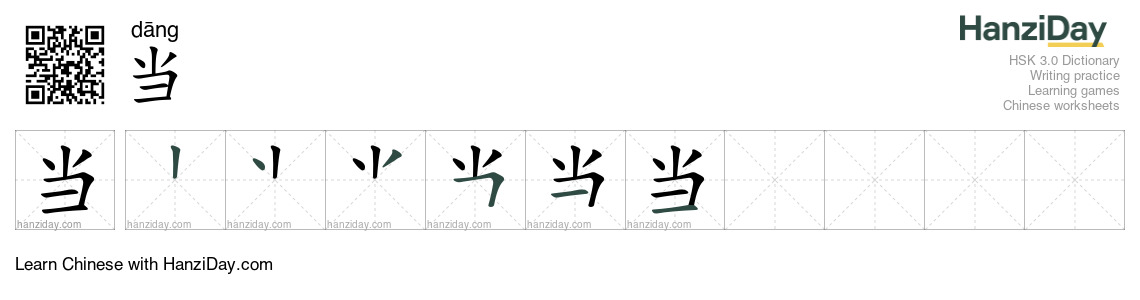
Stroke order
Games & Exercises 9
Find Hanzi
Find Hanzi is a playful exercise for learning Chinese. Spot characters, boost attention, download PDF, and enjoy studying Chinese through games!
Find Radical
Practice Chinese radicals online: choose the Hanzi containing the target component, use optional pinyin hints, and create printable PDF exercises.
Tone Trainer
Learn Mandarin tones online with the Chinese Tone Trainer. Practice tone recognition, pronunciation, and exercises for beginners and advanced learners.
Hanzi Connect
Match Hanzi with pinyin or identify words by sound. Use your own vocabulary or HSK 3.0/YCT levels. Play online after sign-in; printable PDFs with answers are for PRO.
Lost Stroke
Play online: find the missing stroke or radical, restore Chinese characters in order, and create printable PDF worksheets with pinyin and answers.
Calligraphy
Create calligraphy and custom Chinese character coloring pages with pinyin, stroke order, outline styles, and writing grids. Download a print-ready PDF for class or home.
Memo
Flip cards to match Chinese characters or pair Hanzi with Pinyin. Build a custom HSK 3.0 or YCT deck, play online, and create printable PDF cards.
Sudoku
Play Hanzi Sudoku online with 4×4, 6×6, or 9×9 grids, four difficulty levels, custom characters, and HSK 3.0/YCT sets. Create printable PDFs with answers.
Writing trainer
Practice Chinese character writing online with correct stroke order, outlines, a 3–2–1 preview, mistake-based hints, pinyin, and focused Hanzi review.









Examples of use 22
当
我
遇
到
困
难
时
,
我
最
想
的
人
是
爸
爸
妈
妈
。
When I encounter problems, the people I want most are Dad and Mum.
一
年
前
,
我
第
一
次
来
到
中
国
,
当
时
我
一
句
汉
语
也
不
会
说
。
A year ago, when I first came to China, I couldn't even speak a word of Mandarin.
每
个
人
都
想
当
一
个
富
人
,
但
其
实
富
人
也
并
不
那
么
快
乐
。
Everyone wants to be a rich person, but in reality, rich people are not even that happy.
当
机
会
到
来
时
,
千
万
不
要
放
手
,
有
什
么
想
做
的
事
就
马
上
去
做
吧
。
When the opportunity comes, don't let go. Do what you want to do right away.
我
喜
欢
去
不
同
的
地
方
旅
游
,
了
解
当
地
人
的
生
活
。
I like to travel to different places and learn about the life of local people.
当
大
导
演
进
一
步
询
问
原
因
时
,
当
地
人
的
回
答
令
他
受
益
终
生
。
When the director asked further why, the local people's answers benefited him all his life.
长
大
后
我
想
当
一
个
科
学
家
。
I want to be a scientist when I grow up.
你
长
大
后
想
当
什
么
?
What do you want to be when you grow up?
长
大
后
我
想
当
一
名
网
球
运
动
员
。
I want to be a tennis player when I grow up.
我
能
当
上
经
理
,
得
感
谢
你
们
的
支
持
。
I can become a manager thanks to your support.
你
跟
我
打
招
呼
的
时
候
,
我
没
注
意
到
你
,
当
时
正
在
接
电
话
。
When you greeted me, I didn't notice you. I was answering the phone.
当
工
作
很
多
的
时
候
,
我
们
一
定
要
找
到
工
作
的
重
点
,
先
把
重
点
工
作
完
成
。
When there is a lot of work, we must find the key points of the work and finish the important parts first.
我
认
为
教
育
是
最
重
要
的
事
,
我
以
后
想
当
一
个
教
育
家
。
I think education is the most important thing, and I want to be an educator in the future.
当
地
的
居
民
都
很
友
好
。
The local residents are very friendly.
当
地
的
人
民
都
很
友
好
。
The local people are very friendly.
当
地
的
人
都
很
乐
于
助
人
。
The local people are very helpful.
一
个
被
通
缉
了
1
5
年
的
罪
犯
,
今
天
还
应
该
为
当
初
触
犯
法
律
的
行
为
受
到
惩
罚
吗
?
Should a criminal who has been wanted for 15 years still be punished for breaking the law today?
他
雇
了
2
0
来
个
当
地
人
为
他
带
路
和
搬
运
行
李
。
He hired about 20 locals to lead the way and carry his luggage.
当
消
费
者
走
到
相
应
货
架
时
,
仪
器
会
发
出
提
示
音
,
以
免
消
费
者
错
过
商
品
。
When the consumer walks to the corresponding shelf, the instrument will sound a prompt to avoid the consumer missing the goods.
当
然
喜
欢
!
Of course I like it!
当
然
可
以
。
Of course I can.
当
然
可
以
!
Of course!
Learn 当 (dāng) in context
当 appears here with its available localized meaning and tone-marked pinyin dāng. Listen to the pronunciation and review any examples, illustrations, or lexical links shown for this entry.
Use the sections available on this page to compare characters, components, radicals, related words, matching pronunciation, synonyms, or antonyms. HanziDay shows only the information supported by this entry.
当 in HSK 3.0 Level 4
HanziDay organizes HSK 3.0 vocabulary around the new three-stage, nine-level framework. This entry belongs to Level 4; open the level list to study it alongside other vocabulary from the same stage.
Practice the stroke order for 当
Use the stroke animation to follow the writing order, then practice the sequence with the interactive writing tool. After signing in, you can also create a printable worksheet from this entry within your current allowance.