


儿
Learn 几 — HSK 3.0 Level 1
几
Translation
- (pro.) several, a few; how many?
- (n.) small table (in Taiwan, pronounced in the tone ji3)
- (radical.) small table
- (adv.) almost, nearly
Radical
Simplified
几
Traditional
幾
Strokes count
2

Words with 几 2
Same pronunciation 12
Similar pronunciation 159
Writing and worksheets
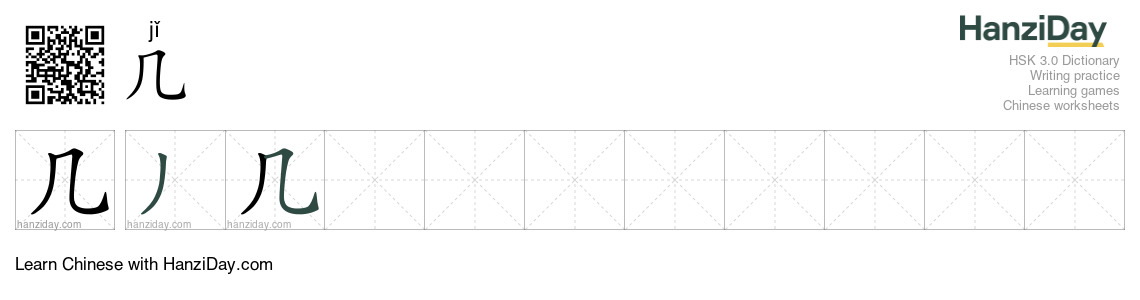
Stroke order
Games & Exercises 9
Find Hanzi
Find Hanzi is a playful exercise for learning Chinese. Spot characters, boost attention, download PDF, and enjoy studying Chinese through games!
Find Radical
Practice Chinese radicals online: choose the Hanzi containing the target component, use optional pinyin hints, and create printable PDF exercises.
Tone Trainer
Learn Mandarin tones online with the Chinese Tone Trainer. Practice tone recognition, pronunciation, and exercises for beginners and advanced learners.
Hanzi Connect
Match Hanzi with pinyin or identify words by sound. Use your own vocabulary or HSK 3.0/YCT levels. Play online after sign-in; printable PDFs with answers are for PRO.
Lost Stroke
Play online: find the missing stroke or radical, restore Chinese characters in order, and create printable PDF worksheets with pinyin and answers.
Calligraphy
Create calligraphy and custom Chinese character coloring pages with pinyin, stroke order, outline styles, and writing grids. Download a print-ready PDF for class or home.
Memo
Flip cards to match Chinese characters or pair Hanzi with Pinyin. Build a custom HSK 3.0 or YCT deck, play online, and create printable PDF cards.
Sudoku
Play Hanzi Sudoku online with 4×4, 6×6, or 9×9 grids, four difficulty levels, custom characters, and HSK 3.0/YCT sets. Create printable PDFs with answers.
Writing trainer
Practice Chinese character writing online with correct stroke order, outlines, a 3–2–1 preview, mistake-based hints, pinyin, and focused Hanzi review.








Examples of use 39
北
京
这
几
天
的
天
气
怎
么
样
?
What's the weather like in Beijing these days?
可
是
,
经
过
测
验
计
算
发
现
,
以
大
树
输
送
管
道
的
尺
寸
产
生
的
毛
细
作
用
,
根
本
无
法
把
水
分
送
到
几
十
米
高
的
地
方
。
However, after testing and calculation, it was found that the capillary effect produced by the size of the big tree transportation pipeline could not send water to places tens of meters high at all.
买
东
西
不
用
在
川
流
不
息
的
人
群
中
奔
走
,
仅
需
登
录
网
站
,
动
几
下
手
指
,
下
几
道
指
令
就
可
以
把
东
西
买
回
家
。
You don't have to run in the endless stream of people to buy things, just log on to the website, move your fingers and give instructions to buy things home.
这
几
天
我
的
身
体
很
不
舒
服
。
I'm not feeling well these days.
我
们
几
点
吃
晚
饭
?
What time do we have dinner?
听
说
有
好
几
家
大
公
司
会
来
招
聘
呢
。
I heard that several big companies will come to recruit.
你
知
道
地
球
上
一
共
有
几
个
大
洲
吗
?
Do you know how many continents there are on the earth?
大
象
现
在
毫
无
抵
抗
能
力
,
只
要
我
在
它
身
体
的
重
要
部
位
咬
几
个
洞
,
它
就
没
命
了
。
The elephant has no resistance now. As long as I bite a few holes in important parts of its body, it will die.
你
是
几
点
来
的
呀
?
What time did you arrive?
这
个
手
机
有
几
个
新
的
功
能
。
This mobile phone has several new functions.
通
过
这
几
年
的
积
累
,
他
已
经
获
得
了
一
些
这
个
专
业
的
基
础
知
识
。
Through accumulation in recent years, he has acquired some basic knowledge of this major.
今
天
晚
上
有
几
百
个
观
众
来
看
我
们
的
节
目
呢
!
There are hundreds of viewers watching our programme tonight!
音
乐
会
几
点
开
始
?
What time does the concert start?
你
几
点
去
学
校
?
What time do you go to school?
我
们
几
点
逛
街
?
What time do we go shopping?
我
们
几
点
上
网
?
What time do we surf the Internet?
你
今
天
几
点
上
课
?
What time do you have class today?
你
每
天
几
点
回
家
?
What time do you go home every day?
你
们
打
算
几
点
出
发
?
What time are you going to leave?
你
有
几
个
哥
哥
?
How many older brothers do you have?
我
家
周
围
有
好
几
个
公
园
。
There are several parks around my home.
你
有
几
个
弟
弟
?
How many younger brothers do you have?
你
有
几
个
姐
姐
?
How many older sisters do you have?
几
个
弟
弟
?
How many younger brothers?
他
有
几
百
个
朋
友
,
只
有
两
个
好
朋
友
。
He has several hundred friends, only have two good friends.
下
个
星
期
我
想
请
几
天
假
。
I'd like to take a few days off next week.
最
近
几
年
,
我
们
国
家
发
展
得
非
常
好
。
In recent years, our country has developed very well.
你
会
说
几
门
外
语
?
How many foreign languages can you speak?
你
会
说
几
个
语
言
?
How many languages can you speak?
我
刚
刚
学
会
这
几
个
字
。
I just learned these words.
明
天
星
期
几
?
What day of the week is it tomorrow?
你
上
几
年
级
?
What grade are you in?
你
几
年
级
?
What school year are you in?
我
这
几
天
住
在
爷
爷
家
。
I'm staying at Grandpa's these days.
你
去
过
哪
几
个
国
家
?
Which countries have you been to?
你
爷
爷
奶
奶
有
几
只
猫
?
How many cats does your grandpa and grandma have?
把
几
条
沙
丁
鱼
的
天
敌
鲇
鱼
放
进
装
鱼
的
设
备
中
。
Put a few catfish, the natural enemy of sardines, into the fish loading equipment.
一
月
有
几
天
?
How many days are there in January?
王
先
生
这
几
天
没
有
出
现
。
Mr. Wang hasn't appeared these days.
Learn 几 (jǐ) in context
几 appears here with its available localized meaning and tone-marked pinyin jǐ. Listen to the pronunciation and review any examples, illustrations, or lexical links shown for this entry.
Use the sections available on this page to compare characters, components, radicals, related words, matching pronunciation, synonyms, or antonyms. HanziDay shows only the information supported by this entry.
几 in HSK 3.0 Level 1
HanziDay organizes HSK 3.0 vocabulary around the new three-stage, nine-level framework. This entry belongs to Level 1; open the level list to study it alongside other vocabulary from the same stage.
Practice the stroke order for 几
Use the stroke animation to follow the writing order, then practice the sequence with the interactive writing tool. After signing in, you can also create a printable worksheet from this entry within your current allowance.