


裸
Learn 课 — HSK 3.0 Level 1
课
Translation
- (n.) lesson; subject, course; class, period
- (char.) tax; levy, collect (tax); session at divination
Radical
Simplified
课
Traditional
課
Strokes count
10

Words with 课 11
Same pronunciation 15
Similar pronunciation 35
Synonyms 5
Writing and worksheets
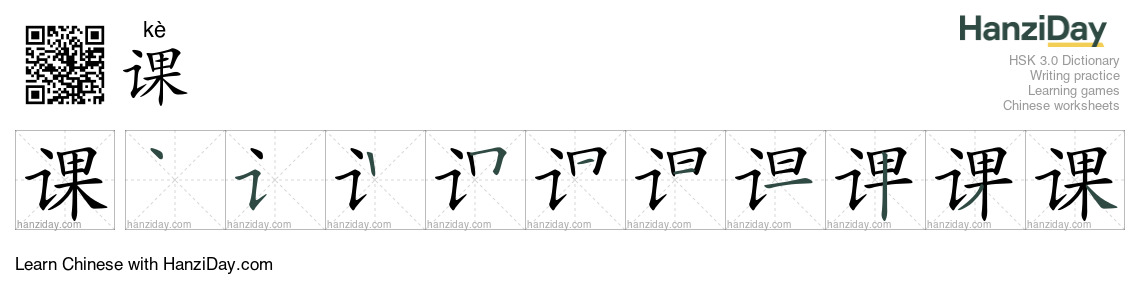
Stroke order
Games & Exercises 9
Find Hanzi
Find Hanzi is a playful exercise for learning Chinese. Spot characters, boost attention, download PDF, and enjoy studying Chinese through games!
Find Radical
Practice Chinese radicals online: choose the Hanzi containing the target component, use optional pinyin hints, and create printable PDF exercises.
Tone Trainer
Learn Mandarin tones online with the Chinese Tone Trainer. Practice tone recognition, pronunciation, and exercises for beginners and advanced learners.
Hanzi Connect
Match Hanzi with pinyin or identify words by sound. Use your own vocabulary or HSK 3.0/YCT levels. Play online after sign-in; printable PDFs with answers are for PRO.
Lost Stroke
Play online: find the missing stroke or radical, restore Chinese characters in order, and create printable PDF worksheets with pinyin and answers.
Calligraphy
Create calligraphy and custom Chinese character coloring pages with pinyin, stroke order, outline styles, and writing grids. Download a print-ready PDF for class or home.
Memo
Flip cards to match Chinese characters or pair Hanzi with Pinyin. Build a custom HSK 3.0 or YCT deck, play online, and create printable PDF cards.
Sudoku
Play Hanzi Sudoku online with 4×4, 6×6, or 9×9 grids, four difficulty levels, custom characters, and HSK 3.0/YCT sets. Create printable PDFs with answers.
Writing trainer
Practice Chinese character writing online with correct stroke order, outlines, a 3–2–1 preview, mistake-based hints, pinyin, and focused Hanzi review.







Examples of use 60
八
点
上
课
,
他
九
点
才
起
床
。
Class starts at eight o'clock, and he doesn't get up until nine o'clock.
这
是
我
的
外
语
课
本
。
This is my foreign language textbook.
这
是
谁
的
课
本
?
Whose textbook is this?
这
些
课
本
是
我
的
。
These textbooks are mine.
星
期
一
我
要
去
书
店
买
课
本
。
I'm going to the bookstore to buy textbooks on Monday.
给
大
卫
上
过
课
的
老
师
们
普
遍
反
映
他
的
表
现
很
好
,
只
是
偶
尔
会
迟
到
。
The teachers who taught David generally reported that he performed well, but occasionally he was late.
休
息
了
十
分
钟
后
,
大
家
继
续
上
课
。
After a ten-minute rest, everyone continued their class.
下
次
上
课
前
,
请
大
家
先
预
习
一
下
。
Before the next class, please preview it first.
你
想
学
理
科
的
话
,
有
很
多
课
程
都
可
以
,
比
如
物
理
,
化
学
,
等
等
。
If you want to study science, there are many courses, such as physics, chemistry and so on.
今
天
我
们
学
习
的
内
容
是
第
十
一
课
的
生
词
和
语
法
。
The content we are learning today is the new words and grammar from Lesson 11.
今
天
老
师
上
课
的
问
题
我
答
对
了
!
I answered the teacher's question correctly today!
我
很
喜
欢
新
来
的
美
术
老
师
,
现
在
美
术
课
是
我
最
喜
欢
的
课
了
。
I like the new art teacher very much. Now art class is my favorite class.
小
学
的
课
包
括
语
文
、
数
学
。
Classes in primary schools include Chinese and mathematics.
给
他
上
过
课
的
老
师
们
普
遍
反
映
他
的
表
现
很
好
,
只
是
偶
尔
会
迟
到
。
Teachers who gave him lessons generally reported that he performed well, only occasionally being late.
你
今
天
几
点
上
课
?
What time do you have class today?
今
天
下
午
我
们
五
点
下
课
。
We finish class at five this afternoon.
我
这
个
学
期
课
太
多
了
,
每
天
都
非
常
忙
。
I have too many classes this semester, and I am very busy every day.
我
每
天
都
有
体
育
课
。
I have PE class every day.
我
们
都
有
汉
语
课
。
We all have Chinese lessons.
我
们
学
校
课
外
活
动
多
,
每
个
人
放
学
后
都
很
忙
。
There are many extracurricular activities in our school, and everyone is busy after school.
二
年
级
有
汉
语
课
吗
?
Are there any Chinese classes in year two?
就
是
找
一
个
班
插
班
听
课
,
随
意
学
学
而
已
。
Is to find a class to attend classes and learn at will.
她
每
个
星
期
三
都
有
科
学
课
。
She has science every Wednesday.
姐
姐
打
排
球
打
得
很
好
,
她
在
学
校
放
学
后
常
常
上
排
球
课
。
My sister plays volleyball very well. She often has volleyball lessons after school.
我
最
喜
欢
历
史
课
了
,
因
为
我
觉
得
历
史
很
有
意
思
。
I like history best, because I think history is very interesting.
上
了
这
门
课
,
你
有
什
么
体
会
?
What experience do you have after taking this course?
别
说
话
了
,
开
始
上
课
了
。
Stop talking and start the class.
最
近
,
老
师
在
使
用
网
络
上
课
,
学
生
也
在
使
用
网
络
学
习
。
Recently, teachers use the internet for classes, and students also use the internet for learning.
这
个
学
期
我
们
有
六
门
课
。
We have six courses this term.
这
个
学
期
我
们
要
上
六
门
课
。
We are going to have six courses this term.
你
喜
欢
哪
门
课
?
Which course do you like?
你
现
在
在
上
什
么
课
?
What class are you taking now?
我
去
上
音
乐
课
。
I go to music class.
我
们
在
体
育
课
上
学
习
武
术
。
We learn martial arts in physical education class.
他
们
在
一
起
学
课
文
。
They study the text together.
我
在
听
中
文
课
文
录
音
。
I'm listening to the recording of the Chinese text.
我
喜
欢
科
学
课
。
I like science.
我
喜
欢
美
术
课
。
I like art class.
历
史
课
有
意
思
。
History class is interesting.
上
课
to go to class | to attend class | to go to teach a class
下
课
to finish class | to get out of class | (fig.) (esp. of a sports coach) to be dismissed | to be fired
授
课
to teach | to give lessons
网
课
online classes
听
课
to attend a class | to go to a lecture
课
文
text | CL:篇[pian1]
课
桌
school desk
课
间
interval between lessons
讲
课
teach | lecture
选
课
to select courses
我
要
么
骑
车
,
要
么
打
的
去
上
课
。
I either ride a bike or take a taxi to go to school.
我
星
期
一
有
课
。
I have classes on Mondays.
他
经
常
借
口
生
病
不
去
上
课
。
He often is absent from classes on the excuse of being sick.
缺
课
be absent from class
语
文
课
Chinese lesson; language and literature lesson
英
语
课
English lesson, English class
音
乐
课
music class
退
课
drop out of a course
有
课
have lesson(s), have class(es)
第
二
课
(of both teacher and student) to finish the class, to finish having the class
体
育
课
lesson 2, the second lesson
Learn 课 (kè) in context
课 appears here with its available localized meaning and tone-marked pinyin kè. Listen to the pronunciation and review any examples, illustrations, or lexical links shown for this entry.
Use the sections available on this page to compare characters, components, radicals, related words, matching pronunciation, synonyms, or antonyms. HanziDay shows only the information supported by this entry.
课 in HSK 3.0 Level 1
HanziDay organizes HSK 3.0 vocabulary around the new three-stage, nine-level framework. This entry belongs to Level 1; open the level list to study it alongside other vocabulary from the same stage.
Practice the stroke order for 课
Use the stroke animation to follow the writing order, then practice the sequence with the interactive writing tool. After signing in, you can also create a printable worksheet from this entry within your current allowance.