


赛
宽 — Wide, Broad, or Lenient
宽 (kuān) means wide or broad and can also refer to width or describe a lenient attitude.
宽
TOP-2000
Frequency
The ranking is based on data from open sources.
HSK 3.0 · Level 5
HSK 3.0 · Level 6
Translation
- (adj./n.) wide; well-off; width, breadth
- (adj./v.) lenient; to be lenient; to extend; to relieve, to relax
Radical
Simplified
宽
Traditional
寬
Strokes count
10

Words with 宽 11
Same pronunciation 2
Similar pronunciation 4
Synonyms 3
Antonyms 2
Writing and worksheets
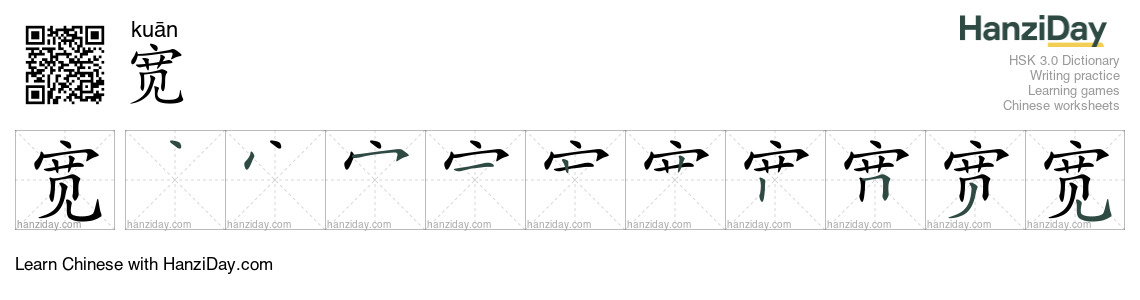
Stroke order
Games & Exercises 9
Find Hanzi
Find Hanzi is a playful exercise for learning Chinese. Spot characters, boost attention, download PDF, and enjoy studying Chinese through games!
Find Radical
Practice Chinese radicals online: choose the Hanzi containing the target component, use optional pinyin hints, and create printable PDF exercises.
Tone Trainer
Learn Mandarin tones online with the Chinese Tone Trainer. Practice tone recognition, pronunciation, and exercises for beginners and advanced learners.
Hanzi Connect
Match Hanzi with pinyin or identify words by sound. Use your own vocabulary or HSK 3.0/YCT levels. Play online after sign-in; printable PDFs with answers are for PRO.
Lost Stroke
Play online: find the missing stroke or radical, restore Chinese characters in order, and create printable PDF worksheets with pinyin and answers.
Calligraphy
Create calligraphy and custom Chinese character coloring pages with pinyin, stroke order, outline styles, and writing grids. Download a print-ready PDF for class or home.
Memo
Flip cards to match Chinese characters or pair Hanzi with Pinyin. Build a custom HSK 3.0 or YCT deck, play online, and create printable PDF cards.
Sudoku
Play Hanzi Sudoku online with 4×4, 6×6, or 9×9 grids, four difficulty levels, custom characters, and HSK 3.0/YCT sets. Create printable PDFs with answers.
Writing trainer
Practice Chinese character writing online with correct stroke order, outlines, a 3–2–1 preview, mistake-based hints, pinyin, and focused Hanzi review.






Examples of use 7
如
果
不
是
女
儿
反
驳
,
我
还
意
识
不
到
,
我
们
自
己
的
做
法
和
对
孩
子
的
要
求
实
行
的
是
两
套
标
准
,
那
便
是
对
自
己
宽
容
,
对
孩
子
严
厉
。
If it weren't for my daughter's rebuttal, I still didn't realize that our own practices and requirements for children are two sets of standards, that is, we are tolerant of ourselves and strict with children.
“
大
伙
儿
要
和
睦
相
处
,
对
人
要
宽
容
。
”
"Everyone should live in harmony and be tolerant of people."
宽
度
width
宽
裕
comfortably off | ample | plenty
两
者
之
间
的
距
离
有
两
指
宽
。
The distance between the two is wide as two fingers.
这
条
马
路
很
宽
,
可
以
并
排
行
驶
四
辆
卡
车
。
This road is so wide that it can take up four lanes of traffic.
有
多
宽
how wide is...; how wide is it
As a verb, 宽 can mean to extend something, relieve pressure, or relax a restriction.