


肤
扶 — Support or Help
扶 (fú) means to hold or support something with the hand and can also mean to help in Mandarin Chinese.
扶
TOP-2000
Frequency
The ranking is based on data from open sources.
HSK 3.0 · Level 5
Translation
- (v.) hold up, support with the hand; place a hand on sth for support
- (char.) to help
Radical
Simplified
扶
Traditional
扶
Strokes count
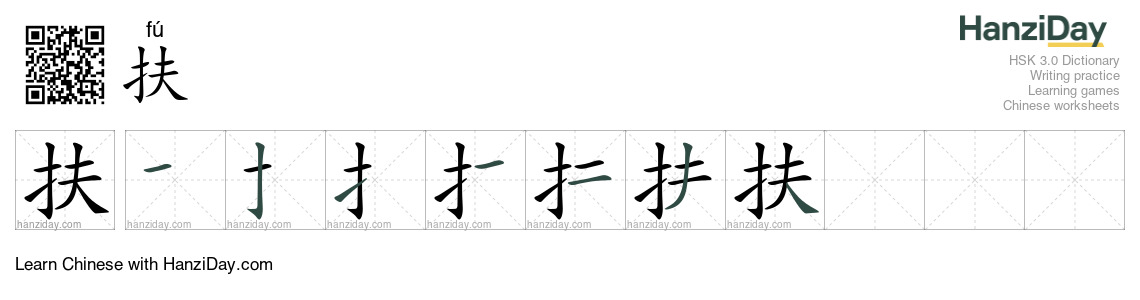
7

Words with 扶 2
Same pronunciation 58
Similar pronunciation 80
Synonyms 39
Antonyms 5
Writing and worksheets
Stroke order
Games & Exercises 9
Find Hanzi
Find Hanzi is a playful exercise for learning Chinese. Spot characters, boost attention, download PDF, and enjoy studying Chinese through games!
Find Radical
Practice Chinese radicals online: choose the Hanzi containing the target component, use optional pinyin hints, and create printable PDF exercises.
Tone Trainer
Learn Mandarin tones online with the Chinese Tone Trainer. Practice tone recognition, pronunciation, and exercises for beginners and advanced learners.
Hanzi Connect
Match Hanzi with pinyin or identify words by sound. Use your own vocabulary or HSK 3.0/YCT levels. Play online after sign-in; printable PDFs with answers are for PRO.
Lost Stroke
Play online: find the missing stroke or radical, restore Chinese characters in order, and create printable PDF worksheets with pinyin and answers.
Calligraphy
Create calligraphy and custom Chinese character coloring pages with pinyin, stroke order, outline styles, and writing grids. Download a print-ready PDF for class or home.
Memo
Flip cards to match Chinese characters or pair Hanzi with Pinyin. Build a custom HSK 3.0 or YCT deck, play online, and create printable PDF cards.
Sudoku
Play Hanzi Sudoku online with 4×4, 6×6, or 9×9 grids, four difficulty levels, custom characters, and HSK 3.0/YCT sets. Create printable PDFs with answers.
Writing trainer
Practice Chinese character writing online with correct stroke order, outlines, a 3–2–1 preview, mistake-based hints, pinyin, and focused Hanzi review.








Examples of use 3
扶
手
handrail | armrest
医
生
扶
着
这
位
妇
女
进
了
病
房
。
The doctor supported this woman by her arm and (helped her) walk into the ward.
请
勿
手
扶
Don't Touch
扶 often describes physical support, as in 扶老人 (fú lǎorén), “support an elderly person,” or 扶着墙 (fúzhe qiáng), “hold on to the wall.”