


往
Learn 住 — HSK 3.0 Level 1
住
Translation
- (v.) live, reside, stay; stop, cease; (after a verb as a complement indicating) a halt or a steadiness; (after a verb as a complement, preceded by "de" or "bu", indicating) being able or unable to reach or meet a standard
Radical
Simplified
住
Traditional
住
Strokes count
7

Words with 住 11
Same pronunciation 24
Similar pronunciation 46
Synonyms 10
Antonyms 1
Writing and worksheets
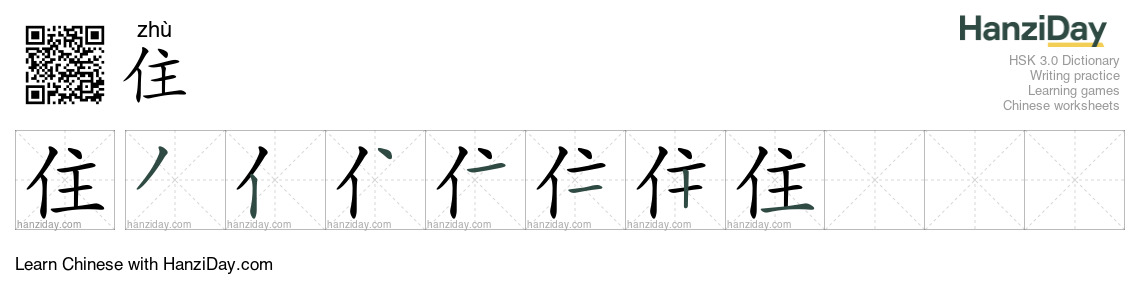
Stroke order
Games & Exercises 9
Find Hanzi
Find Hanzi is a playful exercise for learning Chinese. Spot characters, boost attention, download PDF, and enjoy studying Chinese through games!
Find Radical
Practice Chinese radicals online: choose the Hanzi containing the target component, use optional pinyin hints, and create printable PDF exercises.
Tone Trainer
Learn Mandarin tones online with the Chinese Tone Trainer. Practice tone recognition, pronunciation, and exercises for beginners and advanced learners.
Hanzi Connect
Match Hanzi with pinyin or identify words by sound. Use your own vocabulary or HSK 3.0/YCT levels. Play online after sign-in; printable PDFs with answers are for PRO.
Lost Stroke
Play online: find the missing stroke or radical, restore Chinese characters in order, and create printable PDF worksheets with pinyin and answers.
Calligraphy
Create calligraphy and custom Chinese character coloring pages with pinyin, stroke order, outline styles, and writing grids. Download a print-ready PDF for class or home.
Memo
Flip cards to match Chinese characters or pair Hanzi with Pinyin. Build a custom HSK 3.0 or YCT deck, play online, and create printable PDF cards.
Sudoku
Play Hanzi Sudoku online with 4×4, 6×6, or 9×9 grids, four difficulty levels, custom characters, and HSK 3.0/YCT sets. Create printable PDFs with answers.
Writing trainer
Practice Chinese character writing online with correct stroke order, outlines, a 3–2–1 preview, mistake-based hints, pinyin, and focused Hanzi review.







Examples of use 35
你
住
在
上
海
还
是
北
京
?
Do you live in Shanghai or Beijing?
我
家
住
在
北
京
的
东
边
。
My family lives in the east of Beijing.
哥
哥
和
妈
妈
一
起
住
在
北
京
。
My brother and mother live together in Beijing.
我
们
这
次
旅
游
一
共
要
住
三
个
不
同
的
旅
馆
。
We will stay in three different hotels on this trip.
我
才
住
过
来
不
久
。
I just moved in not long ago.
他
家
住
在
这
栋
大
楼
里
。
His family lives in this building.
我
的
房
子
可
以
给
你
免
费
住
。
My house can give you free living.
我
的
全
家
都
住
在
中
国
。
My whole family lives in China.
我
的
一
家
人
都
住
在
上
海
。
My family all live in Shanghai.
您
介
意
我
安
排
你
们
住
一
家
小
一
点
的
旅
馆
吗
?
那
家
虽
然
小
,
但
是
离
我
们
要
去
的
景
点
很
近
。
Do you mind if I arrange for you to stay in a smaller hotel? Although it is small, it is very close to the scenic spot we are going to.
请
问
您
家
的
住
址
有
没
有
变
?
Have you changed your address?
有
很
多
外
国
人
住
在
上
海
。
There are many foreigners living in Shanghai.
谁
能
够
及
早
抓
住
机
会
,
谁
就
赢
得
了
机
遇
。
Whoever can seize the opportunity early will win the opportunity.
我
这
几
天
住
在
爷
爷
家
。
I'm staying at Grandpa's these days.
我
家
住
在
黄
河
边
上
。
My family lives near the Yellow River.
我
已
经
住
进
新
家
了
。
I have already moved into the new house.
你
家
住
楼
房
还
是
平
房
?
Do you live in a building or a bungalow?
这
个
字
太
难
写
了
,
我
记
不
住
。
This word is so difficult to write that I can't remember it.
你
住
在
哪
里
?
Where do you live?
你
喜
欢
住
在
市
区
吗
?
Do you like living downtown?
你
住
在
哪
儿
?
Where do you live?
请
问
,
你
住
在
哪
儿
?
Excuse me, where do you live?
你
喜
欢
住
在
城
市
还
是
乡
村
?
Do you prefer to live in the city or in the country?
你
更
喜
欢
住
在
城
市
还
是
乡
下
?
Do you prefer to live in the city or in the country?
希
望
您
在
我
们
酒
店
住
得
愉
快
。
Hope you enjoy your stay in our hotel.
住
口
shut up | shut your mouth | stop talking
住
手
to desist | to stop | to stay one's hand
停
住
to stop | to halt | to cease
抓
住
to grab hold of; to capture
接
住
to catch (sth thrown etc) | to receive (sth given) | to accept
握
住
to grip | to hold
站
住
to stand
我
想
换
宿
舍
,
不
想
住
这
儿
了
。
I want to change my dormitory. I do not want to live here anymore.
楼
上
住
着
一
位
医
生
。
There lives a doctor upstairs.
经
得
住
can stand up to, can resist
Learn 住 (zhù) in context
住 appears here with its available localized meaning and tone-marked pinyin zhù. Listen to the pronunciation and review any examples, illustrations, or lexical links shown for this entry.
Use the sections available on this page to compare characters, components, radicals, related words, matching pronunciation, synonyms, or antonyms. HanziDay shows only the information supported by this entry.
住 in HSK 3.0 Level 1
HanziDay organizes HSK 3.0 vocabulary around the new three-stage, nine-level framework. This entry belongs to Level 1; open the level list to study it alongside other vocabulary from the same stage.
Practice the stroke order for 住
Use the stroke animation to follow the writing order, then practice the sequence with the interactive writing tool. After signing in, you can also create a printable worksheet from this entry within your current allowance.