


匀
Learn 习 in Chinese
Meaning of 习 (xí): (char.) (lit. of birds) try flying repeatedly; practice; be used to; very often; habit, custom
Words with 习 11
Writing and worksheets
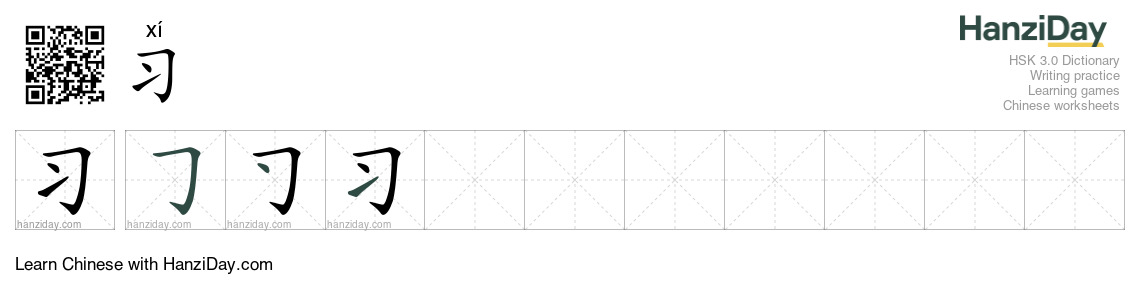
Stroke order
Games & Exercises 9
Find Hanzi
Find Hanzi is a playful exercise for learning Chinese. Spot characters, boost attention, download PDF, and enjoy studying Chinese through games!
Find Radical
Practice Chinese radicals online: choose the Hanzi containing the target component, use optional pinyin hints, and create printable PDF exercises.
Tone Trainer
Learn Mandarin tones online with the Chinese Tone Trainer. Practice tone recognition, pronunciation, and exercises for beginners and advanced learners.
Hanzi Connect
Match Hanzi with pinyin or identify words by sound. Use your own vocabulary or HSK 3.0/YCT levels. Play online after sign-in; printable PDFs with answers are for PRO.
Lost Stroke
Play online: find the missing stroke or radical, restore Chinese characters in order, and create printable PDF worksheets with pinyin and answers.
Calligraphy
Create calligraphy and custom Chinese character coloring pages with pinyin, stroke order, outline styles, and writing grids. Download a print-ready PDF for class or home.
Memo
Flip cards to match Chinese characters or pair Hanzi with Pinyin. Build a custom HSK 3.0 or YCT deck, play online, and create printable PDF cards.
Sudoku
Play Hanzi Sudoku online with 4×4, 6×6, or 9×9 grids, four difficulty levels, custom characters, and HSK 3.0/YCT sets. Create printable PDFs with answers.
Writing trainer
Practice Chinese character writing online with correct stroke order, outlines, a 3–2–1 preview, mistake-based hints, pinyin, and focused Hanzi review.







Examples of use 37
学
习
(v.) learn, study; follow the example of
练
习
(v./n.) to practice; practice, exercise
习
惯
(n.) habit, custom, practice | (v.) be accustomed to, be used to
爸
爸
妈
妈
都
很
关
心
我
们
的
学
习
和
身
体
。
Mom and Dad are very concerned about our study and health.
你
去
了
国
外
如
果
不
习
惯
怎
么
办
?
What if you are not used to it when you go abroad?
今
天
学
的
跳
舞
动
作
有
点
儿
难
,
我
恐
怕
做
得
不
太
标
准
,
在
比
赛
前
我
还
想
多
练
习
练
习
。
The dance moves I learned today are a bit difficult. I'm afraid I didn't do them very well. I want to practice more before the competition.
不
管
你
说
错
多
少
次
汉
语
,
你
还
是
要
坚
持
多
说
,
因
为
这
是
学
习
口
语
的
正
确
方
法
。
No matter how many times you make mistakes in Chinese, you should persist on speaking, because this is the correct way to learn spoken Chinese.
我
想
申
请
去
你
那
个
大
学
学
习
。
I want to apply to study at your university.
下
次
上
课
前
,
请
大
家
先
预
习
一
下
。
Before the next class, please preview it first.
今
天
我
们
学
习
的
内
容
是
第
十
一
课
的
生
词
和
语
法
。
The content we are learning today is the new words and grammar from Lesson 11.
坚
持
运
动
是
我
的
习
惯
。
It is my habit to keep exercising.
只
有
认
真
学
习
,
我
的
成
绩
才
能
提
高
。
Only by studying hard can my grades be improved.
我
们
应
该
养
成
好
的
习
惯
。
We should form good habits.
这
是
给
了
我
复
习
的
好
机
会
。
This gave me a good opportunity to revise.
一
个
偶
然
的
机
会
,
他
发
现
如
果
了
解
汉
字
的
来
源
和
演
变
过
程
,
再
学
习
它
就
变
得
轻
松
、
容
易
。
By chance, he found that if he understood the origin and evolution of Chinese characters, it would be easy to learn them .
预
习
是
个
好
习
惯
,
它
能
帮
助
我
们
提
前
了
解
要
学
习
的
内
容
。
Preparing for a lesson is a good habit. It can help us find out what to learn in advance.
你
一
年
以
前
开
始
学
习
汉
语
了
吗
?
Did you start studying Mandarin a year beforehand?
我
想
学
习
高
级
汉
语
。
I want to learn advanced Chinese.
只
要
认
真
地
学
习
,
就
能
提
高
汉
语
水
平
。
As long as you study hard, you can improve your Chinese.
其
实
,
学
习
汉
语
很
有
意
思
。
Actually, learning Chinese is very interesting.
学
习
汉
语
其
实
很
有
意
思
。
Learning Chinese is actually very interesting.
我
在
学
习
汉
语
和
日
语
。
I'm learning Chinese and Japanese.
这
个
网
站
对
学
习
很
有
帮
助
。
This website is very helpful for learning.
最
近
,
老
师
在
使
用
网
络
上
课
,
学
生
也
在
使
用
网
络
学
习
。
Recently, teachers use the internet for classes, and students also use the internet for learning.
我
们
每
天
为
了
通
过
考
试
而
努
力
学
习
。
We study hard every day in order to pass the exam.
你
在
哪
个
学
院
学
习
?
Which college do you study in?
祝
你
学
习
进
步
!
I wish you progress in your study!
我
们
在
体
育
课
上
学
习
武
术
。
We learn martial arts in physical education class.
他
在
数
学
学
院
学
习
。
He studies at the School of Mathematics.
小
孩
子
喜
欢
快
乐
地
学
习
。
Children like to learn happily
这
个
网
站
对
学
习
有
帮
助
。
This website is helpful for learning.
妹
妹
没
在
练
习
口
语
。
My sister is not practicing her spoken English.
积
习
难
改
old habits are hard to change (idiom)
习
性
character acquired through long habit | habits and properties
习
气
custom; practice (usu. a regrettable one)
陋
习
corrupt practice | bad habits | malpractice
陈
规
陋
习
(idiom) outmoded conventions; old-fashioned ways
Learn 习 (xí) in context
习 appears here with its available localized meaning and tone-marked pinyin xí. Listen to the pronunciation and review any examples, illustrations, or lexical links shown for this entry.
Use the sections available on this page to compare characters, components, radicals, related words, matching pronunciation, synonyms, or antonyms. HanziDay shows only the information supported by this entry.
Practice the stroke order for 习
Use the stroke animation to follow the writing order, then practice the sequence with the interactive writing tool. After signing in, you can also create a printable worksheet from this entry within your current allowance.