


朝
期 : Period, Deadline, or Expect
期 (qī) can mean “a period, term, deadline, or scheduled time, or to expect and anticipate; it also classifies periodic issues” in Chinese.
期
TOP-500
Frequency
The ranking is based on data from open sources.
HSK 3.0 · Level 4
Translation
- (char.) period (of time); scheduled time; make an appointment; expect, anticipate
- (m.) measure word for for things scheduled by periods
- (char.) (lit.) a whole year or month
Radical
Simplified
期
Traditional
期
Strokes count
12

Words with 期 39
Same pronunciation 22
Similar pronunciation 103
Synonyms 2
Writing and worksheets
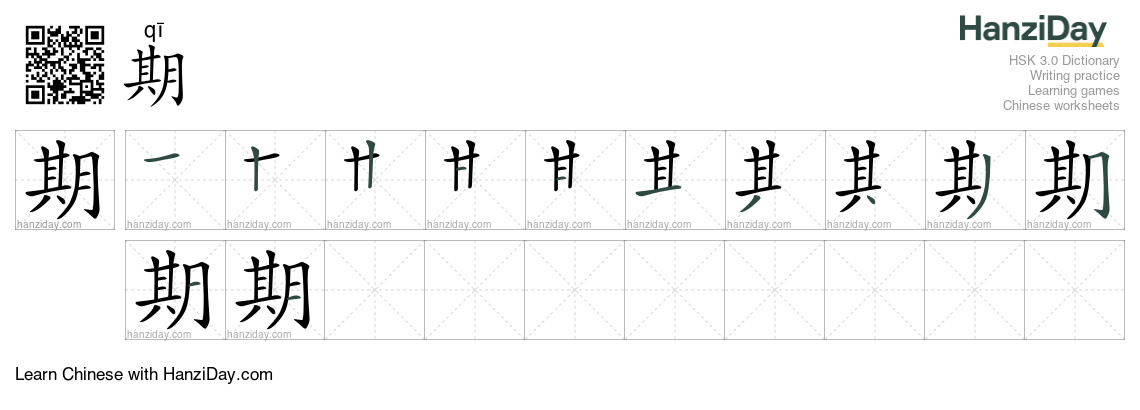
Stroke order
Games & Exercises 9
Find Hanzi
Find Hanzi is a playful exercise for learning Chinese. Spot characters, boost attention, download PDF, and enjoy studying Chinese through games!
Find Radical
Practice Chinese radicals online: choose the Hanzi containing the target component, use optional pinyin hints, and create printable PDF exercises.
Tone Trainer
Learn Mandarin tones online with the Chinese Tone Trainer. Practice tone recognition, pronunciation, and exercises for beginners and advanced learners.
Hanzi Connect
Match Hanzi with pinyin or identify words by sound. Use your own vocabulary or HSK 3.0/YCT levels. Play online after sign-in; printable PDFs with answers are for PRO.
Lost Stroke
Play online: find the missing stroke or radical, restore Chinese characters in order, and create printable PDF worksheets with pinyin and answers.
Calligraphy
Create calligraphy and custom Chinese character coloring pages with pinyin, stroke order, outline styles, and writing grids. Download a print-ready PDF for class or home.
Memo
Flip cards to match Chinese characters or pair Hanzi with Pinyin. Build a custom HSK 3.0 or YCT deck, play online, and create printable PDF cards.
Sudoku
Play Hanzi Sudoku online with 4×4, 6×6, or 9×9 grids, four difficulty levels, custom characters, and HSK 3.0/YCT sets. Create printable PDFs with answers.
Writing trainer
Practice Chinese character writing online with correct stroke order, outlines, a 3–2–1 preview, mistake-based hints, pinyin, and focused Hanzi review.









Examples of use 39
过
期
(v.) to be out of date, stale, be overdue
日
期
(n.) date
时
期
(n.) period (time)
定
期
(adv.) at regular intervals, periodically
期
盼
(v.) expect, look forward to
星
期
一
我
要
去
书
店
买
课
本
。
I'm going to the bookstore to buy textbooks on Monday.
到
期
限
造
不
出
箭
,
他
就
活
该
受
罚
了
。
If he can't make an arrow by the deadline, he deserves to be punished.
星
期
五
中
午
老
师
常
常
吃
炒
面
。
The teacher often eats fried noodles at noon on Friday.
从
前
,
大
概
在
距
今
两
千
五
百
多
年
前
的
春
秋
时
期
,
有
一
个
人
叫
子
路
,
他
是
孔
子
最
年
长
的
学
生
。
Once upon a time, in the Spring and Autumn Period about 2,500 years ago, there was a man named Zilu, who was the oldest student of Confucius.
班
上
同
学
这
个
学
期
的
进
步
都
很
大
。
All the students in the class have made great progress this term.
老
师
说
我
这
个
学
期
进
步
很
大
。
The teacher said that I have made great progress this term.
中
国
的
学
生
一
年
有
两
个
长
的
假
期
,
一
个
在
夏
天
,
一
个
在
冬
天
。
Chinese students have two long holidays a year, one in summer and one in winter.
从
2
0
世
纪
8
0
年
代
起
,
比
尔
•
盖
茨
每
年
都
要
进
行
两
次
为
期
一
周
的
“
闭
关
”
。
Since 1980s, Bill Gates has conducted two one-week "retreat" every year.
如
果
租
一
个
星
期
的
话
,
要
多
少
钱
?
How much will it cost if it is rented for one week?
假
期
的
校
园
寂
静
得
很
。
The campus is very quiet during the holidays.
我
的
身
份
证
过
期
了
,
我
得
办
一
张
新
的
身
份
证
。
My ID card has expired. I have to get a new one.
你
的
假
期
活
动
真
丰
富
啊
!
Your holiday activities are truly abundant!
我
这
个
学
期
课
太
多
了
,
每
天
都
非
常
忙
。
I have too many classes this semester, and I am very busy every day.
他
上
个
星
期
买
了
很
多
东
西
。
He bought a lot of things last week.
下
个
星
期
我
想
请
几
天
假
。
I'd like to take a few days off next week.
她
每
个
星
期
三
都
有
科
学
课
。
She has science every Wednesday.
她
星
期
六
上
午
要
上
网
学
汉
语
。
She will go online to learn Chinese on Saturday morning.
明
天
星
期
几
?
What day of the week is it tomorrow?
你
看
到
自
己
婴
儿
时
期
的
一
张
照
片
,
你
能
认
出
自
己
吗
?
You see a picture of yourself as a baby. Can you recognize yourself?
“
要
面
子
着
呢
,
从
来
没
有
辜
负
过
我
的
期
望
。
”
"I have to face up and never live up to my expectations."
他
们
星
期
六
在
吗
?
Are they here on Saturday?
这
个
学
期
我
们
有
六
门
课
。
We have six courses this term.
这
个
学
期
我
们
要
上
六
门
课
。
We are going to have six courses this term.
星
期
三
妈
妈
做
晚
饭
。
Mother cooks dinner on Wednesday.
你
这
个
学
期
学
中
文
吗
?
Are you learning Chinese this term?
请
问
这
个
日
期
你
们
有
空
房
吗
?
Do you have any vacancies on this date?
王
力
这
个
星
期
五
下
午
在
吗
?
Will Wang Li be here this Friday afternoon?
他
们
这
个
星
期
五
下
午
在
吗
?
Will they be here this Friday afternoon?
这
个
学
期
你
要
学
几
门
外
语
?
How many foreign languages are you going to learn this term?
星
期
天
我
去
足
球
俱
乐
部
踢
球
。
I go to the football club to play football on Sunday.
不
期
而
遇
meet by chance | have a chance encounter
保
质
期
shelf life | expiration date
冰
期
glacial epoch; ice age
期
中
interim | midterm
Learn 期 (qī) in context
期 appears here with its available localized meaning and tone-marked pinyin qī. Listen to the pronunciation and review any examples, illustrations, or lexical links shown for this entry.
Use the sections available on this page to compare characters, components, radicals, related words, matching pronunciation, synonyms, or antonyms. HanziDay shows only the information supported by this entry.
期 in HSK 3.0 Level 4
HanziDay organizes HSK 3.0 vocabulary around the new three-stage, nine-level framework. This entry belongs to Level 4; open the level list to study it alongside other vocabulary from the same stage.
Practice the stroke order for 期
Use the stroke animation to follow the writing order, then practice the sequence with the interactive writing tool. After signing in, you can also create a printable worksheet from this entry within your current allowance.